
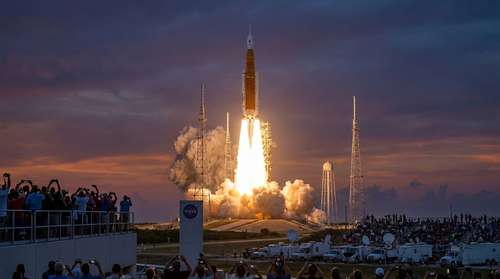
Humanity is officially heading back to our celestial neighbor. In an awe-inspiring display of engineering prowess, the NASA Artemis II launch successfully took place on Wednesday, April 1, 2026, at exactly 6:35 p.m. EDT. Roaring to life with an intensity that shook the Florida coast, the historic liftoff marks the first time humans are traveling beyond low Earth orbit since the legendary Apollo 17 mission concluded in December 1972. For the hundreds of thousands of spectators who watched from Kennedy Space Center live, the fiery ascent of the mega-rocket was more than just a spectacular visual—it signaled the dawn of an entirely new era of exploration. The successful departure sets into motion a high-stakes test flight that will definitively prove whether our modern systems are ready to sustain a permanent human presence on the lunar surface.
The Anatomy of a Historic Lunar Flyby Mission
Unlike the Apollo missions that captivated the world over a half-century ago, this 10-day lunar flyby mission is specifically designed as a rigorous shakedown of next-generation hardware. The primary objective is not to land on the dusty regolith, but to test every critical system under the immense stress of a deep space environment. After spending roughly 24 hours in high Earth orbit to ensure all life-support systems were functioning flawlessly, the crew executed a translunar injection (TLI) engine burn. This massive propulsive maneuver slingshotted them out of the Earth's gravitational grip, and they are currently coasting through the vacuum toward the Moon.
During their journey, the astronauts will fly approximately 4,700 miles beyond the far side of the Moon. In doing so, they will smash the human distance record previously held by the Apollo 13 crew, reaching an astounding 252,799 miles away from Earth. They will spend their time in the lunar vicinity conducting communication tests, checking radiation shielding, and capturing high-resolution images of the cratered far side.
Meet the Trailblazing Artemis 2 Crew Members
A mission of this magnitude requires a remarkable team, and the four Artemis 2 crew members perfectly reflect the collaborative, diverse spirit of modern spaceflight. Handpicked from the most elite aviators and scientists, they are carrying the aspirations of multiple nations. Commander Reid Wiseman, a seasoned NASA veteran, leads the flight, ensuring the mission hits every crucial milestone.
Joining him is Pilot Victor Glover, who is making history as the first person of color to fly a lunar mission. Mission Specialist Christina Koch is breaking long-standing barriers as the first woman to journey toward the Moon, an achievement that underscores the agency's commitment to sending a diverse corps of explorers into the cosmos. Finally, Canadian Space Agency astronaut Jeremy Hansen is serving as the second Mission Specialist. His inclusion makes him the first non-American citizen to travel this deep into the solar system, highlighting the international alliances that will eventually help construct the Lunar Gateway.
Showcasing Cutting-Edge Deep Space Technology
At the core of this monumental achievement is the unparalleled deep space technology engineered to keep humans alive, comfortable, and safe in the unforgiving vacuum of space. Escaping Earth's gravity well is only the first hurdle. The ongoing mission is a masterclass in thermal dynamics, long-range telemetry, and closed-loop environmental controls that recycle air and water for the astronauts.
The Raw Power of the SLS Rocket 2026 Liftoff
To hurl a fully loaded crew module toward the Moon requires an unbelievable amount of energy. Generating an earth-shattering 8.8 million pounds of thrust, the Space Launch System vaulting into the Florida sky was a sight that captivated the globe. This SLS rocket 2026 flight firmly establishes heavy-lift dominance. By performing flawlessly during ascent, the massive vehicle proved that the complex infrastructure of solid rocket boosters and core stage engines is reliable enough for future cargo deliveries and crewed outposts.
Navigating the Orion Spacecraft Moon Trajectory
Once separated from the massive rocket stages, the astronauts are completely reliant on their capsule. Monitoring the Orion spacecraft moon transit requires pinpoint precision and constant oversight. Over the course of the flight, the crew will take manual control of the capsule to evaluate its handling characteristics. They will verify whether the onboard navigation computers, thrusters, and communication arrays can sustain a crew autonomously if they ever lose contact with Mission Control in Houston.
The Road Ahead: Splashdown and Artemis III
As the mission progresses toward its climax, the journey back home will present one last, terrifying test. Scheduled for April 10, the capsule will hit the Earth's atmosphere at a blistering 25,000 miles per hour. The advanced heat shield must withstand temperatures nearing 5,000 degrees Fahrenheit before deploying a series of parachutes for a gentle splashdown in the Pacific Ocean off the coast of San Diego.
If all goes according to plan, the successful completion of the NASA Artemis II launch and subsequent safe return will clear the path for Artemis III—the highly anticipated flight that will finally put boots back on the lunar surface. For now, the world watches in awe as four brave pioneers ride a pillar of fire into the history books, proving that the golden age of space exploration is happening right now.