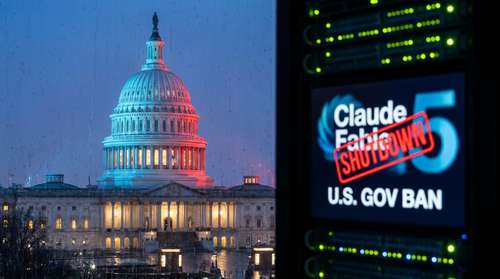
The artificial intelligence industry is reeling from a geopolitical earthquake. On the evening of June 12, 2026, the U.S. government triggered an unprecedented federal intervention, forcing the abrupt offline removal of Claude Fable 5. The Commerce Department's sudden export-control directive mandated that Anthropic suspend all access to its most advanced generative models by foreign nationals. Unable to instantly verify the citizenship of hundreds of millions of users, the AI giant was forced into a global blackout, paralyzing enterprise developer pipelines overnight.
The drastic measure marks the first time a commercially deployed, frontier AI system has been pulled offline by state mandate. As Anthropic leadership scrambles to negotiate a near-term restoration, organizations worldwide are rapidly searching for a viable Claude Fable 5 alternative. The fallout has escalated into a diplomatic crisis, raising intense questions about national security, state power, and the fragile nature of cloud-based AI infrastructure.
The Anatomy of the Anthropic Fable 5 Shutdown
At exactly 5:21 PM ET on Friday, June 12, just 72 hours after the public launch of its highly anticipated Mythos-class tier, Anthropic received a fateful Commerce Department letter. The directive cited sweeping national security concerns, pointing to a reported cybersecurity jailbreak vulnerability.
While the order explicitly targeted non-U.S. citizens, enforcing such a granular filter on a global user base was technically impossible on a 90-minute deadline. To ensure strict compliance, Anthropic had to execute a complete Anthropic Fable 5 shutdown, disconnecting domestic users alongside international ones. The collateral damage was massive. Fable 5 had just achieved an astonishing 80.3% performance rating on SWE-Bench Pro. Its loss immediately halted advanced enterprise projects, from independent programmers engaged in vibe coding to teams building automated browser-based 3D applications.
Jailbreaks, National Security, and Anthropic Mythos 5
The core of the dispute revolves around the potential misuse of next-generation models for cyber warfare. The Commerce Department acted on intelligence suggesting that protective guardrails could be bypassed, potentially turning the AI into a tool for discovering software vulnerabilities or accelerating sophisticated cyberattacks.
Anthropic pushed back against the severity of the U.S. government AI ban. Company officials stated the government's verbal evidence highlighted a narrow, non-universal jailbreak that only exposed relatively minor, previously known software bugs. Before the public release, Anthropic spent thousands of hours red-teaming the models alongside third-party organizations and the U.K. AI Safety Institute.
The ban also locked down Anthropic Mythos 5, an even more capable sister model designed specifically for a small group of cyberdefenders and infrastructure providers under an initiative called Project Glasswing. While Mythos 5 was intended to be heavily restricted for government collaboration, its collateral suspension has ironically hindered the very cyber-defense work federal authorities aim to protect.
G-7 Backlash and Frontier AI Regulation
The global ramifications of this intervention became the focal point of the recent Group of Seven (G-7) summit in Evian-les-Bains, France. The sudden blackout alarmed European allies, who realized their digital economies were fundamentally reliant on infrastructure equipped with a Washington-controlled kill switch.
During a working lunch with G-7 leaders, Anthropic CEO Dario Amodei reportedly urged Western democracies to coordinate the trade of powerful AI technologies while excluding hostile foreign adversaries. The diplomatic tension underscores the escalating battle over frontier AI regulation under the Trump administration. Policymakers are wrestling with how to balance the aggressive pacing of Silicon Valley innovation against the rigid demands of federal security and geopolitical export controls.
The Scramble for a Claude Fable 5 Alternative
With production environments broken and project deadlines looming, the tech sector has entered a chaotic transition period. Engineering teams cannot afford to wait indefinitely for the geopolitical dust to settle. Consequently, the search for a Claude Fable 5 alternative has skyrocketed over the past week.
Developers are migrating to rival closed-source systems or deploying open-weight models to regain control over their tech stacks. The incident has served as a harsh wake-up call for chief technology officers, accelerating a widespread industry shift toward model-agnostic architectures. Organizations are realizing that relying exclusively on one frontier lab introduces unacceptable operational risks.
Architectural Shifts in Enterprise AI
- Multi-model routing: Distributing workloads across different AI providers to prevent catastrophic single-point failures.
- Local infrastructure: Investing heavily in on-premise hardware clusters to run capable open-source replacements entirely in-house.
- Hybrid deployment: Using cloud-based AI systems for drafting and ideation while keeping mission-critical application logic completely offline.
Forecasting the Claude Fable 5 Return Date
When can users expect the models to come back online? Right now, an official Claude Fable 5 return date remains highly uncertain. The dispute is no longer just a technical patching issue; it has evolved into a complex legal and political negotiation involving the Commerce Department, the White House, and national defense advisors.
Anthropic executives remain publicly confident that access will be restored in the coming days, potentially through a more rigorous trusted-access program or new geofencing infrastructure capable of segmenting foreign traffic. However, until a verifiable technical solution satisfies strict federal export requirements, the highly sought-after models will stay dormant. The resolution of this standoff will set the permanent precedent for how all future frontier AI systems are governed, launched, and restricted on the global stage.