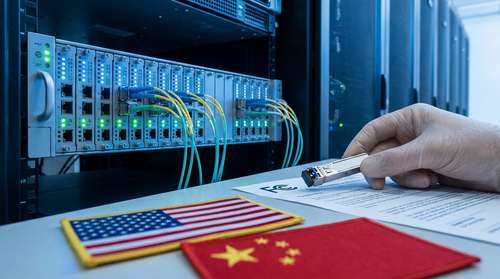
In a major escalation of the ongoing US China tech cold war, the Trump administration is actively preparing a new regulatory measure aimed squarely at the backbone of modern artificial intelligence. The Federal Communications Commission is drafting a comprehensive Chinese optical transceivers ban designed to halt the import of new hardware models crucial to high-speed data transmission within AI facilities. If implemented, the FCC data center import ban could fundamentally reshape how tech giants build out their computing clusters, securing domestic networks while simultaneously threatening to delay the rapid expansion of American artificial intelligence capabilities.
The Scope of the Proposed FCC Data Center Import Ban
Optical transceivers are the critical workhorse components that convert electrical signals into pulses of light, allowing immense volumes of data to travel across fiber-optic cables at the speed of light. An optical transceiver combines a transmitter and a receiver into a single housing unit, serving as the critical bridge linking switches, routers, and servers. Traditional copper wiring emits electromagnetic radiation that can be intercepted and suffers from severe bandwidth limitations over long distances. Fiber-optic connections eliminate these bottlenecks but require transceivers that are notoriously complex to manufacture at scale. A ban would force data center architects to rethink their procurement strategies for the most foundational layer of their network architecture.
According to sources familiar with the matter, the administration views these hardware modules as a severe vulnerability. The primary concern among national security officials is that foreign-manufactured networking components could be exploited to siphon sensitive data, install latent malware, or intentionally disrupt operations within the facilities that power the nation's leading generative AI models. By potentially pushing a broader FCC Covered List update 2026, regulators aim to prohibit U.S. companies from seeking authorization for new optical transceiver models manufactured by Chinese entities.
Why the AI Infrastructure Supply Chain is Vulnerable
The global AI infrastructure supply chain is currently heavily dependent on overseas manufacturing. Divyansh Kaushik, an AI policy expert at Beacon Global Strategies, noted that securing these facilities from the ground up is essential as the physical footprint of computing scales rapidly. A compromised transceiver could silently intercept data traveling between servers, presenting an espionage risk that software-level encryption might struggle to mitigate completely if the physical hardware itself is compromised.
Market Fallout: The Zhongji Innolight Ban and Shifting Demand
The immediate target of these proposed restrictions appears to be major overseas suppliers who have cornered the market on high-speed connectivity. A potential Zhongji Innolight ban—referencing the Suzhou-based manufacturer that controls an estimated 27% of the global optical transceiver market—would force a massive pivot for hyperscalers like Amazon Web Services, Google Cloud, and Microsoft Azure. Innolight currently provides the majority of the 800-gigabit modules deployed in Nvidia's dominant AI clusters.
Because these parts require rigorous compatibility validation and testing alongside network switches and data processing units, finding alternatives is not as simple as swapping a basic commodity. Industry analysts warn that shutting out market leaders could artificially cap growth for the broader tech sector, driving up costs and pushing buildout schedules back by months or even years.
Coherent Lumentum Networking Stocks Surge on the News
While cloud providers face potential logistical headaches, domestic hardware manufacturers are experiencing a massive windfall. Following reports of the impending regulatory action, Coherent Lumentum networking stocks skyrocketed. Applied Optoelectronics (AAOI) jumped nearly 18% in pre-market trading, while Lumentum Holdings and Coherent saw their valuations surge by 11% and 15%, respectively.
These domestic manufacturers are well-positioned to capture the displaced demand, particularly for the next-generation 1.6T high-speed optical modules that the industry will require soon. However, U.S.-based facilities currently lack the sheer manufacturing scale to immediately replace the massive volume supplied by their overseas competitors. Bridging this capacity gap will require significant capital investment and time.
Navigating the Next Phase of the Trade Conflict
The proposed restrictions signal a calculated strategy to de-risk critical technology sectors. Just weeks prior, the FCC updated its Covered List to restrict foreign-produced advanced robotic devices and connected power inverters. Extending these restrictions deep into the racks of enterprise computing centers represents a dramatic expansion of federal oversight.
This aggressive regulatory posture aligns with broader efforts to ring-fence American intellectual property and infrastructure. Hyperscale cloud providers, who have already committed trillions of dollars to capital expenditures for new computing infrastructure, are now forced to rapidly audit their supply chains. The impending restrictions could mandate costly redesigns for facilities currently in the planning phases, as architects swap out familiar hardware for domestic alternatives that remain untested at the scale required for training trillion-parameter models.
China has already signaled its dissatisfaction with the proposal, with embassy officials urging the administration to heed the rational voices of the business community. Whether this diplomatic friction results in retaliatory export controls on critical raw materials—such as the Indium Phosphide required for manufacturing these very transceivers—remains a major concern for global markets.
As policymakers attempt to balance national security imperatives with the ravenous hardware demands of the AI sector, the tech industry finds itself at a difficult crossroads. Ensuring the absolute security of the data center ecosystem is a clear priority, but achieving that goal without stalling American innovation will require a delicate, highly coordinated industrial strategy.