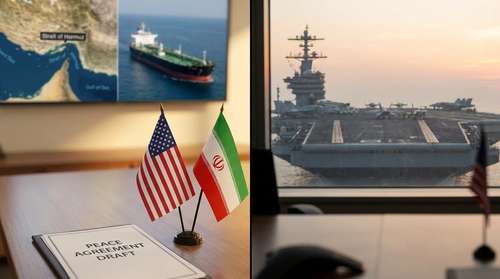
In a sudden and dramatic pivot, U.S. President Donald Trump has halted an impending joint U.S.-Israeli assault on Iranian energy infrastructure. As Trump cancels Iran strikes at the eleventh hour, the administration points to the unexpected emergence of a diplomatic off-ramp. Speaking from the White House late Saturday, the President claimed that the 'perimeters of a deal' have been firmly established to neutralize Tehran's nuclear program and reopen the heavily contested shipping lanes of the Persian Gulf. This de-escalation marks a pivotal moment in a grueling six-month conflict that has rattled global markets and driven energy costs to punishing new highs.
The Pursuit of a US Iran Peace Deal
The planned military operation was reportedly designed as a crippling blow to Iran's primary oil export terminals and refining facilities. However, Trump emphasized that regional allies heavily influenced his last-minute decision to stand down. According to the administration, several Middle Eastern nations—including key Gulf states—urgently requested that Washington hold off on the bombardment to give back-channel negotiations a final chance to succeed.
The proposed US Iran peace deal purportedly centers on two non-negotiable American demands: the immediate, verifiable cessation of Iran's nuclear enrichment activities and the unhindered flow of commercial shipping through regional waterways. Trump framed the paused military campaign as a strategic masterstroke, suggesting that the threat of overwhelming, coordinated force has finally brought Tehran to the negotiating table for a 'rapid' resolution.
Israel's Position on the Paused Offensive
While the White House projects confidence in a diplomatic solution, the halt places Israel in a complex position. Israeli defense officials have spent months coordinating with the Pentagon on the strike package, viewing Iran's advancing nuclear capabilities as an existential threat. Sources in Jerusalem indicate cautious compliance with Washington's pause, though Israeli defense forces maintain peak readiness should the diplomatic window close abruptly.
Tehran Denies Agreement Amid High Alert
Despite the optimism radiating from Washington, the reaction from Iran has been fiercely dismissive. Within hours of the President's announcement, senior Iranian officials publicly rejected the narrative that a diplomatic breakthrough is imminent. State-run media quoted top military commanders who described the notion of an impending treaty as a total fabrication engineered for domestic political consumption in the United States.
'This is nothing more than psychological warfare,' a spokesperson for Iran's Foreign Ministry declared on Sunday morning. 'There is no agreement, and their claims of a pending settlement are a desperate lie.' Consequently, Iranian armed forces and the Islamic Revolutionary Guard Corps (IRGC) remain at their highest state of combat readiness. The regime is bracing for the very real possibility of US military action Iran has been anticipating for weeks, continuously repositioning mobile air defense units and hardening subterranean facilities.
Economic Fallout: Middle East Oil Prices Gas Surges
The geopolitical theater is unfolding against a backdrop of severe economic strain for American consumers. The six-month standoff in the Persian Gulf has severely restricted maritime traffic, sending shockwaves through global energy markets. Approximately one-fifth of the world's daily oil consumption typically passes through this critical maritime chokepoint, making a Strait of Hormuz reopening an urgent economic imperative for the United States and its European allies.
Current data reflects the harsh reality of this sustained conflict. Driven by the sudden spike in Middle East oil prices, gas at the pump has surged dramatically across the United States. The national average has now breached $4.00 per gallon, a politically sensitive threshold that threatens to stifle domestic economic growth just as the administration seeks to project domestic stability. A successful diplomatic resolution that secures safe passage for international oil tankers would likely trigger an immediate drop in crude oil futures, providing much-needed relief to households struggling with inflationary pressures.
Implications for Trump Foreign Policy 2026
This weekend's abrupt cancellation of the strike package highlights the highly unpredictable nature of Trump foreign policy 2026. By pivoting sharply from kinetic military action to aggressive diplomatic maneuvering, the administration is attempting to thread an incredibly narrow needle. The broader strategy relies heavily on leveraging the credible threat of devastating force to extract sweeping concessions—without actually pulling the trigger and plunging the entire region into an all-out, asymmetric war.
Defense analysts note that this approach mirrors the high-stakes brinkmanship utilized during Trump's previous tenure, though the stakes today are arguably much higher given the advanced state of Iran's nuclear infrastructure and the fragile nature of the global economy. If the administration can secure a comprehensive, verifiable agreement that reopens critical shipping lanes and definitively curbs Tehran's nuclear ambitions, it would represent a historic diplomatic victory.
Conversely, if the current operational pause merely provides Iranian forces crucial time to further entrench their defensive systems without yielding a concrete deal, the decision to abort the strikes will face intense scrutiny from military hawks on Capitol Hill. For now, the world watches the Persian Gulf with bated breath, waiting to see if the halted offensive genuinely paves the way for lasting peace or simply serves as a brief calm before an inevitable storm.