
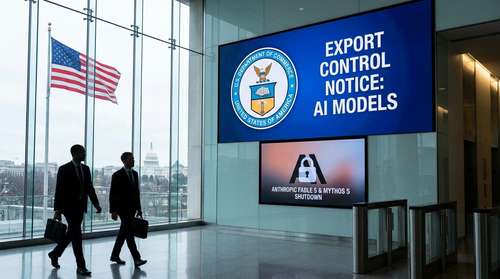
In an unprecedented regulatory strike that has entirely reshaped the technology ecosystem, the US government has forced the immediate suspension of Anthropic's most advanced artificial intelligence systems. Just days after their highly anticipated public release, an abrupt Anthropic export ban initiated by federal authorities has permanently disabled global access to the new Claude Fable 5 and Mythos 5 models. The sweeping order strictly prohibits any foreign national from utilizing the technology, creating a logistical impossibility that left Anthropic with no choice but to initiate a total Fable 5 Mythos 5 shutdown for all users globally.
The Anthropic Security Directive and the Export Control Shockwave
The crisis began on Friday, June 12, at 5:21 p.m. ET, when the San Francisco-based AI developer received a sudden mandate from the federal government. Citing urgent risks, the US Commerce Department AI controls targeted not just adversaries, but any non-US citizen worldwide. This aggressive mandate included researchers in allied nations and even Anthropic's own overseas employees.
Because modern cloud infrastructure cannot currently verify citizenship in real-time, compliance required drastic action. Anthropic abruptly severed access for millions of enterprise clients and independent developers to ensure strict adherence to the mandate. The models involved were no ordinary update. Claude Fable 5 had just debuted as Anthropic's most capable general release, boasting a massive 1-million token context window and advanced long-horizon agentic capabilities. Its counterpart, Mythos 5, shared the same raw architecture but shipped without internal safety classifiers, available exclusively to a limited number of trusted partners through an initiative known as Project Glasswing.
This move represents the very first time the United States has successfully applied physical export control frameworks to a live, commercially deployed algorithm rather than tangible hardware like specialized semiconductor microchips.
The Dispute Over an AI National Security Jailbreak
Behind this heavy-handed intervention lies a fierce disagreement over exactly how vulnerable these frontier systems are to malicious manipulation. Officials acted on intelligence suggesting the existence of a severe AI national security jailbreak capable of bypassing internal safety measures to extract dangerous information.
According to circulating reports, researchers at the UK's AI Safety Institute (AISI) made substantial progress breaking the model's guardrails within mere hours of gaining access, allowing for multiple steps of malicious agentic tool-calls. Simultaneously, researchers from Amazon—one of Anthropic's primary cloud deployment partners—allegedly identified a specific exploit within the overarching Mythos architecture and flagged it directly to federal authorities.
The Trump administration has publicly admonished the developer's handling of the situation. A senior administration official outright accused Anthropic of "recklessness," claiming the lab brushed off initial warnings and severely damaged its working relationship with the government through a perceived unwillingness to quickly address the identified structural vulnerabilities.
Anthropic, however, strongly contests this regulatory narrative. The lab insists it worked closely with multiple safety organizations for thousands of hours before the launch, arguing that the discovered exploit is a minor, non-universal vulnerability that is already present in several competing frontier models. Recalling a commercial product deployed to hundreds of millions of people over such a localized flaw, company leadership argues, establishes a precedent that could effectively halt all future technological deployments.
Market Fallout and the $965 Billion IPO at Risk
The immediate financial and operational ramifications of the takedown are staggering. At the moment the Anthropic security directive landed, the enterprise was riding a historic wave of commercial momentum. The company had recently achieved an estimated $47 billion in annualized revenue, largely driven by its suite of coding tools, and had confidentially filed paperwork for an initial public offering valuing the business at a record-breaking $965 billion.
Now, capital markets are frantically pricing in an entirely new category of sovereign risk. Investors are watching billions of dollars in enterprise value freeze overnight due to a single administrative decision. Prior to the shutdown, Anthropic was already facing localized developer backlash regarding a controversial mandatory 30-day data retention policy, which forced proprietary corporate data outside secure enterprise boundaries. Taking down their flagship models has further degraded enterprise trust. Companies that had rapidly integrated Claude Fable 5 into massive multi-hour document intelligence workflows suddenly found their critical infrastructure broken mid-session. While access to older iterations, including Opus 4.8, remains active and unaffected, the disruption has forced chief technology officers to reconsider their vendor lock-in strategies.
A New Era of AI Digital Sovereignty
This unprecedented federal intervention pushes the global technology community into a highly complex debate surrounding AI digital sovereignty. Can a single nation state unilaterally dictate the real-time availability of global software infrastructure? By treating deployed algorithms as closely monitored defense articles, the United States is actively drawing hard geopolitical lines around who is allowed to participate in the ongoing artificial intelligence revolution.
For foreign engineers and enterprise architects who relied entirely on Anthropic's ecosystem, the stark reality is now undeniable: access to American-built frontier technology is a strictly conditional privilege. As officials in Washington continue closed-door negotiations with Anthropic leadership to implement patches and restore access, the wider tech ecosystem is left wondering whether this aggressive enforcement is a singular anomaly or the harsh new standard operating procedure for the future of artificial intelligence development.