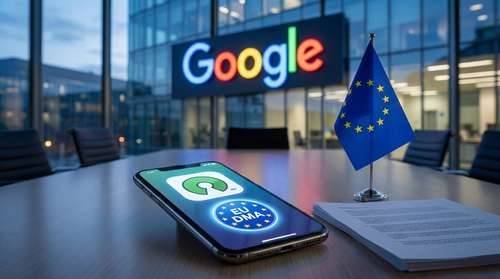
In a landmark Google Android AI ruling that promises to reshape the mobile technology landscape, the European Commission has adopted two legally binding decisions forcing Google to fundamentally change how it operates its mobile and search ecosystems. Issued on July 16, 2026, under the sweeping EU Digital Markets Act (DMA), the mandates require Google to grant third-party AI assistants deep, system-level access to Android devices. Furthermore, the tech giant must begin sharing its closely guarded, anonymized search data with competing search engines and AI developers.
The bold regulatory move targets the core of Google's competitive advantage in Europe, where Android currently commands roughly 60% of the mobile market. For years, alternative AI developers have faced severe limitations when operating on Google's mobile platform, unable to match the seamless integration of native applications. Now, this EU Google AI assistant decision clears the path for true parity, setting strict deadlines over the next year for Google to tear down its walled garden and foster genuine consumer choice.
Dismantling Gemini's Exclusive Access
Until now, Google's own AI service, Gemini, has enjoyed a virtual monopoly on deep system integration within Android. When users wanted an assistant to read their on-screen context, draft an email seamlessly, or wake up to a voice prompt while the screen was locked, Gemini was the only smooth option. Rival applications hit restrictive software walls, forcing users into clunky, app-based workarounds that degraded the user experience.
The Commission's first specification decision directly tackles this disparity by forcing Android to be open to rival AI. Following a six-month regulatory dialogue, Google has been ordered to unlock 11 core operating system features for third-party developers. This means that in the highly anticipated Gemini vs ChatGPT Android showdown, users will finally be able to set an alternative assistant like OpenAI's ChatGPT, Anthropic's Claude, or Perplexity as their true system default.
Under the new technical mandates, competing bots will gain the ability to:
- Respond instantly to custom wake words, mirroring the familiar 'Hey Google' functionality even when the device screen is powered off.
- Execute complex actions inside other installed apps, such as booking transit, pulling up flight details during a phone call, or retrieving documents from cloud storage.
- Access context-aware intelligence and screen automation features natively, allowing the assistant to see and interact with whatever is currently displayed on the smartphone.
Google is required to implement the bulk of these interoperability measures by the launch of Android 18, with a hard compliance deadline set for August 1, 2027. While Google can demand baseline security certifications before apps touch highly sensitive system integrations, they cannot block access to vetted competitors.
Leveling the Field with Shared Search Data
While the Android integration mandate shifts the consumer hardware experience, the second directive targets the data pipeline powering modern digital ecosystems. The European Commission has ordered that Google share search data with rival search providers and, notably, AI chatbots that offer web-search functionalities.
Because Google commands a staggering share of the European search market, it generates massive volumes of user query, click, ranking, and view data. This data is the lifeblood of training responsive, accurate search algorithms and large language models. Starting in January 2027, Google must license this information to eligible competitors under fair, reasonable, and non-discriminatory (FRAND) pricing structures.
By compelling the search giant to open its data vaults, the EU hopes to catalyze the development of innovative, privacy-focused search alternatives and smarter third-party AI assistants that don't rely entirely on Google's consumer-facing APIs. This structural shift guarantees that smaller developers can utilize the same back-office mechanics that Google relies on to refine its search results.
Privacy and Security Safeguards
Opening access to search data naturally raises severe privacy concerns, a factor the European Commission has heavily regulated within this decision. The data-sharing framework mandates a strict, multi-layered anonymization process. User data must be bundled into groups of at least 1,000, stripping all personal identifiers and suppressing rare or highly sensitive search records. Additionally, Google retains the right to audit data-sharing requests to mitigate serious cybersecurity or data protection risks before handing over any intelligence. Independent auditors will also oversee the firms receiving this data to ensure it is strictly used to improve search capabilities.
The Broader Impact on Mobile Competition
These specification proceedings represent a critical evolution in tech regulation. It marks the first time the European Commission has used its targeted powers under the DMA to dictate explicit engineering requirements rather than simply levying financial penalties. By forcing Google to convert vague legal obligations into concrete technical architectures, regulators are providing smaller competitors with a clear blueprint for deep integration.
European officials emphasize that these measures are designed to drive diversity and enable fair competition, giving consumers genuine options for their daily digital workflows. While Google executives have previously expressed public disagreement with the expansive nature of these rulings, the mandates remain legally binding. The Commission retains its distinct power to launch non-compliance investigations, meaning any failure to build these features could eventually trigger massive financial penalties.
As the rollout phases approach between early 2027 and late 2028, the smartphone market is poised for a significant transformation. European Android users will soon hold devices that serve as neutral platforms for the booming artificial intelligence industry, empowering them to choose exactly which intelligent agent manages their daily routines.