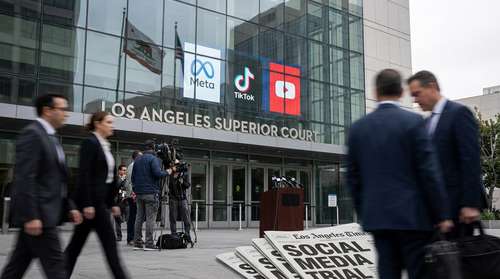
Jury selection began Tuesday, January 27, 2026, in a Los Angeles Superior Court for a landmark civil trial that could fundamentally reshape the internet. For the first time, tech giants Meta, TikTok, and YouTube are facing a jury to defend against allegations that their platforms are not just popular tools for communication, but “defective products” intentionally designed to addict children. This high-stakes social media addiction trial puts the algorithmic engines of the world's most powerful companies under a legal microscope, with the potential to set a precedent for thousands of similar cases nationwide.
The ‘Bellwether’ Case: K.G.M. vs. Big Tech
At the center of this legal storm is a 19-year-old plaintiff identified in court documents only as ‘K.G.M.’ Her lawsuit paints a harrowing picture of a childhood consumed by screens. According to filings, K.G.M. began using social media at age 10 and quickly spiraled into a cycle of compulsive use that her lawyers argue was engineered by the defendants. The complaint alleges that the platforms' relentless notifications, infinite scrolls, and intermittent variable rewards—psychological triggers often compared to slot machines—fueled her severe depression, anxiety, body dysmorphia, and suicidal ideation.
This case is considered a “bellwether” trial. Its outcome will serve as a litmus test for the more than 1,000 similar lawsuits currently pending in California state courts, alongside a massive federal multidistrict litigation consolidating claims from school districts and families across the country. “The fact that a social media company is going to have to stand trial before a jury is unprecedented,” said Matthew Bergman, founder of the Social Media Victims Law Center and lead attorney for the plaintiffs. He argues that this trial will finally force tech executives to answer for “deliberate design decisions” that prioritized engagement over safety.
A New Legal Strategy: Design Defect vs. Content
The plaintiffs are deploying a novel legal strategy designed to pierce the shield of Section 230 of the Communications Decency Act, the 1996 federal law that historically protects internet platforms from liability for user-generated content. Instead of suing over the harmful videos or posts K.G.M. viewed, her legal team is attacking the platforms' architecture itself.
They argue that the algorithms and engagement features constitute a product defect, making the apps inherently dangerous to developing brains. Judge Carolyn Kuhl, who is presiding over the case, has allowed this line of reasoning to proceed, ruling last year that jurors can consider whether specific design features—like autoplay and push notifications—contributed to mental health harms independent of the content served.
Snap Inc. Settles, Leaving Rivals Exposed
Just days before jury selection began, a significant crack appeared in the unified front of Big Tech. Snap Inc., the parent company of Snapchat, reached a settlement with the plaintiff for an undisclosed sum. While Snap admitted no wrongdoing, their exit leaves Meta (Facebook and Instagram), ByteDance (TikTok), and Alphabet (YouTube) to face the jury alone. Legal experts suggest this settlement could signal Snap's desire to avoid a public dissection of its internal documents, a prospect the remaining defendants must now face head-on.
The Defense: Parental Responsibility and Free Speech
The tech giants are expected to mount a vigorous defense. Meta, TikTok, and YouTube will likely argue that their platforms offer robust safety tools and that parental responsibility plays a crucial role in managing a child's screen time. They maintain that there is no scientific consensus proving social media causes mental health disorders, suggesting that K.G.M.’s struggles may have stemmed from other factors.
Furthermore, the defense will likely lean on the First Amendment, asserting that the curation and arrangement of content are protected forms of speech. They have consistently denied allegations that they prioritize profit over safety, pointing to the billions of dollars invested in trust and safety teams. “Providing young people with a safer, healthier experience has always been core to our work,” a YouTube spokesperson stated recently, echoing similar sentiments from Meta and TikTok.
What’s at Stake for the Industry?
If the jury finds the companies liable, the consequences could extend far beyond financial damages. A verdict for the plaintiff could force a fundamental redesign of how social media apps operate, potentially ending the era of the “attention economy” as we know it. It would validate the comparison plaintiffs' lawyers often make to the tobacco industry litigation of the 1990s: that these companies knew their products were addictive and harmful but hid that truth from the public.
As opening arguments approach, the eyes of the tech world, regulators, and concerned parents are fixed on Judge Kuhl's courtroom. For K.G.M. and thousands of other families, this trial represents the first real chance to hold Big Tech accountable for what they describe as a stolen childhood.