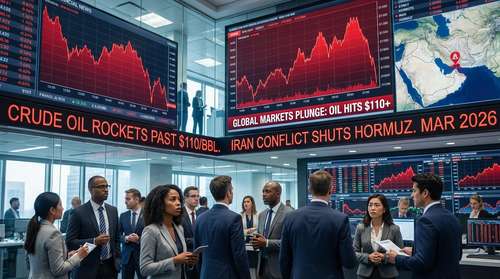
The global financial landscape is experiencing a severe shockwave this week. Following an unprecedented escalation in Middle Eastern military strikes, oil prices 2026 have shattered psychological barriers, surging past the $110 mark for the first time since Russia invaded Ukraine four years ago. The sudden geopolitical ignition has paralyzed critical shipping lanes and ignited a stock market crash today that is actively erasing billions in equity valuation across Asian, European, and U.S. trading floors. With the Strait of Hormuz effectively closed to commercial tanker traffic, investors are bracing for a prolonged energy shock that threatens to unravel the fragile economic recovery.
The Unprecedented Brent Crude Price Spike
Energy markets are currently witnessing their most aggressive upward trajectory in decades. The Brent crude price spike saw the international benchmark touch a staggering $119.50 a barrel during early Asia Pacific trading hours on Monday, representing a near 30% jump before settling closer to $112. Simultaneously, West Texas Intermediate (WTI), the U.S. standard, vaulted over 66% from its late-February levels, easily establishing crude oil $110 barrel as the new, grim reality for energy consumers.
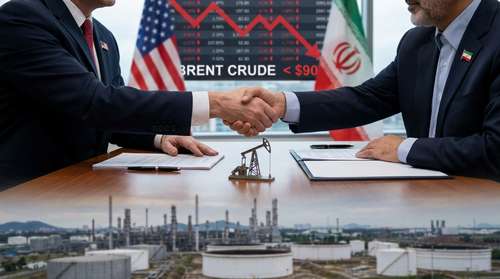
This rapid appreciation stems directly from the ongoing U.S.-Israeli military operations against Iranian targets, which began on February 28. Following strikes on energy sites around Tehran, Iranian authorities retaliated by halting maritime flows through the Strait of Hormuz. This narrow chokepoint historically accommodates roughly 15 million barrels of crude daily—amounting to 20% of the world’s petroleum liquid supply.
Severe Iran War Business Impact on Global Supply
The physical logistics of the oil trade are deteriorating by the hour. The Iran war business impact extends far beyond the trading pits of Chicago and London, presenting severe logistical hurdles for the entire global supply chain:
- Strait of Hormuz Paralysis: Independent research from Rystad Energy highlights that tankers carrying fuel from Saudi Arabia, Qatar, Bahrain, and the UAE are stalled indefinitely.
- Emergency Production Cuts: Kuwait's national oil company announced emergency production cuts this weekend, citing exhausted onshore storage capacities as exports remain blocked. Iraq and the UAE have implemented similar output reductions.
- Rerouting Failures: While Saudi Arabia is attempting to divert shipments through the Red Sea, maritime data confirms these alternative volumes cannot offset the massive deficit left by the Hormuz closure.
Stock Market Crash Today: Indices Bleed Red
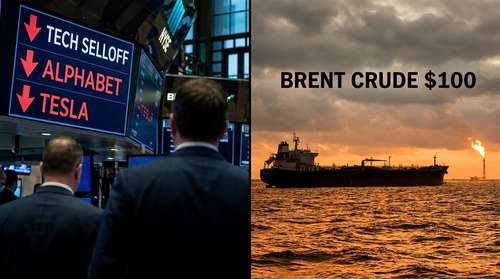
Equities have violently repriced the risk of a sustained energy drought. The market volatility March 2026 has been historically brutal, erasing months of steady gains in a matter of hours. Asian indices bore the initial brunt, with Japan's Nikkei 225 shedding over 5% and South Korea's KOSPI plummeting 6% by Monday's close. European markets followed suit, as the pan-European benchmark dropped 2.34% in early trading, marking its worst week in nearly a year.
Wall Street is not immune to the contagion. Pre-market trading data shows the Dow Jones Industrial Average and the S&P 500 futures tumbling 1.5%. Heavy sell-offs in the banking and technology sectors—which dropped 3.2% and 3.1% respectively—are dragging down portfolios as managers panic over compressed corporate profit margins. High energy costs act as a regressive tax on consumers and corporations alike, squeezing operational budgets and leaving investors scrambling for safe-haven assets.
Are We Facing a New Global Economic Crisis?
The immediate fear rippling through the corridors of central banks is stagflation—a toxic blend of stagnant economic growth and rising inflation. A global economic crisis becomes increasingly plausible if oil remains in the triple digits for an extended period. U.S. retail gasoline prices have already climbed to a national average of $3.45 per gallon, their highest mark since August 2024. The International Monetary Fund notes that while the world economy could absorb a 10% energy price hike, sustained levels at $110+ could slash growth expectations significantly.
Policymakers are scrambling to project stability. The Group of Seven (G7) finance ministers are reportedly coordinating an emergency release of petroleum reserves with the International Energy Agency to artificially flood the market and suppress costs. Furthermore, U.S. President Donald Trump took to social media to call the spike a "short term" consequence that will drop rapidly once military objectives are achieved. Secretary of Energy Chris Wright echoed these sentiments, promising Americans that the pump price surge would be temporary.
The Federal Reserve's Dilemma
Despite political assurances, macroeconomic indicators suggest rough waters ahead. Asian economies, which recently enjoyed strong industrial growth powered by the global tech boom, now face the acute risk of supply disruptions. Financial strategists warn that the U.S. Federal Reserve, which investors eagerly expected to execute multiple rate cuts in 2026, might be forced to pivot. Rather than easing, the central bank may need to keep interest rates elevated to combat energy-driven inflation, further suffocating business borrowing and consumer credit.
For business leaders and everyday consumers, the coming weeks will be critical. If geopolitical tensions de-escalate and maritime corridors reopen, markets could stabilize. However, if the rhetoric from Iranian President Masoud Pezeshkian holds true and regional retaliation expands, the global economy may be forced to adapt to a painful new era of energy scarcity.