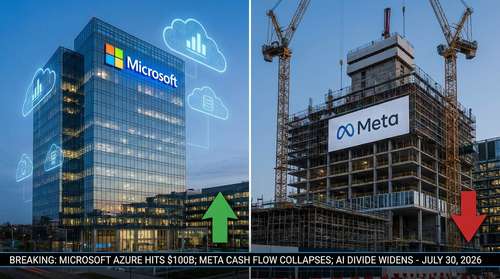
The highly anticipated Wall Street market update July 30 2026 delivered a stark reality check for investors who have spent the last two years betting blindly on artificial intelligence. A dramatic divergence is unfolding across the technology sector, perfectly illustrated by the fallout from this week's blockbuster financial disclosures. Following the release of the Microsoft Q4 earnings 2026, global markets witnessed a profound shift in how capital expenditures are being rewarded. While one enterprise software giant demonstrated the immediate profitability of its infrastructure build-out, a social media titan revealed the painful, cash-draining reality of competing in the generative AI arms race without a public cloud computing safety net.
The contrast in fortunes could not be sharper. The drastic MSFT vs META stock reaction underscores an emerging dynamic in modern equities: investors are no longer satisfied with abstract promises of future consumer engagement returns. They are aggressively demanding tangible enterprise revenue streams today. Meta shares plunged nearly 10% in after-hours trading to $529.15, wiping out billions in market capitalization, while Microsoft shares surged on accelerated cloud growth. This fundamental shift has crystallized a growing AI tech stocks divide, ruthlessly separating the companies that are actively selling the shovels from those who are merely digging the trenches.
Microsoft Azure 100 Billion: The Enterprise AI Payoff
For Microsoft, the unprecedented infrastructure investments of the past several quarters are yielding staggering financial returns. The standout metric from their latest earnings report was crystal clear: Microsoft Azure 100 billion. For the first time in the company's history, the standalone Azure cloud platform surpassed $100 billion in annual revenue, fueled by an impressive 43% year-over-year growth rate in the fiscal fourth quarter.
Under the steady leadership of CEO Satya Nadella, the Redmond-based software giant posted overall quarterly revenue of $90 billion—an 18% increase—alongside a net income of $35.8 billion. The market's enthusiastic response proves that Wall Street is perfectly comfortable with Microsoft's record $41 billion in quarterly capital expenditures, provided that new server capacity can be immediately monetized. Management confirmed they added 31 new datacenters across five continents in just three months to keep up with explosive demand.
By weaving generative models into products like Microsoft 365 Copilot, which now boasts over 30 million paid seats, and directly renting out raw compute power to enterprise clients, Microsoft has successfully closed the loop between its infrastructure costs and its top-line software growth. The quarter's success was further bolstered by a $3.2 billion gain from their strategic investment in AI startup Anthropic, proving their multi-pronged approach to the sector is paying deep dividends.
Meta Earnings Miss: A Dramatic Cash Flow Collapse
Meanwhile, in Menlo Park, the financial narrative took a considerably darker turn. Despite delivering a highly respectable 28% increase in overall quarterly revenue to $60.8 billion—driven by a 14% rise in ad impressions and a 12% bump in average ad pricing—the social networking conglomerate suffered a punishing Meta earnings miss on the bottom line. Diluted earnings per share came in at just $6.18, falling significantly short of the roughly $7.17 Wall Street consensus estimate.
The root cause of this profitability shortfall was an unprecedented 55% surge in total costs and expenses, which ballooned to $42.03 billion for the quarter. This massive overhead burden included several distinct hurdles:
- Legal Proceedings: A hefty $2.4 billion in unexpected legal charges severely weighed down operating margins.
- Severance Expenses: Roughly $1.18 billion was attributed to restructuring and workforce reduction charges.
- Runaway Infrastructure Costs: Capital expenditures for the quarter alone hit an eye-watering $31.1 billion.
The most alarming figure for institutional analysts, however, was the staggering 91% collapse in free cash flow. Plunging from over $8.5 billion in the same period last year to a mere $784 million today, the metric highlights the immense financial strain of Mark Zuckerberg's hardware ambitions. Management subsequently raised the lower bound of their full-year capex outlook to a range of $130 billion to $145 billion, signaling to wary investors that the aggressive spending spree is far from over.
The Harsh Reality of Big Tech AI Spending
What we are currently witnessing is the inherent structural advantage of diversified enterprise cloud providers. Big Tech AI spending is universally high across the industry, but the architecture and immediate return on that expenditure vary wildly. Microsoft and Alphabet can justify their multibillion-dollar data center investments because they operate vast public cloud ecosystems; every advanced GPU they install can be leased out to thousands of eager developers the very next morning.
Meta lacks this commercial cloud division entirely. Its astronomical capital expenditures go almost exclusively toward powering its internal proprietary models, enhancing its core advertising recommendation algorithms, and building out new consumer-facing AI agents. While these features undoubtedly improve ad targeting and user engagement metrics, the immediate financial translation is far murkier. The cash goes out the door to buy servers and real estate, but it does not immediately come back in as direct, high-margin enterprise subscription revenue.
Creative Financing to Navigate the Divide
The sheer scale of these compute costs is forcing companies to look for creative solutions. To manage the immense capital requirements without further devastating its balance sheet, Meta has begun shifting financing strategies. The company recently established a $14 billion data-center joint venture with BlackRock, moving a significant portion of its real estate footprint off its direct books. However, even these strategic financial maneuvers were not enough to mask the underlying free cash flow deterioration showcased in this week's report.
As the dust settles on this chaotic week of financial disclosures, the broader market implications are becoming acutely apparent. Portfolio managers are actively adjusting their holdings to reflect a new tier system within the technology sector. The companies capable of turning silicon into immediate software-as-a-service revenue are retaining their premium valuations. Those absorbing the hardware costs internally to protect their consumer moats are facing unprecedented scrutiny. This latest earnings cycle decisively proves that the technological revolution is no longer a rising tide lifting all boats; it has become a brutal discriminator of business models.