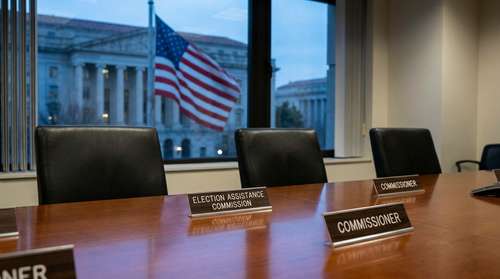
President Donald Trump has abruptly cleared out the federal government's only agency dedicated to election administration, removing the remaining bipartisan members of the U.S. Election Assistance Commission. The unprecedented move late Thursday leaves the critical watchdog completely vacant just months before the critical 2026 midterm elections, sending shockwaves through state election offices nationwide.
When a sitting president like Trump fires election commission members in such a sweeping fashion, it raises immediate alarms over what the sudden purge means for voting system certification and the broader integrity of November's congressional contests. The aggressive executive action was made possible by a landmark judicial ruling that vastly expanded Supreme Court presidential power over independent federal agencies.
The Sudden Ouster of Thomas Hicks, Benjamin Hovland, and the EAC's Collapse
The swift dismantling of the commission unfolded rapidly via email. The two sitting Democratic commissioners—Thomas Hicks, Benjamin Hovland—were notified Thursday evening that their terminations were effective immediately. The emails were signed by Morgan DeWitt Snow, the deputy director of presidential personnel. Meanwhile, the lone remaining Republican commissioner, Christy McCormick, was permitted to resign. A fourth member, Republican Donald Palmer, had already left the agency voluntarily earlier this year to join a conservative think tank.
As a result, the four-seat commission now has zero sitting members. Congress established the agency following the disputed 2000 presidential election through the Help America Vote Act (HAVA) to assist state and local officials with the logistical complexities of running elections.
Without a quorum of at least three commissioners, the body is legally paralyzed. It cannot hold votes to disburse federal election security grants or officially update crucial guidelines, leaving local election directors effectively stranded as they prepare for a highly contested midterm cycle.
How Trump v. Slaughter Expanded Presidential Reach
For decades, the commissioners of the Election Assistance Commission operated with a degree of insulation from the Oval Office, shielded by statutes designed to keep election administration strictly bipartisan. However, a recent and highly controversial Supreme Court decision, Trump v. Slaughter, fundamentally altered the balance of power in Washington.
The high court's ruling upended established legal precedent, granting the executive branch broad authority to fire the heads of independent federal agencies at will. The White House wasted no time exercising this newly affirmed mandate. In a statement confirming the dismissals, the administration directly cited the ruling as justification.
"The President, and head of the Executive Branch, reserves the right to remove individuals that may not be totally aligned with the important task of securing America's elections and ensuring every legal vote is counted," the White House statement read, adding that the recent Supreme Court decision "gives the President precedence to do so".
Impacts on Voting System Certification and Midterm Preparations
The immediate fallout of an empty commission falls squarely on state and county election administrators. The agency plays a specialized but vital role in the mechanics of American democracy. Its primary responsibilities include maintaining the national mail voter registration form, overseeing voting system certification to ensure voting machines meet strict security standards, and distributing essential federal funds used by states to harden their cybersecurity infrastructure.
While state laws ultimately govern how elections are run, local officials rely heavily on federal certification guidelines before purchasing or deploying new voting equipment. A prolonged vacancy at the top of the commission could freeze equipment upgrades and delay security funding right as states enter the final sprint toward November.
Fears of Political Interference in the 2026 Midterm Elections
The timing of the purge has drawn fierce condemnation from Democratic leadership and voting rights advocates, who view the maneuver as a blatant attempt to federalize and manipulate local election procedures. Rep. Steny Hoyer, the original lead sponsor of HAVA, issued a scathing rebuke, accusing the administration of paralyzing an agency designed to make voting accessible.
Elections administrators are voicing serious unease over the disruption. Dustin Czarny, an elections commissioner in New York and member of the EAC's Local Leadership Council, noted that the sudden dismissals place state officials in uncharted territory during a period of constant turmoil. While some routine operations managed by career staff may continue, any new policy directives or emergency rulings are essentially blocked.
Administration officials push back against these criticisms, arguing that the president is simply ensuring that all federal bodies operate in lockstep with executive efforts to prevent voter fraud. The White House has consistently pushed to implement stricter voting requirements, including proof-of-citizenship mandates on federal registration forms—an effort the recently ousted commissioners had previously resisted.
The Future of Independent Federal Agencies
The clearing of the Election Assistance Commission serves as the first major test case for the post-Slaughter executive branch. Legal scholars warn that if the president can unilaterally dismantle a bipartisan elections board, other regulatory bodies historically protected from political headwinds could be next.
As the Senate remains the only hurdle for confirming new commissioners, the immediate future of the federal election watchdog is entirely dependent on partisan gridlock. Unless new members are nominated and quickly confirmed by the Senate, the agency will remain dark through the election. For local officials tasked with executing the upcoming midterms, the sudden federal vacuum adds an unprecedented layer of instability to an already tense political landscape.