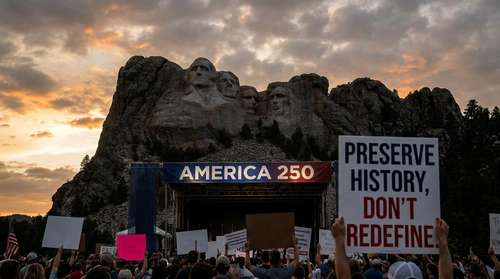
As the United States kicked off its historic Semiquincentennial weekend, President Donald Trump traveled to South Dakota on Friday to deliver a fiery keynote address beneath the iconic granite faces of four American presidents. The highly anticipated Donald Trump Mount Rushmore visit, designed to headline the nation's America 250 celebrations, has rapidly transformed into a fierce national debate. The catalyst for the dispute was a fresh push from the administration suggesting that the 45th and 47th president deserves a permanent spot carved into the Black Hills monument.
The White House Push for a Trump Face Mount Rushmore Addition
The prospect of a Trump face Mount Rushmore expansion has circulated as a political talking point for nine years, but the concept gained unprecedented official weight on the eve of the nation's 250th birthday. Ahead of the president's Friday night remarks, White House spokeswoman Taylor Rogers issued a statement declaring that there would be "no better addition to the iconic Mount Rushmore than the 45th and 47th President of the United States".
This bold declaration follows weeks of digital signaling from the president himself. Just last month, Trump shared AI-generated mock-ups on his social media platform, Truth Social, depicting his likeness alongside George Washington, Thomas Jefferson, Theodore Roosevelt, and Abraham Lincoln. The monument holds a particular fascination for Trump. During his first term, he privately told then-Congresswoman Kristi Noem that joining the carving was his "dream". When Noem later became governor of South Dakota, she presented Trump with a $1,100 bust depicting his face added to the mountain—a gift he proudly displays at his Mar-a-Lago estate.
Geological Realities and the Freedom 250 Controversy
Despite the political momentum and legislative efforts—such as a 2025 bill introduced by Representative Anna Paulina Luna to commission the addition—altering the sculpture faces a literal wall of resistance. The National Park Service has long maintained that there is simply no carvable rock left on the mountain to safely support a fifth face without compromising the structural integrity of the existing artwork.
However, the administration's continued persistence has kept the Freedom 250 controversy alive. For the president's most ardent supporters, the proposal has become a symbolic rallying point, representing a desire to see modern conservative leadership permanently etched into American history. Conversely, critics argue the push distracts from the unifying purpose of the Semiquincentennial and attempts to bypass strict historic preservation laws.
US Independence Day 2026 Politics and Indigenous Pushback
The intersection of pageantry and US Independence Day 2026 politics was on full display in Keystone, South Dakota, the gateway town to the monument. Authorities designated a specific First Amendment zone along the highway, anticipating protests similar to the tense clashes that occurred during Trump's previous visit in July 2020.
Those previous demonstrations were led by Indigenous advocacy groups, including the NDN Collective, who highlighted the federal government's violation of treaties that originally granted the Black Hills to the Lakota tribes. The site remains deeply sacred to the Lakota people, and many view the original carvings as a desecration. Interestingly, by late Friday afternoon, the designated protest area stood entirely empty under heavy law enforcement and National Guard watch, allowing the administration's narrative to dominate the local airspace unhindered.
A Sizzling Backdrop for America 250 Celebrations
The localized political theater in South Dakota stood in stark contrast to the environmental hurdles facing the rest of the country's America 250 celebrations. A brutal, nationwide heatwave forced major metropolitan areas to drastically alter their anniversary plans. Extreme temperatures led organizers to completely cancel Philadelphia's highly anticipated "Salute to Independence Semiquincentennial Parade," while officials in Washington, D.C., temporarily closed the Great American State Fair on the National Mall to protect attendees from heat exhaustion.
With daytime events melting under the summer sun, national attention shifted toward cooler evening festivities. In a novel twist typically reserved for New Year's Eve, New York City organized a midnight ball drop in Times Square to ring in the historic July 4th holiday.
Will the Mount Rushmore Fireworks 2026 Mark a Historic Shift?
As dusk fell over the Black Hills, the Mount Rushmore fireworks 2026 display served as the visual centerpiece for the administration's broader anniversary agenda. Following fighter jet flyovers that shook the granite peaks, Trump delivered remarks that merged themes of historic American exceptionalism with his current political platform.
Shortly after the pyrotechnics concluded, the president departed for Washington to headline the weekend's subsequent celebrations, having already signed a formal proclamation honoring the 250th anniversary of the Declaration of Independence.
Whether the physical face of Mount Rushmore is ever altered remains highly improbable due to geological limitations, lack of carvable space, and inevitable legal hurdles. Yet, by forcefully placing the idea into the mainstream discourse during the nation’s most significant birthday in a generation, the White House has ensured that the debate over monumental legacy will linger long after the smoke from the fireworks clears.