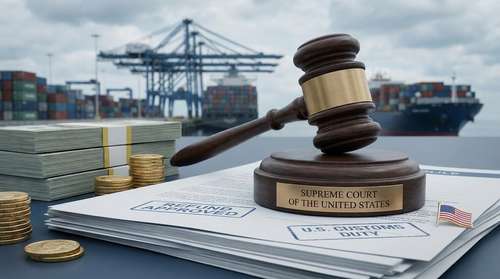
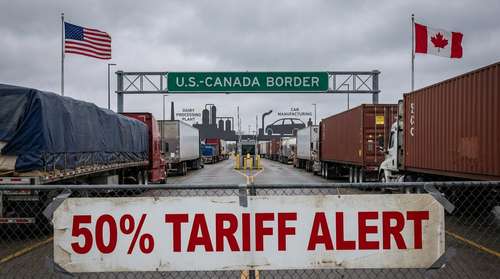
President Donald Trump has announced a massive escalation that threatens to upend North American commerce, raising the specter of severe economic chaos with sweeping 50% levies on Canadian imports. The aggressive imposition of these Trump Canada tariffs, set to take effect in just 30 days on August 19, 2026, represents a historic peak in the ongoing US Canada trade war 2026. By targeting approximately $20 billion in cross-border trade, the White House claims it is retaliating against Canada's unfair trade barriers in the dairy, alcohol, and automotive sectors. As businesses on both sides of the border brace for significant supply chain disruptions, leaders are scrambling to contain the economic fallout before the deadline expires.
Invoking the Section 338 Tariff Act of 1930
To bypass legal challenges that struck down other global tariffs earlier this year, the Trump administration has dusted off a rarely used, nearly century-old piece of legislation. The Section 338 Tariff Act of 1930 empowers the president to impose punitive duties of up to 50% against trading partners deemed to be discriminating against American commerce. This bold move marks the first time in almost a century that this obscure Great Depression-era law has been weaponized on such a massive scale.
The White House specifically cited Canada's handling of quotas for American dairy, regional boycotts of US wine in certain Canadian provinces, and alleged unequal treatment of American-made motor vehicles. Under the new proclamations, everyday goods ranging from cement and furniture to wine and even ice hockey sticks will face a devastating 50% import tax. Although the administration carved out strategic exemptions for essential resources like energy, potash, and critical minerals, the broad stroke of the Trump 50 percent tariffs Canada promises widespread economic shockwaves for manufacturers and everyday consumers alike.
Immediate Supply Chain Disruptions
The sheer scale of the affected goods—accounting for roughly 5.2% of all Canadian imports to the US—means that retailers are already panicking. Industries reliant on Canadian lumber and cement are warning of immediate price hikes in the housing and construction markets, while grocers anticipate sharp jumps in the cost of imported agricultural products. Because these tariffs do not currently exempt goods compliant with existing trade agreements, the logistical nightmare of re-routing supply chains is already beginning.
A Clash Over Free Trade
The latest tariff threat has sparked immediate pushback from Ottawa. Canadian Prime Minister Mark Carney countered by calling the move a direct violation of existing free trade agreements. The diplomatic dynamic involving Mark Carney, Donald Trump, and their respective trade delegations has been fraught with tension for months, culminating recently during the World Cup final when the two leaders met, only for Trump to double down on trade penalties shortly after.
In a Tuesday morning press briefing, Carney confirmed he had spoken directly with the US president and agreed to intensify CUSMA trade negotiations in the coming weeks. However, the prime minister stood firm on Canadian sovereignty, making it clear that Ottawa is preparing strategic countermeasures. "We will look at all options in terms of how we would respond if they do come into effect," Carney stated to reporters, pledging to protect Canadian farmers, autoworkers, and businesses from the devastating impact of these levies.
The Roots of the US Canadian Trade Dispute
At the heart of the US Canadian trade dispute is a fundamental disagreement over market access and domestic economic protections. Tensions flared dramatically after the US refused to renew the United States-Mexico-Canada Agreement (known as CUSMA in Canada) earlier this year, creating an environment ripe for retaliation. The Trump administration claims that Canada unfairly biases its own auto sector and maintains stringent supply-managed dairy systems that shut out American farmers from fair competition.
Canada, meanwhile, argues that its policies are standard protective measures and that previous US levies were themselves illegal under international trade law. The recent introduction of these Trump Canada tariffs is largely seen by analysts as a high-stakes pressure tactic to force concessions before a new trade framework must be finalized. Experts warn, however, that it is a high-risk strategy that could easily backfire and trigger a tit-for-tat escalation.
Economic Impacts of the US Canada Trade War 2026
With the 30-day countdown officially underway, industries across North America are sounding the alarm. Economists caution that the US Canada trade war 2026 could stall economic recovery and severely drive up inflation, particularly in northern border states that rely heavily on Canadian exports. Retailers and manufacturers are already mapping out contingency plans, anticipating severe price hikes if the duties hold.
Whether this brinkmanship will lead to a diplomatic breakthrough or severe economic retaliation remains to be seen. If intense CUSMA trade negotiations fail to produce a compromise, the enactment of Trump 50 percent tariffs Canada will fundamentally alter the North American economic landscape. For now, businesses and consumers are left watching this diplomatic high-wire act, hoping that intense upcoming talks can prevent the worst-case scenario of spiraling consumer costs.