
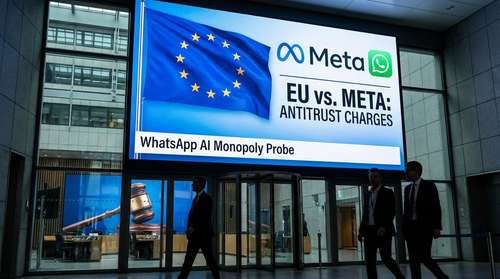
The European Commission has formally charged Meta with violating antitrust laws, accusing the tech giant of abusing its dominant market position to shield its own AI assistant from competition on WhatsApp. The charges, announced Monday, center on a controversial policy change that effectively blocks third-party general-purpose AI assistants—such as OpenAI's ChatGPT and Anthropic's Claude—from accessing the WhatsApp Business API, while giving Meta's proprietary AI exclusive reign over the platform's 2 billion users.
The Core Accusation: Abuse of Dominance
Regulators allege that Meta is leveraging WhatsApp's ubiquity to stifle the burgeoning market for AI chatbots. The investigation, which began in December 2025, focused on updated terms for the WhatsApp Business Solution that came into full effect on January 15, 2026. Under these new rules, Meta prohibits third-party providers from using the API if their primary service is a general-purpose AI assistant. While businesses can still use simple automated support bots for ancillary tasks, the lucrative and rapidly expanding sector of conversational AI agents has been effectively shut out.
"Meta is likely to be abusing this dominant position by refusing access to WhatsApp to other businesses," the European Commission stated in its preliminary view. By restricting access to what regulators call a "key gateway" for reaching consumers, Meta is accused of artificially favoring its own Meta AI, which remains fully integrated and accessible within the app.
The "Primary Service" Loophole
The crux of the EU AI assistant probe lies in how Meta defines permissible use. The policy distinguishes between "ancillary" AI tools—like a customer service bot that answers FAQs—and "primary" AI services. This distinction conveniently allows Meta to maintain the utility of WhatsApp for enterprise clients while walling off the platform from direct competitors in the generative AI space. Critics argue this creates an uneven playing field where Meta AI becomes the default, and potentially only, sophisticated AI companion for European WhatsApp users.
Immediate Action: The Threat of Interim Measures
In a rare and aggressive move, the Commission has signaled its intent to impose "interim measures." This legal mechanism would force Meta to immediately reverse the ban and reopen WhatsApp Business API access to rival AI providers while the full investigation proceeds. Interim measures are reserved for cases where there is a risk of "serious and irreparable harm" to competition—a high bar that underscores the urgency regulators feel regarding the fast-moving AI chatbot competition.
EU Competition Commissioner Teresa Ribera emphasized the need for speed, noting that network effects in the AI sector could allow Meta to permanently entrench its dominance before a standard investigation could conclude. "We need to defend our market," Ribera told reporters, highlighting that allowing the policy to stand could irreparably marginalize smaller innovators.
Italy's Preemptive Strike
Interestingly, the Commission's charge sheet covers the entire European Economic Area (EEA) with the notable exception of Italy. The Italian Competition Authority had already taken independent action in December 2025, imposing its own interim measures that ordered Meta to keep the platform open to competitors. This fragmented regulatory landscape highlights the mounting pressure Meta faces across the continent regarding Meta AI regulation 2026.
Meta's Defense and Market Implications
Meta has staunchly denied the allegations. A spokesperson for the company stated that the policy is necessary to ensure the "quality, reliability, and safety" of the user experience on WhatsApp. The company argues that the WhatsApp Business API is not an essential facility for AI distribution, pointing to the availability of rival chatbots via app stores, web browsers, and operating system integrations. "There are many AI options and people can use them from devices and websites," the spokesperson said.
However, market analysts suggest that losing access to WhatsApp—the primary communication channel for millions of Europeans—is a death knell for AI startups hoping to achieve mass adoption. If the European Commission vs Meta case leads to a forced reversal of the policy, it could set a global precedent for platform neutrality in the AI era.
What This Means for the Future
The outcome of this WhatsApp AI monopoly case will likely shape the digital economy for years to come. If the Commission proceeds with interim measures, Meta could be forced to open its gates within weeks, potentially flooding WhatsApp with a diverse ecosystem of AI assistants. Conversely, if Meta successfully delays or defeats the charges, it could cement WhatsApp as a closed ecosystem where Meta AI reigns supreme.
For now, the tech world waits to see if Meta will comply with the impending order or launch a protracted legal battle. With the Digital Markets Act (DMA) already testing the limits of Big Tech's power, this latest clash marks a critical new front in the war for the future of artificial intelligence.