
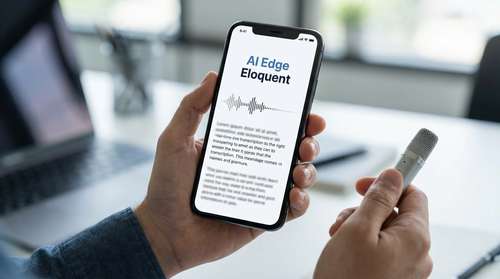
It is no secret that voice dictation has traditionally been a frustrating experience, plagued by literal transcriptions of our messy human speech. But a quiet launch on the iOS App Store this week has changed the game entirely. On April 6, 2026, the tech giant released Google AI Edge Eloquent, a groundbreaking, offline-first voice dictation tool designed to transform raw, stumbling speech into pristine text. Unlike the clunky tools of the past, this application bridges the gap between how we actually talk and the professional prose we want to present, marking a significant milestone for AI speech-to-text apps 2026.
The Dawn of Seamless Dictation: How It Works
When you open the app, you are greeted by a sleek interface featuring a live waveform. As you speak, the application performs real-time audio transcription directly on your screen. The real magic happens the moment you hit the pause or stop button. Instead of leaving you with a block of text littered with filler words, stutters, and mid-sentence corrections, the software automatically strips away the noise. What remains is a clean, coherent draft instantly copied to your clipboard.
Tailored for Your Unique Voice
For professionals with highly specific vocabularies, generic transcription often falls short. The app solves this by letting users build a personal dictionary. You can manually input industry jargon or link your Google Account to safely import frequently used terms from your Gmail history. This ensures that names and specialized terminology are spelled perfectly every time you use this polished dictation software.
Uncompromising Privacy with On-Device AI Processing
One of the most compelling aspects of this release is its commitment to data security. Historically, highly accurate voice-to-text tools required an internet connection to beam your audio to a remote server for processing. This posed significant risks for confidential meetings or sensitive journalistic interviews.
By leveraging lightweight Gemma models, the app executes heavy computational tasks locally on your iPhone. This means you get the power of on-device AI processing without your audio ever leaving your smartphone.
- Fully Offline Mode: Ensure absolute privacy with zero cloud connectivity required.
- Optional Cloud Integration: Toggle on Gemini models for heavier text cleanup and advanced rewrites if desired.
- Hardware Optimization: The software works flawlessly on older devices running iOS 16 or later, not just the latest flagships.
Premium Features Without the Subscription Trap
If you have researched transcription tools recently, you know that high-quality automated audio editing usually comes with a steep price tag. Popular alternatives in the mobile market often charge anywhere from $85 to $180 annually for similar functionality. In a refreshing departure from industry norms, this latest entry into the market of Google iPhone AI apps is completely free. There are no monthly subscriptions, no hidden paywalls, and absolutely no usage caps.
Going Beyond Basic Transcription
The software does more than simply act as a glorified typewriter. Below your cleaned-up transcript, you will find a suite of transformation tools. With a single tap, you can reshape your spoken words into different formats:
- Key Points: Instantly turn a rambling brainstorm into concise bulleted notes.
- Formal: Elevate your casual voice memo into an executive-ready email.
- Short & Long: Expand brief thoughts into full paragraphs or condense lengthy speeches into quick summaries.
Furthermore, a built-in history tab tracks your productivity, displaying session statistics like your words-per-minute speed and overall word counts.
Expanding the Ecosystem: What Is Next for AI Transcription?
It might seem puzzling that a major developer released such a powerful AI tool for Apple's ecosystem before bringing it to their own Pixel hardware. However, this strategy highlights a broader push to make local AI universally accessible, proving that open-weight models can run efficiently on competitor hardware.
While the app is currently only available for iPhone users—and explicitly excluded from the UK, Switzerland, and the European Economic Area while awaiting regulatory approval—evidence buried in the App Store listing strongly hints at an impending Android rollout. The description teases upcoming features like seamless system-wide integration, where users will be able to set the tool as their default keyboard across all text fields. It also mentions a persistent floating button, which would give Android users instant access to transcription no matter what application they are actively using.
As the market for AI speech-to-text apps 2026 heats up, competitors will be forced to adapt to this new baseline. Offering a premium, privacy-centric experience for free fundamentally alters the landscape of mobile productivity, making seamless communication more accessible than ever before.