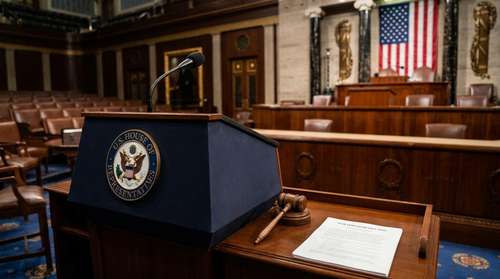
In a historic and narrowly won legislative battle, the U.S. House of Representatives delivered a profound rebuke to the White House on Wednesday. In a razor-thin 215-208 decision, the House passes war powers resolution designed to force an end to the ongoing military confrontation in Iran. Four Republicans defected from party lines, joining a unified Democratic caucus to challenge the executive branch's handling of a conflict that has now stretched well past the 90-day mark.
The decisive vote underscores mounting legislative resistance to unilateral military strategies. Lawmakers on both sides of the aisle are expressing deep frustration over the economic and human costs of the operation, signaling that Congress is finally ready to reclaim its constitutional oversight over foreign engagements.
Invoking the 1973 Law: Trump Iran War Powers in the Crosshairs
At the center of Wednesday's clash is the War Powers Act of 1973, a Vietnam-era statute requiring the president to secure explicit authorization from Congress or end fighting within 60 days of initiating hostilities. That critical deadline quietly expired on May 1, prompting escalating demands for a debate on the House floor. By passing the resolution, Congress limits Trump military authority, asserting that the administration cannot bypass the legislative branch indefinitely.
Representative Jared Golden (D-ME), who had previously opposed similar measures while the administration met initial reporting obligations, shifted his stance this week. "The War Powers Act is not a recommendation. It is the law," Golden stated following the vote, emphasizing that the executive branch must make its case directly to the American public if the fighting is to continue.
The defection of four conservative lawmakers—Representatives Thomas Massie of Kentucky, Brian Fitzpatrick of Pennsylvania, Warren Davidson of Ohio, and Tom Barrett of Michigan—was the linchpin of the bipartisan war powers vote. Their willingness to cross the aisle highlights a growing conservative faction deeply skeptical of open-ended foreign interventions.
The Toll of the US Iran Military Conflict 2026
Political unease on Capitol Hill mirrors a broader national fatigue. The US Iran military conflict 2026 has triggered significant global instability, driving domestic gas prices to nearly $5 a gallon nationwide and severely straining household budgets. More devastatingly, the fighting has claimed the lives of 13 American service members, a grim milestone that hung heavily over the chamber during the proceedings.
Representative Gregory Meeks (D-NY), the top Democrat on the House Foreign Affairs Committee who led the resolution effort, captured the prevailing mood among the opposition. "Enough is enough," Meeks declared, arguing that the operation is an "illegal and costly war" that has failed to achieve its stated objectives. For many lawmakers, the sheer length of the campaign without a clear exit strategy necessitated an emergency intervention to prevent further escalation.
Pushback from Leadership and Diplomatic Stakes
The effort faced fierce opposition from GOP leadership. House Speaker Mike Johnson had abruptly shut down floor action two weeks ago when a similar measure appeared dangerously close to passing. Following Wednesday's successful vote, Johnson warned that stripping the commander-in-chief of military leverage is a "dangerous" move that severely weakens Washington's position at the negotiating table. Secretary of State Marco Rubio also attempted to calm lawmakers earlier in the week by suggesting that hostilities against Tehran were effectively over, though skeptical representatives pushed forward anyway.
Further complicating President Trump foreign policy are the fragile Middle East ceasefire negotiations. Administration officials maintain that the threat of force is necessary to secure a favorable diplomatic outcome. Recent reports indicate that peace talks are already highly complex, with regional allies—including Israel—expressing divergent views on the best path toward stability.
What Happens Next: The Senate Challenge
While the House victory is a massive symbolic and political win for anti-war advocates, the legislative reality remains daunting. The measure now heads to the Senate, which advanced its own procedural war powers resolution last month with a handful of Republican defectors. However, securing a final vote in the upper chamber will be an uphill battle.
Even if the Senate successfully passes the resolution, it faces an inevitable veto from the Oval Office. Overriding a presidential veto requires a two-thirds supermajority in both chambers—a mathematical threshold the current opposition simply does not possess.
Nevertheless, Wednesday's historic vote serves as a powerful barometer of shifting political winds. In a secondary display of defiance later the same day, the House also bucked leadership to advance a bill providing $8 billion in loans and $300 million in long-term security aid to Ukraine. Together, these moves indicate that Congress is increasingly willing to challenge the executive branch and demand a more rigorous, transparent approach to America's global military footprint.