Newly minted Federal Reserve Chairman Kevin Warsh has officially thrown the old central banking playbook out the window. During his highly anticipated initial appearance on Capitol Hill this week, the central bank chief formally laid out his strategy to conquer sticky price increases. The latest Kevin Warsh Fed testimony delivered a profound jolt to financial markets, marked by a staunchly hawkish tone and an immediate pivot away from the transparent communication strategy investors have relied on for over a decade.
Declaring a Monetary Policy Regime Change
Speaking before the House Financial Services Committee on Tuesday, July 14, 2026, Warsh wasted no time diagnosing the economic strain felt by American households. He characterized the last five years of above-target price growth as an unacceptable failure.
"Sixty-three months of inflation above target have been an unfair burden," Warsh testified to lawmakers. "It has acted as a tax on the American people and businesses. We plan to eliminate that tax".
Achieving this, according to Fed Chair Kevin Warsh, requires a complete departure from the frameworks championed by his immediate predecessors. He explicitly called for a "monetary policy regime change" and a total reevaluation of past central bank practices. The aggressive messaging underscores his fundamental belief that persistent inflation is a conscious policy choice, noting that current policymakers must actively choose lower prices. To facilitate this pivot, Warsh has already launched five internal task forces aimed at studying potential overhauls to the institution's daily operations.
The Sudden Death of Fed Forward Guidance
Perhaps the most jarring shift for Wall Street is the explicit abandonment of the communication tool known as Fed forward guidance. First popularized during the 2008 financial crisis, this strategy involved openly telegraphing future interest rate moves to soothe volatile markets.
Under the new administration, that era of central bank hand-holding is definitively over. Warsh bluntly refused to offer legislators any concrete hints regarding the committee's upcoming rate decisions. By refusing to condition the Federal Reserve to a pre-determined path, he intends to restore absolute flexibility to the Federal Open Market Committee (FOMC). Instead of coddling market expectations, the new framework demands that traders react to macroeconomic data in real-time.
A Bumpy Transition Behind the Scenes
While the chairman projects unity, this transition hasn't been entirely seamless. Minutes from the latest FOMC meeting revealed a vigorous internal debate—what Warsh described as a "good family fight"—over policy direction and statement length. Some regional Fed officials continue to defend forward guidance as a valuable stabilizing tool, suggesting Warsh may face internal resistance as he overhauls the bank's communication strategy.
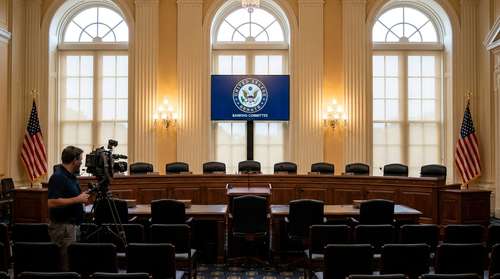
Combative Kevin Warsh Senate Banking Committee Hearing
The tough talk continued during Wednesday's session, where the chairman faced a noticeably chillier reception from the upper chamber. During the highly publicized Kevin Warsh Senate Banking Committee hearing, lawmakers pressed the new Fed chief on a myriad of sensitive issues, ranging from the inflationary impacts of artificial intelligence to his personal contacts with the White House.
Ranking Member Senator Elizabeth Warren delivered a blistering opening statement challenging the chairman's political independence. Warren pointed to his historically tight confirmation margin, asserting he has a steep uphill battle to demonstrate he serves everyday families over political allies or billionaires. Warsh deftly sidestepped these partisan provocations. Instead, he repeatedly steered the conversation back to his primary objective, stating unequivocally that central bank decisions will strictly follow the law and the macroeconomic data.
How June Inflation Data 2026 Alters Federal Reserve Interest Rates
Despite the combative, hawkish rhetoric deployed across both days of congressional testimony, financial markets remain highly skeptical of an immediate rate hike. This stark disconnect stems directly from the newly released June inflation data 2026, which revealed a surprisingly rapid cooling of both consumer and producer prices.
Government data published on Tuesday morning revealed that overall consumer prices actually declined by 0.1% month-over-month—the first monthly contraction witnessed in over six years. Furthermore, the annual CPI rate moderated to 3.5%, a sharp deceleration from May's alarming 4.2% print. Producer prices mirrored this trend, tumbling at a pace not seen since the immediate aftermath of the pandemic.
This confluence of softer data has fundamentally altered the near-term trajectory for Federal Reserve interest rates. While Warsh maintains a tough posture, the tangible cooling of domestic prices has essentially boxed the FOMC out of pulling the trigger, making a rate increase at the upcoming July 28-29 meeting highly improbable.
The Geopolitical Wildcard
However, the inflation battle is far from settled. Escalating US-Iranian military hostilities in the Persian Gulf have already rattled global commodities. With Brent crude oil hovering near $85 a barrel amidst active shipping disruptions in the Strait of Hormuz, energy costs threaten to serve as a massive inflationary headwind in the second half of the year.
Market participants are now forced to operate within a narrow, volatile corridor. They face a radically different central bank chief actively dismantling the familiar guardrails of forward guidance, just as a nascent global energy shock collides with otherwise cooling domestic inflation. If Warsh's inaugural testimony proved anything, it is that Wall Street will have to navigate this precarious new landscape entirely on its own.