
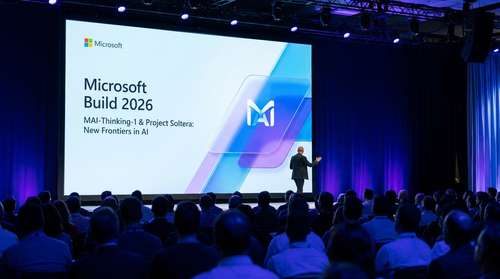
The artificial intelligence landscape experienced a seismic shift this week. During the highly anticipated Microsoft Build 2026 announcements, the tech giant officially declared its intent to control the full software stack. Headlining the event was the launch of the MAI-Thinking-1 reasoning model, a 35-billion-parameter flagship system built completely from scratch. This strategic rollout signals a definitive push toward Microsoft AI independence from OpenAI, its longtime strategic partner.
For years, Microsoft relied heavily on external laboratories to power its Copilot ecosystem and cloud APIs. Now, the company is pivoting to capture both the infrastructure and the intelligence layers, offering enterprise developers unprecedented control over their applications and drastically lowering API token expenses.
The Dawn of Homegrown Microsoft AI Models
Leading the new initiative is Mustafa Suleyman, head of Microsoft AI, who introduced a diverse family of seven new homegrown Microsoft AI models. The lineup covers every core generative modality. Developers can now utilize MAI-Image-2.5 for text-to-image and image-to-image workloads, MAI-Voice-2 for multilingual voice cloning, and MAI-Transcribe-2 with advanced speaker diarization. However, the indisputable centerpiece is the MAI-Thinking-1 reasoning model.
Unlike previous internal experiments, this model was trained with zero distillation from third-party systems. It utilizes exclusively clean, enterprise-grade, and commercially licensed data. This meticulous data lineage addresses a major pain point for corporate clients who remain wary of copyright infringement risks associated with standard open-weight models.
Suleyman emphasized that the goal is to build a "hill-climbing machine" for the next phase of superintelligence. By creating a commercial-grade system that sits comfortably between rigid proprietary APIs and maintenance-heavy open-source alternatives, Microsoft and platform partners like Baseten are offering AI teams a way to own their intelligence without compromising on capability.
MAI-Thinking-1 vs Claude Sonnet 4.6
In the highly competitive mid-weight AI tier, the MAI-Thinking-1 vs Claude Sonnet 4.6 matchup is drawing significant attention from developers. Anthropic's Claude Sonnet has dominated the enterprise sector due to its balance of speed and analytical depth. Microsoft's new contender enters the arena specifically engineered to disrupt this dominance.
Operating with a 128K context window, MAI-Thinking-1 excels at complex, multi-step logic and chat applications. Early developer benchmarks indicate that it matches the performance of heavyweights like Deepseek V3.2 while offering deep native integration with the Microsoft Foundry ecosystem. Furthermore, a specialized MAI-Code-1-Flash variant caters directly to the growing "vibe coding" trend, where developers generate functional source code via intuitive natural language prompts.
Project Soltera: Pioneering the Multi-Agent Ecosystem
While the new foundation models captured the headlines, the most unexpected convergence of hardware and software came via the Project Soltera Android agent platform. Microsoft describes this ambitious initiative as a complete chip-to-cloud operating system designed expressly for an open, multi-agent world.
Project Soltera functions as a secure, underlying layer for autonomous AI agents to operate across mobile, desktop, and wearable form factors. Instead of treating AI as a simple chatbot application, this platform embeds autonomous capabilities directly into the hardware level. To showcase this potential, Microsoft demonstrated prototype enterprise devices, including smart-display hubs and biometric employee badges, all powered natively by Soltera.
Working in tandem with this new platform is Microsoft Scout, an always-on background agent integrated into Microsoft 365. Built using the open-source OpenClaw framework, Scout can independently orchestrate daily workflows, draft corporate communications, and preemptively schedule meetings without requiring manual user prompts.
Hardware Synergy and the Path Forward
To support this massive on-device compute demand, Microsoft highlighted its ongoing collaboration with Nvidia, specifically showcasing the RTX Spark system-on-chip inside the newly announced 15-inch Surface Laptop Ultra. This hardware integration ensures that systems utilizing the Project Soltera Android agent platform can run complex reasoning tasks locally, significantly reducing latency and protecting sensitive corporate data.
The market reaction to these Microsoft Build 2026 announcements has been complex. While developers are eager to leverage the flexibility of the MAI-Thinking-1 reasoning model, financial analysts have noted the massive capital expenditures required to scale this independent proprietary infrastructure. Options traders even signaled anxiety over the short-term financial headwinds.
Nonetheless, the strategy is abundantly clear. By delivering a comprehensive suite of homegrown Microsoft AI models and a dedicated agentic operating system, the company is ensuring it will not merely participate in the next decade of artificial intelligence. It intends to own the foundational blueprint entirely.