
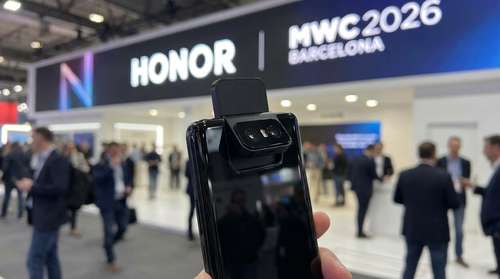
BARCELONA — The gasp was audible inside the Fira Gran Via. On a stage typically reserved for incremental updates—brighter screens, faster chips, slightly better cameras—Honor CEO James Li placed a sleek, metallic device on a podium and stepped away. For a moment, nothing happened. Then, the device moved. It didn't vibrate or ring; it physically lifted its upper segment, rotated a camera lens toward the audience, and nodded.
This was the world’s introduction to the Honor Robot Phone, a device that has arguably stolen the show at Barcelona Mobile World Congress 2026. By integrating a motorized gimbal camera array directly into the chassis, Honor hasn't just released a new smartphone; they have fired the opening shot of a "Hardware Rebellion." After a decade of next-gen smartphone design stagnating into identical static glass slabs, the era of mobile robotics has officially arrived.
The End of the Static Smartphone Era
For years, the industry has chased the dream of the "all-screen" device, removing buttons and moving parts in favor of durability. Honor is reversing that trend entirely. The Honor Robot Phone challenges the very definition of a mobile device by introducing Agentic AI hardware that possesses physical agency.
"We are done with the era of passive tools," Li announced to a stunned crowd. "True intelligence requires a body. To understand the human world, AI must be able to move within it."
The centerpiece of this innovation is a proprietary, industry-first micro-motor system—smaller than a one-euro coin—that powers a 3-axis gimbal camera. Unlike the pop-up cameras of the past, which were rigid and fragile, this mechanism is fluid and expressive. It allows the camera module to extend, rotate 360 degrees, and track subjects autonomously without the phone itself needing to move. It creates a device that feels less like a gadget and more like a companion, capable of "looking" at you during a conversation.
Engineering the Impossible: The Motorized Gimbal Smartphone
Fitting a mechanical gimbal into a pocketable device required what Honor engineers describe as a "physics-defying" breakthrough. The motorized gimbal smartphone features a 200-megapixel main sensor mounted on a 4DoF (Four Degrees of Freedom) arm. When retracted, the device is indistinguishable from a standard flagship. When active, it transforms.
Cinematic Capabilities in Your Pocket
The practical implications for content creators are immense. During the live demo, the phone was placed on a table and instructed to "film me." As the subject walked around the stage, the camera head smoothly panned and tilted to keep them in frame, mimicking the movements of a professional cameraman. Honor claims this eliminates the need for external gimbals like the DJI Osmo, integrating that stability directly into the handset.
Furthermore, the device introduces "AI SpinShot," a feature that utilizes the motor to perform rapid 90-degree and 180-degree whips for cinematic transitions that would be impossible with a human hand alone. This is MWC 2026 technology at its peak—solving real-world problems with audacious engineering.
Embodied AI: Giving Intelligence a Body
While the hardware is flashy, the software philosophy driving it is profound. Honor calls it "Augmented Human Intelligence" (AHI). The concept is that Agentic AI hardware shouldn't just process data; it should embody intent.
Because the phone can move, it can communicate non-verbally. In a video call demonstration, when the remote user nodded, the Robot Phone on the desk physically nodded back. When music played, the device swayed rhythmically, "dancing" on the table. It sounds whimsical, but it fundamentally changes the emotional connection between user and machine. It bridges the uncanny valley between a lifeless screen and a responsive robot.
This aligns with the broader trend of "Embodied AI" seen throughout Barcelona Mobile World Congress 2026, where the line between smart devices and robotics is blurring. Honor just happened to be the first to put it in your pocket.
Market Availability and The Competitor Response
Skeptics might dismiss this as a concept car meant only for headlines, but Honor has committed to a commercial timeline. The company confirmed the Honor Robot Phone will go on sale in China in the second half of 2026, with global markets likely to follow.
This aggressive timeline puts pressure on competitors like Samsung and Apple, whose 2026 offerings remain focused on software-based AI and refinement of the foldable form factor. While Honor also unveiled the razor-thin Magic V6 foldable—boasting a 6,660mAh silicon-carbon battery—it was the Robot Phone that dominated the conversation.
As the curtains close on the first day of MWC, one thing is clear: the "glass slab" is no longer the final form of the smartphone. The Honor Robot Phone has proven that consumers are hungry for hardware that is as dynamic and alive as the software running inside it. The Hardware Rebellion has begun, and it just nodded hello.