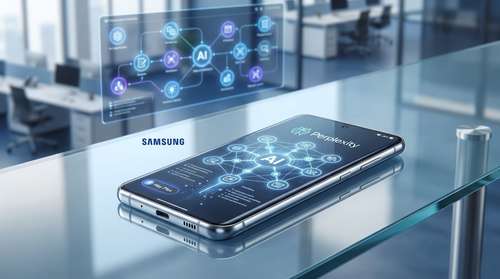
Samsung Electronics has officially redefined the smartphone landscape with the launch of its Galaxy AI multi-agent ecosystem, a groundbreaking shift that integrates Perplexity AI directly into the operating system of the upcoming Galaxy S26 series. Announced just days before Galaxy Unpacked 2026, this strategic move transitions mobile artificial intelligence from passive chatbots to proactive Agentic AI capable of executing complex, system-wide workflows.
The Dawn of the Multi-Agent AI Ecosystem
For years, smartphone users have been locked into a single default assistant—whether it's Siri, Google Assistant, or Bixby. Samsung is shattering this "walled garden" model by positioning Galaxy AI as an open orchestrator. The new framework allows multiple AI agents to coexist and collaborate at the system level, giving users the unprecedented freedom to choose the best tool for the job without friction.
According to Won-Joon Choi, Samsung’s President of Mobile eXperience, this shift is driven by user behavior. Internal research revealed that nearly 80% of users now rely on multiple AI agents for different daily tasks—using one for creative writing, another for research, and a third for scheduling. Samsung’s new architecture bridges these islands of intelligence, allowing them to share context and execute multi-step actions seamlessly.
Deep Integration: Perplexity AI at the System Level
The headline feature of this new ecosystem is the deep integration of Perplexity AI, a leading conversational answer engine. Unlike a standard app installation, Perplexity is woven into the fabric of the One UI 8.5 interface. Users can summon the agent instantly with the new wake phrase "Hey Plex" or by long-pressing the side button, bypassing the need to unlock the phone and navigate to an app.
This system-level access enables Perplexity to "see" and interact with other native applications. It allows for a fluid exchange of data between the AI agent and core Samsung apps like Notes, Calendar, Gallery, and Reminder. This level of integration is a critical differentiator from competitors like Apple, whose third-party integrations often remain siloed within specific query types.
Real-World 'Agentic AI' Workflows
The true power of Samsung mobile automation lies in its ability to handle "Agentic" tasks—workflows where the AI takes action rather than just providing text. During the announcement, Samsung showcased several powerful scenarios that will be possible on the Galaxy S26:
- The Client Follow-up: A user can say, "Plan a follow-up for my client meeting," and the system will automatically pull key highlights from a specific Samsung Note, create a task in Reminders, suggest available slots in the Calendar, and even attach a relevant chart from the Gallery to a draft email.
- Travel Automation: A command like "Wake me for my 7 a.m. flight and summarize the itinerary" doesn't just answer a question. It sets an intelligent alarm in the Clock app based on traffic conditions and generates a concise travel brief using flight data found in your emails.
Why 2026 is the Year of Agentic AI
The term Agentic AI 2026 represents a major pivot in the tech industry. While 2024 and 2025 were about generative AI (creating text and images), 2026 is about action-oriented AI. Samsung's approach addresses the "app grid" fatigue, where users are tired of manually stitching together information from different apps.
By acting as an orchestrator, Galaxy AI removes the friction of copy-pasting and app switching. This specifically targets the productivity-focused demographic that has historically gravitated towards the Galaxy Ultra line. With Galaxy AI system integration, the phone becomes less of a screen and more of a proactive assistant that understands the context of what you are doing in real-time.
Samsung vs. Apple and Google: The AI Standoff
This announcement positions Samsung uniquely in the competitive market. While Google Gemini dominates the Android ecosystem with a "one-size-fits-all" approach, and Apple Intelligence focuses on privacy-centric, on-device processing with limited third-party handoffs, Samsung is betting on choice and flexibility.
Analysts view this as a direct challenge to the monopoly of default assistants. By allowing Perplexity AI Samsung integration to live alongside Bixby and Gemini, Samsung is acknowledging that no single AI model can be perfect for every task. This "open garden" strategy could be the decisive factor for power users debating between the iPhone 17 and the Galaxy S26.
The Future of AI Smartphones
As we approach the official Galaxy Unpacked event on February 25, 2026, the implications of this launch extend beyond just one phone. Samsung has set a goal to expand Galaxy AI to over 800 million devices by the end of the year. If successful, this multi-agent AI ecosystem could force the entire industry to adopt a more open, interoperable standard for mobile AI, finally delivering on the promise of a truly smart assistant.