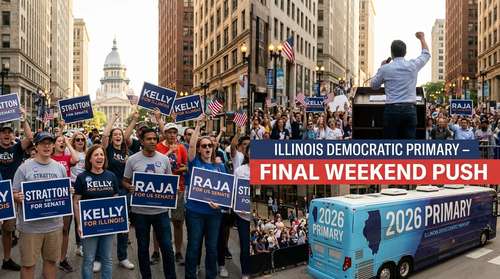
As the deeply contested 2026 Illinois Senate Primary enters its high-stakes final weekend, campaigns are blanketing the state with a massive last-minute push. Following the historic decision by Senator Dick Durbin to retire at the end of his current term, the March 17 vote marks the first time in nearly three decades that Illinois Democrats are staring down a fiercely competitive open primary. The three-way battle—featuring Lt. Gov. Juliana Stratton, Rep. Robin Kelly, and Rep. Raja Krishnamoorthi—has rapidly evolved into a national flashpoint.
The stakes for representation are intensely historic. If either Stratton or Kelly captures the party's nomination and eventually wins the general election in deep-blue Illinois, they would become only the sixth Black woman ever to serve in the U.S. Senate. With the 2026 Midterm Elections looming and national attention locked on the state, political analysts recognize this race as a defining moment for the future ideological direction of the Democratic Party.
The Battle to Succeed a Democratic Giant
Since the bombshell Dick Durbin retirement announcement in April 2025, political operatives have watched this primary shift from a crowded field into a tense three-way sprint. Durbin, who has held his seat since 1997 and serves as the influential Senate Democratic Whip, leaves behind massive shoes to fill. His legacy includes steering vital federal funding to Illinois and launching the national political career of figures like Barack Obama, who credited Durbin's early support as instrumental to his own presidency. Over the last ten months, candidates have crisscrossed the state attempting to prove they possess the legislative chops necessary to replace a titan of state politics.
The Raja Krishnamoorthi Senate campaign has aggressively capitalized on a towering financial advantage. Krishnamoorthi entered the race with a campaign war chest surpassing $19 million. Leaning heavily into his personal narrative, he frequently shares his journey of being born in India and relying on public housing and food stamps during his early years in New York. Krishnamoorthi is framing himself as a pragmatist running to protect the American Dream from Donald Trump's influence. He is advocating for federal funding protections, expanded Social Security, and robust election security measures. However, his massive financial backing has drawn sharp criticism; progressive rivals have attacked him for accepting corporate PAC money, painting him as out of touch with working-class struggles.
Stratton and Kelly: A Historic Clash of Progressivism
The progressive lane is largely dominated by two exceptionally qualified Black women who offer voters distinctly contrasting visions of leadership. The Juliana Stratton Senate campaign has boldly positioned the Lieutenant Governor as the race’s most unapologetic progressive force. Stratton has galvanized young voters and activists by strictly rejecting corporate PAC donations and proposing the outright abolition of Immigration and Customs Enforcement (ICE) following recent controversial raids.
Stratton's platform also includes pushing for a staggering $25-an-hour statewide minimum wage. She points to her success under Governor J.B. Pritzker—including making election day a state holiday and expanding vote-by-mail—as proof of her ability to deliver structural change. Drawing on her personal experience caring for her mother who suffered from Alzheimer's, Stratton has promised voters she will aggressively protect senior health care. Pritzker has heavily boosted her campaign, though this establishment backing has drawn unexpected ire from national political groups.
Conversely, the focus for Robin Kelly Illinois voters is her extensive, hard-fought federal experience. As the daughter of a postal worker, Kelly has spent 13 years serving the state's 2nd Congressional District. She argues her established Washington relationships make her uniquely qualified to effectively navigate the Senate. Kelly’s campaign expertly blends progressive values with pragmatic execution. She is pushing for comprehensive ICE reform rather than total abolition, advocating for a federal $17 minimum wage, and taking bold, definitive stances on international issues, notably labeling the war in Gaza a "genocide".
Coalitions and Closing Arguments
Kelly has systematically built a powerful coalition that extends far beyond her South Side Chicago base. The Congressional Black Caucus has notably rallied behind her, emphasizing her unmatched legislative resume and directly criticizing Pritzker's interference in the primary. Furthermore, Kelly has secured pivotal endorsements from major LGBTQ+ advocates and organizations, bolstered by her history of saving vital community resources like Mercy Hospital.
In the final 48 hours, the airwaves have become saturated. Millions of dollars have poured into digital campaigns and mailbox flyers, largely defined by late-stage financial attacks. Stratton continues to hammer Krishnamoorthi over special interest funding, asserting that her grassroots focus is exactly what everyday working families desperately need. Kelly has consistently rejected media suggestions to step aside, reminding voters of her legislative success and 80% win rate backing Democratic state attorneys general against conservative policies.
What to Watch in the Illinois Democratic Primary 2026
As election day nears, voter turnout will be the ultimate decider in this remarkably tight contest. Polling has shown a razor-thin margin, with Krishnamoorthi and Stratton frequently swapping the lead, while Kelly remains a fiercely competitive contender capable of pulling off a surprise victory through targeted rural outreach and deep community loyalty.
For voters making their final decisions this weekend, the choice on March 17 extends well beyond basic party loyalty. The Illinois Democratic Primary 2026 offers three entirely distinct paths forward: Krishnamoorthi’s well-funded moderate pragmatism, Stratton’s unabashed progressive populism, or Kelly’s experienced institutional progressivism. Come Tuesday night, the election results will not only crown a successor to a historic legend but could fundamentally rewrite the demographic and ideological makeup of the United States Senate.