
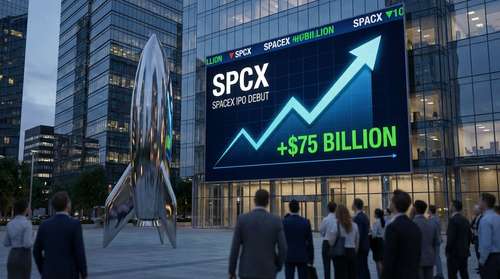
The aerospace and artificial intelligence landscape has been permanently altered following the highly anticipated SpaceX IPO. In a blockbuster Wall Street event, Space Exploration Technologies Corp. completed the largest IPO in history, with shares of SPCX stock surging over 19% on their first day of public trading to close at $160.95. The monumental SpaceX Nasdaq debut pushed the company's market capitalization past $2.1 trillion, setting a new benchmark for global financial markets. Beyond the corporate victory, the record-shattering valuation officially propelled founder Elon Musk's net worth past the thirteen-digit threshold, making Elon Musk a trillionaire.
The Largest IPO in History Shatters Wall Street Records
Wall Street had been bracing for SpaceX's arrival for months, but the sheer scale of the offering stunned even veteran analysts. Bypassing the traditional IPO book-building process, the company offered a fixed, take-it-or-leave-it price of $135 per share. This unconventional strategy successfully raised an unprecedented $75 billion, completely eclipsing the previous record holder, Saudi Aramco, which raised $25.6 billion during its 2019 debut.
The atmosphere on the trading floor was electric. As Elton John's Rocket Man played across the Nasdaq exchange in New York City, SpaceX executives rang the opening bell to officially commence trading. Demand was voracious from the start. Opening at $150 per share, SPCX stock rapidly climbed, peaking at an intraday high of $176 before stabilizing. Financial institutions and retail investors alike clamored for a piece of the space giant, with reports indicating that individual investors had placed over $100 billion in orders prior to the launch.
Elon Musk Crowned World's First Trillionaire
The explosive growth of SpaceX's valuation didn't just break market records—it completely rewrote the global wealth leaderboard. With Musk retaining a 42% equity stake and a commanding 82% of voting control through Class B shares, the stock's first-day pop fundamentally altered his financial standing.
When the closing bell rang, Musk's combined wealth—stemming from his massive holdings in both Tesla and SpaceX, alongside private ventures like Neuralink and The Boring Company—reached an estimated $1.14 trillion. This historic milestone officially establishes him as the world's first trillionaire, transforming his personal fortune into a figure that rivals the gross domestic product of several developed nations.
Fueling the Surge: Starlink Valuation 2026 and the xAI Grok Merger
While massive Starship rockets capture the public's imagination, the underlying financials of the SpaceX offering are heavily supported by two rapidly maturing pillars: satellite broadband and artificial intelligence.
The Starlink valuation 2026 metrics provided a robust foundation for the public offering. The satellite internet constellation has evolved into a formidable revenue engine, surpassing 10 million active global subscribers earlier this year. Current market projections indicate Starlink will generate upwards of $20 billion in revenue in 2026 alone. This recurring revenue stream provides the crucial cash flow needed to justify the company's astronomical market capitalization.
Building the Ultimate Space-Based AI Infrastructure
Adding significant fuel to investor enthusiasm was the strategic xAI Grok merger finalized in February 2026. By absorbing his own AI startup in a deal that valued xAI at $125 billion, Musk integrated the Grok large language model directly into the SpaceX ecosystem.
This merger is widely viewed as a bold technological leap designed to create an unparalleled space-based AI infrastructure. The ambitious corporate strategy involves deploying orbital data centers, utilizing Starlink's massive global constellation to provide low-latency, off-planet computational power. By combining advanced AI processing with satellite network dominance, SpaceX is positioning itself not just as a transport company, but as the backbone of next-generation global communications.
What's Next for SPCX Stock?
As the dust settles on this historic trading debut, market participants are fiercely debating where the aerospace behemoth goes from here. Bullish investors argue that the synergistic combination of Starlink's telecom dominance, the reusable Starship program, and advanced AI capabilities makes the $2.1 trillion valuation entirely justified. They point to Friday morning's successful launch of 29 Starlink satellites from Cape Canaveral—which happened just hours before trading began—as proof of the company's relentless operational tempo.
Conversely, cautious analysts warn that a price-to-sales ratio hovering near 60 leaves little margin for execution errors. They note that scaling orbital AI data centers and achieving rapid, multi-launch reusability for Starship are complex engineering hurdles that may take until 2028 or beyond to fully realize.
Regardless of short-term price fluctuations, SpaceX's public market debut has permanently altered the financial landscape. Wall Street's attention is now firmly fixed on the stars, watching closely to see if this newly public titan can deliver on its promise to make humanity multi-planetary while revolutionizing global technology infrastructure.