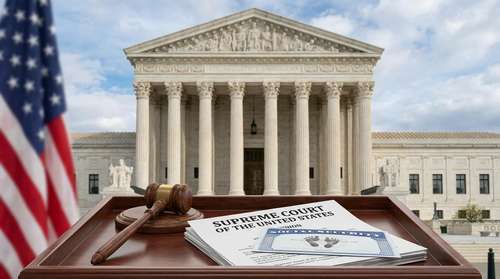
In a historic judicial rebuke that redefines the modern boundaries of executive power, the United States Supreme Court has decisively struck down President Donald Trump's controversial executive order aimed at ending automatic birthright citizenship. The landmark 6-3 Trump v. Barbara decision, handed down on Tuesday, June 30, 2026, reinforces a foundational legal principle that has governed American demographic life for over a century and a half. The ruling effectively guarantees that children born on American soil, regardless of their parents' immigration status, will continue to receive automatic citizenship.
The highly anticipated Supreme Court birthright citizenship case challenged Executive Order No. 14,160, officially titled 'Protecting the Meaning and Value of American Citizenship'. Signed by President Trump shortly after his January 2025 inauguration, the sweeping measure directed federal agencies to deny passports and citizenship documents to children born to undocumented immigrants or temporary visa holders. For millions of immigrant families, this week's ruling brings an end to immense legal and personal uncertainty.
The Chief Justice John Roberts Opinion
The legal battle centered entirely on the interpretation of the 14th Amendment Citizenship Clause, which states that 'All persons born or naturalized in the United States, and subject to the jurisdiction thereof, are citizens of the United States'. The Trump administration argued that children of parents unlawfully in the country—or those on temporary visas—were not 'subject to the jurisdiction' of the United States, suggesting that true allegiance required a legal domicile.
A divided court soundly rejected this revisionist premise. The Chief Justice John Roberts opinion—joined by Justices Sonia Sotomayor, Elena Kagan, Amy Coney Barrett, and Ketanji Brown Jackson—concluded that anyone born on American territory who is subject to its laws is fundamentally a citizen at birth. Roberts drew heavily on historical precedent, tracking the roots of citizenship back to English common law. The majority cited foundational legal texts, including William Blackstone's Commentaries, which established that natural allegiance is owed to the sovereign who protects an individual at birth. Furthermore, the opinion emphasized the explicit post-Civil War rejection of the infamous Dred Scott decision, solidifying the Constitution's expansive view of citizenship.
Justice Brett Kavanaugh filed a separate opinion concurring in the judgment, bringing the total votes against the administration to six. Meanwhile, Justices Clarence Thomas, Samuel Alito, and Neil Gorsuch issued staunch dissenting opinions. The alignment of Barrett and Kavanaugh against the conservative dissents showcased a profound ideological split on how SCOTUS rules on birthright citizenship in the modern era.
The Trump Immigration Executive Order Unravels
The legal saga began when the Trump immigration executive order triggered immediate, widespread challenges in lower courts across the country. Civil rights organizations argued the administration was attempting to bypass Congress and override the Constitution via unilateral executive fiat. After district courts issued universal injunctions blocking the measure in July 2025, the legal battles rapidly escalated through the appellate system.
Ultimately, the Supreme Court granted certiorari before judgment to expedite the resolution, hearing two hours of intense oral arguments on April 1, 2026. During these arguments, the justices aggressively questioned whether a president could single-handedly redefine a constitutional right that places the United States among a select group of global nations guaranteeing territorial citizenship.
Protecting Automatic US Citizenship Rules
Had the executive order survived judicial scrutiny, it would have radically altered automatic US citizenship rules, affecting hundreds of thousands of children born annually in the United States. The American Bar Association celebrated the decision, noting it 'affirms a principle that has been long-established' in U.S. jurisprudence. For countless families, including Indian H-1B visa holders and other temporary foreign residents, the ruling offered immense relief, ensuring their U.S.-born children would not be left stateless or ensnared in bureaucratic limbo.
Conservative Backlash and the Legislative Path Forward
The Trump v. Barbara decision has sparked a political firestorm among the president's conservative base. Prominent MAGA influencers expressed outrage over the ruling, with extreme fringes even demanding dramatic retaliatory measures, such as bans on pregnant women traveling to the U.S. and the sterilization of foreign visitors. The visceral reaction underscores the deep partisan divisions characterizing American politics as the nation approaches its 250th birthday.
President Trump swiftly criticized the ruling, pivoting his strategy to the legislative branch. He has formally called on Congress to address the immigration debate through federal law. Legal analysts note that Justice Kavanaugh's concurring opinion may have provided a subtle roadmap for this exact strategy. Seizing on this legislative opening, Missouri Senator Eric Schmitt immediately announced plans to draft new legislation, stating on social media that Kavanaugh 'MAY have left Congress a door' and that he fully intends to 'walk through it'.
While the immediate threat to birthright citizenship has been neutralized by the Supreme Court, the political and cultural battles surrounding the 14th Amendment remain far from over. As America navigates an increasingly polarized landscape leading into the upcoming election cycles, the fundamental debate over who gets to call themselves an American will undoubtedly remain a cornerstone of the national discourse.