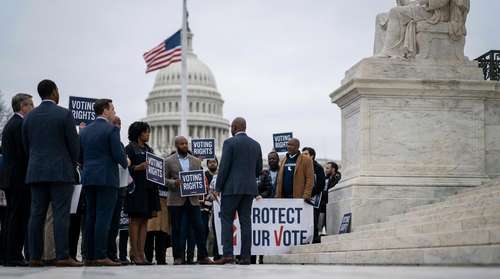
In a sweeping 6-3 decision issued on Wednesday, the U.S. Supreme Court significantly curtailed the protections of the 1965 Voting Rights Act by striking down a second majority-Black congressional district in Louisiana. The landmark SCOTUS decision fundamentally rewrites the rules for electoral mapmaking, delivering a major victory to conservative lawmakers. Legal analysts and civil rights advocates immediately warned that the Louisiana redistricting ruling will trigger a wave of redrawn GOP congressional maps across the South, dramatically altering the battle for House control in the highly anticipated 2026 midterm elections.
The Legal Battle Over Voting Rights Act Section 2
The closely watched case, Louisiana v. Callais, centered on the state's 6th Congressional District. Following a protracted legal fight that included orders from lower federal courts to increase minority representation, Louisiana enacted a map featuring a second majority-Black district to comply with earlier Supreme Court Voting Rights Act precedents. That district, represented by Democrat Cleo Fields, stretches diagonally from Shreveport to Baton Rouge.
Writing for the six-justice conservative majority, Justice Samuel Alito declared the Louisiana map an "unconstitutional racial gerrymander" that violated the 14th and 15th Amendments. Alito asserted that utilizing race in government decision-making, even to satisfy federal minority protections, represents a stark departure from constitutional norms. During oral arguments, Chief Justice John Roberts characterized the challenged district as a "snake" winding more than 200 miles to connect disparate communities across the state.
The majority opinion effectively neutralizes Voting Rights Act Section 2, long considered the crown jewel of civil rights-era legislation. For more than six decades, Section 2 served as the primary legal mechanism to challenge racially discriminatory election practices. By imposing an extraordinarily high bar that effectively limits challenges to instances of intentional discrimination, the Court did a remarkable about-face from a similar case out of Alabama decided less than three years ago.
Dissent Warns of "Far-Reaching" Consequences
The three liberal justices issued a scathing dissent, with Justice Elena Kagan arguing that the majority had demolished a foundational pillar of American democracy. Kagan wrote that the ruling allows state legislatures to systematically dilute the voting power of minority citizens without facing meaningful legal consequences. "The consequences are likely to be far-reaching and grave. Today's decision renders Section 2 all but a dead letter," she noted, echoing concerns from advocacy groups nationwide.
Redrawing GOP Congressional Maps Across the South
The political reverberations of the decision were instantaneous. With control of the U.S. House of Representatives resting on razor-thin margins, the ability to redraw maps free from strict Section 2 constraints provides Republicans with a critical structural advantage. Election law experts estimate that nearly 70 of the 435 congressional districts nationwide were previously protected by the now-weakened civil rights provision.
Republican-led legislatures wasted no time capitalizing on the newly permissive legal landscape. Within an hour of the opinion's release in Washington, lawmakers in the Florida House pushed forward a new redistricting proposal aimed at securing additional safe seats. This aggressive maneuvering underscores how pivotal this single ruling will be for the balance of power in the 2026 midterm elections.
While filing deadlines for some local races have already passed, the broader implications for federal contests are unmistakable. States that previously faced federal lawsuits over alleged vote dilution—including Alabama, Georgia, and Texas—are widely expected to reconsider their electoral boundaries to solidify partisan gains and expand GOP congressional maps.
The Future of Minority Voting Rights
For decades, the Voting Rights Act successfully integrated Black and Latino voters into the political process, profoundly transforming the demographics of Congress. Wednesday's ruling signals a definitive shift away from those historical protections. By prioritizing the Equal Protection Clause's prohibition on racial considerations over the Voting Rights Act's mandate for equitable representation, the Court has drastically narrowed the avenue for challenging discriminatory boundaries.
- Legal Standard Shifted: Plaintiffs must now prove explicit intentional discrimination rather than just discriminatory outcomes—a nearly impossible legal hurdle in modern politics.
- Partisan Shielding: Legislators can defend racially polarized maps by claiming the boundary lines were drawn strictly for partisan benefit. The Supreme Court previously ruled in 2019 that partisan gerrymandering is beyond the scope of federal judicial review.
- Incumbency Protection: State lawmakers are expected to aggressively draw lines that protect powerful incumbents, framing these actions as standard political strategy rather than racial maneuvers.
Civil rights organizations are already pivoting their strategies, acknowledging that federal courts no longer offer a reliable safe harbor for protecting minority voting rights. Voting advocates face a daunting uphill battle as they search for new state-level methods to ensure fair representation in an increasingly polarized nation.
As the dust settles on this historic reversal, the focus shifts entirely to the statehouses. The Louisiana redistricting ruling hasn't just reshaped one state's electoral map; it has effectively fired the starting gun for a nationwide redistricting frenzy that will echo through the halls of Congress for at least a generation.