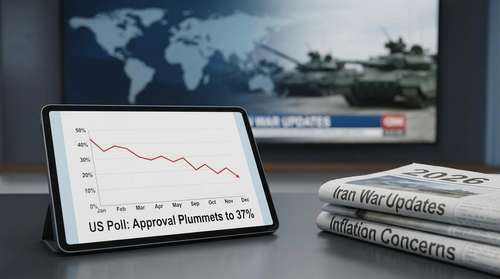
President Donald Trump is confronting the fiercest political headwinds of his second term. The latest Trump approval rating 2026 figures from the New York Times Siena poll show his support has plummeted to a historic low of 37%. This unprecedented dip reflects mounting public discontent over dual crises: the prolonged US-Israel conflict with Iran and the severe economic strain of soaring living costs. As the 2026 midterm elections fast approach, these numbers signal a potential tectonic shift in American politics.
A Historic Low: Unpacking the New York Times Siena Poll
Conducted between May 11 and May 15, the survey of 1,507 registered voters paints a stark picture of the current administration's standing. Beyond the headline 37% approval figure, the widely discussed New York Times Siena poll reveals a staggering 59% disapproval rating.
No president has seen their numbers remain beneath the 38% threshold for more than a few days over the last 17 years. The data indicates that voters are decisively rejecting the administration's handling of core issues, spanning immigration, the economy, and recent military interventions. The sharpest declines in support are emerging from key demographics that were instrumental in securing his 2024 victory. Today, 71% of Hispanic voters and 70% of independents express deep dissatisfaction with his performance in office.
Iran War Updates: Rising Conflict Costs and Shifting Sentiment
The ongoing war, which commenced with joint US-Israel strikes in late February 2026, has become a massive liability for the White House. While initial military actions often yield a temporary surge in domestic support, the prolonged nature of this conflict has severely eroded public confidence.
The latest Iran war updates indicate that nearly two-thirds of American voters now view the decision to enter the conflict as the wrong choice. Notably, the frustration is not confined to the political left or center. A deepening rift is forming within the Republican base itself, with 22% of GOP voters now highly critical of the president's foreign policy approach. Overall, only about 30% of the general public believes attacking Iran was the correct course of action.
The Economic Toll: Gas Prices Inflation Squeeze Voters
Military conflicts rarely happen in an economic vacuum, and the financial blowback from the Middle East has been swift. Global energy markets have reacted violently, driving the nationwide average for fuel to a painful $4.52 per gallon—a steep climb from $3.18 just one year ago.
This surge in energy costs has acted as an accelerant for broader economic instability. Consumer prices hit a three-year high of 3.8% by the end of April, directly tying gas prices inflation to everyday affordability concerns. Unsurprisingly, 49% of respondents now rate the US economy as "poor," representing an 11-point spike since January.
The administration's messaging has seemingly failed to resonate with struggling families. In a recent press briefing, the president drew intense bipartisan criticism when he stated, "I don't think about Americans' financial situation," in response to a question about whether economic hardship might motivate him to pursue a peace deal. This perceived detachment has only fueled the narrative that the current leadership is out of touch with working-class struggles.
2026 Midterm Elections: A Looming Democratic Advantage?
With the 2026 midterm elections just months away, these approval metrics provide a grim forecast for Republican candidates. Presidential approval ratings historically serve as a reliable barometer for the incumbent party's performance in upcoming congressional races. When analyzing the Trump approval rating 2026 data, strategists note a severe vulnerability for the GOP.
The political fallout is already materializing on the generic congressional ballot. Democrats have opened up a commanding double-digit lead, outpacing Republicans 50% to 39%. This 11-point margin is a significant expansion from the narrow 2-to-5-point leads Democrats held earlier in the cycle. If these numbers hold through November, it would likely be more than enough to overwhelm existing GOP redistricting advantages, potentially granting Democrats full control of Congress.
The shifting generic ballot underscores how local races are increasingly being nationalized. Candidates who tethered their political brands to the president are now finding themselves on the defensive, forced to answer for a highly unpopular war and an economy that feels fundamentally broken to the average consumer. Young voters, a critical demographic block, appear particularly galvanized against the current administration, with 76% of voters aged 18-29 disapproving of the president's job performance.
Navigating Trump Foreign Policy and Domestic Unrest
For anyone following US political news, the path forward for the White House appears exceedingly narrow. The administration must find a way to stabilize Trump foreign policy objectives while simultaneously easing the economic burden on American households.
Breaking the current polling floor will require more than just rhetorical shifts; it demands tangible results on the global stage and at the gas pump. Until the administration can broker a conclusive end to the hostilities in the Middle East and rein in runaway inflation, the political landscape will remain heavily tilted against them. Lawmakers on Capitol Hill are reportedly growing anxious, with some moderate Republicans beginning to distance themselves from the Oval Office's defense strategy.
The interplay between international conflict and domestic economic health has never been more apparent. As experts continue to monitor the Trump approval rating 2026 trends, voters are directly connecting their dwindling savings accounts to the administration's geopolitical maneuvers. Whether the White House can engineer a diplomatic breakthrough or an economic recovery before November remains the defining question of this election cycle.