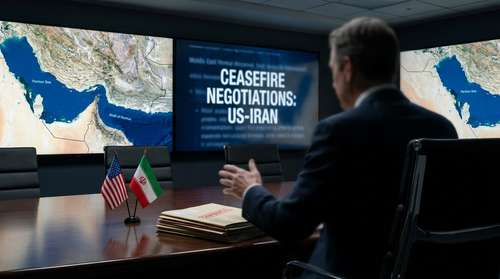
President Donald Trump has returned a drafted 60-day ceasefire agreement to Tehran with revised, highly stringent conditions, putting a temporary hold on what was expected to be a major diplomatic breakthrough. As the international community watches closely, the fate of the US Iran ceasefire 2026 hangs in the balance. Trump's insistence on stricter concessions has sparked deep frustration in Tehran, particularly concerning the destruction of uranium stockpiles and the unfreezing of Iranian assets.
Decoding the Trump Iran Nuclear Terms
The crux of the current diplomatic deadlock centers on sweeping revisions made by the U.S. administration. The latest draft sent to Tehran includes uncompromising Trump Iran nuclear terms, chief among them a demand that Iran's entire stockpile of highly enriched uranium be permanently destroyed. While Iranian negotiators initially anticipated a mutual return to previous agreements, the revised text pushes for an unprecedented dismantling of their nuclear infrastructure.
Further complicating matters is a sharp dispute over financial concessions. Previous drafts of the agreement reportedly included the U.S. accepting the immediate release of $12 billion in frozen Iranian assets. However, Trump recently declared on social media that no money will be exchanged until further notice. This drew swift condemnation from Iranian officials, who called the claims a mixture of truth and lies, insisting that destroying nuclear material was never part of the initial memorandum of understanding.
Will We See the Strait of Hormuz Reopened?
Economic markets remain on edge as the maritime crisis in the Middle East continues to choke global trade routes. A core pillar of the revised agreement demands that Tehran not only reopen the Persian Gulf but also actively de-mine the strategic waterway. While global shipping conglomerates desperately want to see the Strait of Hormuz reopened, Iranian authorities maintain they will only lift restrictions based on their own predetermined arrangements, which include monitoring and inspecting passing ships without yielding to U.S. toll demands.
Currently, the U.S. military is conducting a temporary mission to guide American-flagged merchant vessels and stranded mariners out of the danger zone. Joint Chiefs Chairman Gen. Dan Caine confirmed that a safety corridor involving guided-missile destroyers, over 100 aircraft, and 15,000 service members is operational.
The Pentagon's Stance: Pete Hegseth on the Iran War
As diplomatic channels stall, military leaders are issuing stark reminders of their readiness to act if the truce collapses. Addressing reporters, Defense Secretary Pete Hegseth emphasized that the current pause in the Pete Hegseth Iran war strategy is contingent entirely on Tehran's behavior. While Hegseth insists that the ceasefire is not over, he warned that the U.S. military remains fully prepared to resume strikes should Iran violate the tenuous truce.
The conflict, which escalated sharply under Operation Epic Fury, faces strict deadlines. Hegseth argued that the 60-day clock under the War Powers Act authorizing offensive operations has been paused by the ceasefire, granting the administration leverage in ongoing negotiations. Yet, with recent reports of Iranian aggression against civilian ships falling just below the threshold of major combat operations, the situation remains extraordinarily volatile.
High Stakes in the White House Situation Room
The intelligence community and military brass are tracking every movement in the Gulf directly from the White House Situation Room. Trump retains the ultimate authority to determine if any skirmish constitutes a formal breach of the ceasefire. The administration is operating under extreme pressure, knowing that a miscalculation could instantly reignite regional warfare and prompt devastating strikes on Iranian power plants, bridges, and energy infrastructure.
Navigating the Future of the Trump Iran Peace Deal
For a sustainable resolution to take hold, both sides will need to navigate a minefield of domestic politics and geopolitical strategy. The administration's aggressive negotiation tactics are clearly designed to extract maximum concessions, but they also risk alienating weary regional partners. If the uncompromising demands push Tehran to walk away from the table, the prospect of a lasting Trump Iran peace deal could vanish entirely.
As this 60-day window slowly closes, the international community braces for two distinct possibilities: a historic, ironclad agreement that neuters Iran's nuclear ambitions, or a rapid return to the devastating military exchanges that defined the early months of 2026. For now, the ceasefire holds, but the terms of peace have never looked more daunting.