President Donald Trump has set a definitive Tuesday night deadline for Iran to lift its naval blockade, delivering a high-stakes Trump Iran ultimatum that threatens a massive U.S. military strike to "obliterate" the nation's civilian infrastructure. As the Middle East conflict grinds into its sixth brutal week, a staggering global oil price surge has sent Brent crude past $110 per barrel, inflaming a fierce debate in Washington over executive war powers and the rules of military engagement.
The Tuesday Night Iran Military Strike Deadline
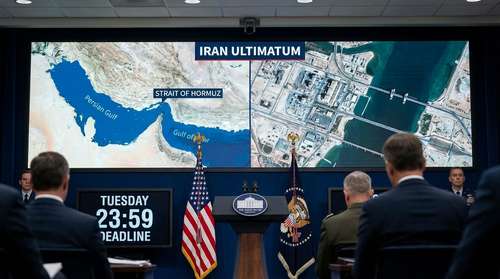
In an expletive-laced post on his Truth Social platform Sunday, the president doubled down on previous warnings, stating that failure to comply by the 8 p.m. Eastern deadline would result in devastating consequences. "Tuesday will be Power Plant Day, and Bridge Day, all wrapped up in one, in Iran," Trump declared. Speaking later to reporters at the White House, he added, "They'll have no bridges. They'll have no power plants. They'll have no anything."
The looming Iran military strike deadline comes as the world's most critical energy artery remains paralyzed by the Islamic Revolutionary Guard Corps (IRGC). The current crisis, which began with a joint U.S.-Israeli offensive on February 28, has steadily escalated from targeted airstrikes into a full-scale maritime siege. Initially, the president issued a 48-hour warning in late March, but after a series of tense extensions and broken negotiations, Tuesday night has been designated as the absolute cutoff.
The administration's explicit Iran infrastructure threat marks a severe escalation in rhetoric. The Pentagon has reportedly prepared target packages focusing heavily on Tehran's vital energy grid, water desalination plants, and major transit bridges. This aggressive posture aims to force an immediate reopening of the shipping lanes, but it has simultaneously triggered alarm bells regarding the legal boundaries of the commander-in-chief's authority.
Clash Over Trump Executive War Powers and International Law
The threat to systematically destroy a sovereign nation's civilian infrastructure has provoked immediate blowback from the international community and renewed intense scrutiny over Trump executive war powers. Under the Geneva Conventions, deliberately targeting civilian power grids and transit bridges is strictly prohibited. U.N. Secretary-General António Guterres formally warned the United States that such strikes would constitute a direct violation of international law.
When pressed by reporters on the potential for committing war crimes, Trump flatly stated he was "not at all" concerned. The administration's unyielding posture has sharply divided lawmakers. Hardliners praise the firm ultimatum as necessary to break the regional stalemate, while critics argue the executive branch is bypassing congressional oversight, risking an uncontrollable regional conflagration to solve a maritime dispute.
Strait of Hormuz Blockade 2026: Economic Fallout
The ongoing Strait of Hormuz blockade 2026 has crippled international logistics, trapping roughly 20% of the world's seaborne oil supply behind a wall of Iranian anti-ship cruise missiles, naval mines, and advanced drone swarms. The resulting supply shock has been immediate and severe, nullifying the administration's attempts to stabilize the market via the release of 400 million barrels from emergency reserves.
By Tuesday morning, Brent crude settled near $110.83 per barrel, while West Texas Intermediate (WTI) breached $112. Market analysts warn that if the waterway remains closed, crude could quickly spike toward $140, triggering a stagflationary crisis that threatens to derail the global economy. The ripple effects are already hitting American consumers directly in their wallets. According to AAA, the national average for a gallon of gasoline has surged to $4.11—a massive 38% increase since the conflict initiated in late February.
Will Tehran Yield to the US Iran Military Conflict?
Despite the crippling economic pressure and the mounting threat of U.S. bombardment, Tehran has shown little willingness to capitulate ahead of the deadline. The broader US Iran military conflict has already taken a heavy toll, with the Pentagon recently confirming that 365 American service members have been injured during operations over the past five weeks.
A senior Iranian military official from the Khatam al-Anbiya Central Headquarters rejected the president's ultimatum as a "helpless, nervous, unbalanced and stupid action," promising that any U.S. strike would open the "gates of hell." Furthermore, Iranian diplomats have insisted that the strait will not reopen until the country is fully compensated for damages incurred during the initial allied airstrikes, denouncing the U.S. demands as a double standard.
Behind the scenes, mediators from Pakistan, Turkey, and Oman are frantically working backchannels to secure a last-minute compromise and avert a catastrophic bombardment. Earlier in the week, these diplomatic efforts successfully paused strikes against key Iranian political figures. Yet, as the Tuesday night deadline approaches, the window for diplomacy is rapidly closing. Whether this midnight ultimatum is the ultimate high-stakes negotiating tactic or the definitive prelude to a devastating aerial campaign will be decided before the sun rises tomorrow.