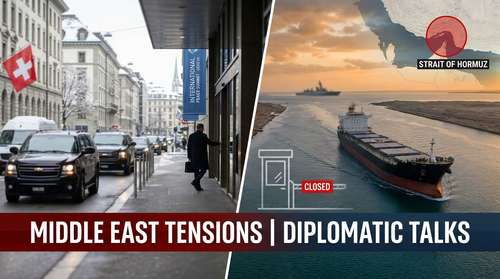
Vice President JD Vance has touched down in Switzerland to kick off highly anticipated direct negotiations with Iran, aiming to rescue a fragile preliminary peace agreement. The high-stakes diplomatic mission comes amid explosive renewed tensions in the Middle East, as Tehran threatened to close the critical Strait of Hormuz following recent Israeli airstrikes in Lebanon. In response, President Donald Trump escalated the pressure from Washington, issuing a bold threat to impose American tolls in the waterway if a final deal is not secured within 60 days.
Trump's 60-Day Strait of Hormuz Toll Ultimatum
The diplomatic standoff reached a fever pitch over the weekend after Iranian military officials claimed they had shut down the Strait of Hormuz, citing continued Israeli strikes in southern Lebanon as a direct breach of the recent U.S.-Iran memorandum of understanding. President Donald Trump wasted no time firing back. Posting from the presidential retreat at Camp David, Trump delivered an unprecedented ultimatum regarding the world's most critical oil chokepoint.
According to the preliminary peace framework, the Strait of Hormuz is designated for toll-free travel during a 60-day negotiation window. However, Trump warned that if a comprehensive Donald Trump Iran deal is not finalized by the deadline, the United States will step in. "There will be no tolls after the 60 day period has expired, unless they are imposed by and for the United States of America," Trump stated on his Truth Social platform.
The president added that any U.S.-imposed fees would serve as compensation for "services rendered as the Guardian Angel to the countries of the Middle East". While the U.S. Central Command quickly disputed Iran's closure claims—with spokesperson Capt. Tim Hawkins confirming that millions of barrels of oil continue to flow safely—Trump's rhetoric underscores a dramatic shift in Washington's approach to maritime security and international negotiations.
JD Vance in Switzerland: The Fight to Save Middle East Peace Negotiations
As the rhetorical war over the Strait of Hormuz intensified, Vice President JD Vance departed Joint Base Andrews, arriving at the Bürgenstock Resort near Lake Lucerne in Switzerland to spearhead the American delegation. Vance is joined by special envoys Steve Witkoff and Jared Kushner, signaling the administration's deep commitment to finalizing the framework.
The US Iran peace talks face immense hurdles, with a heavy presence of international mediators trying to bridge the gap. Pakistan’s Prime Minister Shehbaz Sharif and Qatari mediators have also converged on the Swiss Alps to facilitate discussions. On the opposite side of the table, the Iranian delegation is led by parliamentary Speaker Mohammad Bagher Ghalibaf and Foreign Minister Abbas Araghchi. For Tehran, the primary objective remains securing the unfreezing of billions of dollars in assets in exchange for regional de-escalation.
Before boarding his flight, Vance projected optimism to reporters, denying that the Strait of Hormuz was closed and expressing confidence that the broader peace efforts could succeed. He emphasized that the administration's goal is to make the entire region "safe and secure," though he acknowledged the complex "chicken and egg problem" of halting retaliatory violence long enough for agreements to take root.
Israel-Hezbollah Ceasefire Complications
The immediate threat to the summit is the deteriorating situation on the Israel-Lebanon border. An emergency session has been aggressively pushed to the top of the Switzerland agenda to address the Israel Hezbollah ceasefire. Iran nearly pulled out of the weekend talks entirely, accusing Israel of violating the preliminary truce by continuing deadly strikes against Hezbollah targets overnight.
Despite the grim headlines, Vance remains resolute. The Vice President indicated that Secretary of State Marco Rubio and the diplomatic team are actively managing the border conflict, noting that hostilities are "slowing down a little bit". By allowing the Israel-Hezbollah conflict to become a central focus of the initial sessions, U.S. negotiators are demonstrating a willingness to address Tehran's immediate security grievances to keep the broader nuclear and economic discussions alive.
The Future of US Foreign Policy 2026
The unfolding events at the Bürgenstock Resort represent a defining moment for US foreign policy 2026. The Trump administration is attempting an aggressive balancing act: offering unprecedented economic relief to Tehran while wielding the heavy stick of unilateral maritime tolls and military readiness.
If JD Vance and the diplomatic team can successfully navigate these turbulent waters, the resulting treaty could reshape the geopolitical landscape of the Middle East. It would potentially neutralize Hezbollah's northern front against Israel, secure the unimpeded flow of global energy supplies, and put significant guardrails on Iran's nuclear ambitions. However, if the talks collapse within the 60-day window, Trump's vow to impose a Strait of Hormuz toll could trigger a severe escalation, drawing the U.S. military into direct confrontation with Iranian forces.
For now, the world watches the Swiss Alps. The next few days of back-channel negotiations will likely determine whether the region moves toward a historic stabilization or plunges back into open conflict.