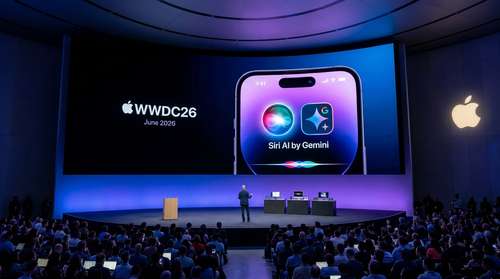
The wait is finally over. WWDC 2026 officially kicks off today, June 8, setting the stage for what is undoubtedly the most critical software event in Apple's history. Facing immense pressure to deliver a robust generative AI strategy, the tech giant is using today's keynote to unveil iOS 27 and a completely reimagined version of Apple Intelligence. At the center of it all is a massive Siri AI overhaul, which is now officially powered by Google Gemini and shifting toward a dynamic, multi-model approach.
If you are tuning into WWDC26 live, expect a dramatic departure from the intent-based voice assistant we have known for over a decade. Apple is fundamentally transforming how the iPhone operates, blending deep system integration with industry-leading third-party foundation models.
Apple Keynote 2026: The Dawn of a Multi-Model AI Ecosystem
For years, Apple faced criticism over Siri's limitations, but the Apple keynote 2026 is actively rewriting that narrative. Rather than attempting to build a solitary, all-encompassing large language model from scratch, Apple is adopting a multi-model ecosystem for Apple Intelligence. While Apple continues to utilize its own specialized local models for basic, on-device operations, complex requests and multi-step reasoning are being securely offloaded.
The Google Gemini Siri integration is the flagship partnership, serving as the foundational bedrock for the assistant's world knowledge and conversational capabilities. Crucially, Apple is giving users unprecedented control over their devices. Reports confirm that iOS 27 will allow iPhone owners to swap out the default AI with third-party agents, seamlessly integrating alternatives like OpenAI's ChatGPT and Anthropic's Claude directly into system frameworks.
Processing for these advanced tasks is routed through Apple's Private Cloud Compute servers, guaranteeing that user data remains entirely secure. Despite providing the underlying AI models, Google receives absolutely no access to individual user data, prioritizing the privacy-first approach Apple is famous for.
iOS 27 Delivers a Highly Anticipated Siri AI Overhaul
The star of the show for iOS 27 is undeniably the modernized voice assistant. Apple has rebuilt Siri from the ground up to operate more like a sophisticated conversational chatbot. The changes immediately apparent with the new Google Gemini Siri include several groundbreaking capabilities.
- Standalone Application: For the first time, Siri features a dedicated application, offering a ChatGPT-style interface equipped with a full message history.
- Dynamic Island Integration: The user interface has been heavily tied into the Dynamic Island, creating a more fluid, less intrusive visual experience when invoking the assistant globally.
- On-Screen Awareness: After significant delays, Siri finally understands precisely what is happening on your screen and can take multi-step actions across different third-party applications.
By offloading broad factual queries to Gemini, Siri no longer falls back on frustrating web-search responses. Instead, it provides natural context, emotional support, and conversational answers directly within the unified interface.
Visual Intelligence and a Smarter Camera App
Apple is significantly expanding its visual intelligence toolkit, which was initially introduced alongside the iPhone 16. In iOS 27, the native Camera app includes a brand-new Siri mode alongside traditional Photo and Video settings. Utilizing Gemini's multi-modal capabilities, users can instantly scan their environment, identify objects, translate live text, or receive contextual information without snapping a picture.
Beyond AI: Photos, Liquid Glass, and System Stability
While the Siri AI overhaul commands the headlines, iOS 27 is not solely about artificial intelligence. Internally, Apple developers have reportedly treated this update as a massive push for core performance stability and bug squashing. Everyday applications are still receiving meaningful workflow enhancements. The Photos app is introducing three powerful new generative editing tools. Extend seamlessly generates additional background imagery beyond the original frame boundaries. Enhance automatically calibrates complex lighting and color profiles using machine learning, while Reframe allows users to shift perspectives after a spatial photo is captured.
Additionally, users can look forward to updates to the Liquid Glass interface featuring a new dimmer, a streamlined Safari start page with auto-tab groups, and expanded AirPlay functionality tailored for European Union compliance.
Hardware Support and Beta Release Timeline
As always, groundbreaking software requires modern hardware. The integration of advanced on-device operations means older iPhones will sadly be left behind. While the exact cutoff list will be finalized later today, older devices lacking sufficient Neural Engine capabilities or RAM will likely lose support for the latest operating system altogether, which could significantly impact their resale value.
If you want to experience the future of Apple Intelligence, developers can install the first beta immediately following today's event. For the rest of the public, the final polished version of iOS 27 is slated for a traditional fall release, running perfectly on the upcoming hardware lineups. Stay tuned to our ongoing WWDC26 live coverage as we track all the major announcements dropping at Apple Park today.