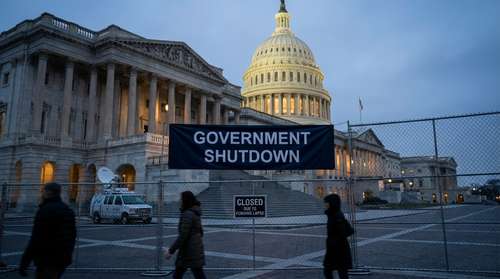
WASHINGTON, D.C. – The federal government has officially entered a partial shutdown as of midnight Saturday, plunging Washington into chaos after House Speaker Mike Johnson refused to recall the House of Representatives to vote on a last-minute Senate funding package. The legislative impasse is fueled by a volatile standoff over Department of Homeland Security (DHS) spending, sparked by the fatal shooting of Minneapolis nurse Alex Pretti by federal agents last week.
Shutdown Begins as House Speaker Mike Johnson Holds Firm
As the clock struck midnight on January 31, 2026, funding lapsed for key federal agencies, including the Departments of Homeland Security, State, Labor, and Health and Human Services. While the Senate successfully advanced a bipartisan continuing resolution late Friday evening—intended to keep the government open for another two weeks while negotiations continued—the measure died on the vine as the House remained out of session.
House Speaker Mike Johnson (R-LA) drew a line in the sand Thursday night, declaring he would not call lawmakers back to Washington over the weekend. "The earliest floor action we could have is Monday," Johnson told reporters, effectively guaranteeing a disruption in federal operations. The Speaker’s refusal to reconvene the lower chamber is widely seen as a tactical move to pressure Senate Democrats, who have conditioned long-term DHS funding on sweeping oversight reforms for Immigration and Customs Enforcement (ICE).
Alex Pretti Shooting Ignites National Furor
The current fiscal deadlock is inextricably linked to the events of January 24 in Minneapolis, where 37-year-old Alex Pretti was shot and killed by Customs and Border Protection (CBP) agents. Pretti, an intensive care nurse at the Minneapolis VA Medical Center, was filming agents during a controversial "Operation Metro Surge" enforcement action when he was killed.
While the Department of Homeland Security initially claimed Pretti brandished a "9mm semi-automatic handgun," bystander video verified by multiple major news outlets appears to contradict the official narrative, showing Pretti holding a smartphone with his hands raised. The incident, which occurred just weeks after the similar shooting of Renee Good, another U.S. citizen in Minneapolis, has catalyzed a national outcry for accountability.
"We are not asking for the moon," said Senator Chris Murphy (D-CT), a key negotiator on the Homeland Security panel. "We are asking for basic policing standards: body cameras, identification, and an end to anonymous roving patrols. Until we get those guarantees, there is no blank check for DHS."
Senate Funding Bill Stalls Over ICE Oversight
The Senate's emergency measure, crafted by Senate Majority Leader John Thune (R-SD) and Minority Leader Chuck Schumer (D-NY), attempted to bridge the divide by offering a temporary two-week extension for DHS while funding other agencies through September. The deal included $20 million for body cameras—a concession to Democrats—but lacked the mandatory enforcement language progressives have demanded.
"It is going to be really, really hard to get anything done," Thune admitted late Friday, acknowledging the deep fissures within his own party and the intense pressure from the White House to resist any restrictions on ICE authority. The Trump administration has steadfastly defended the agents involved in the Minneapolis incident, with DHS Secretary Kristi Noem rejecting calls for her resignation and dismissing the proposed reforms as "pro-criminal" constraints.
What This Shutdown Means for Americans
With the House not scheduled to return until Monday afternoon, the partial shutdown will remain in effect for at least 48 hours. The immediate impact will be blunted by the weekend, but federal employees at affected agencies—including thousands of TSA agents and border patrol officers—are now working without pay. If the stalemate drags into the workweek, passport processing, small business loans, and non-essential federal operations will grind to a halt.
The Office of Management and Budget (OMB) Director Russ Vought issued a memo late Friday directing agencies to "execute plans for an orderly shutdown," though he expressed hope that the lapse would be short. However, with protests continuing in Minneapolis and Speaker Johnson showing no signs of blinking, the path to reopening the government remains dangerously unclear.