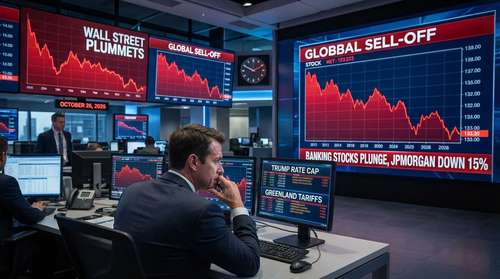
Wall Street faced its most brutal trading session of 2026 on Tuesday, as a dual shockwave of domestic regulatory threats and geopolitical escalation sent major indexes tumbling. The Dow Jones Industrial Average plunged nearly 877 points, while the S&P 500 and Nasdaq Composite dropped 2.1% and 2.4% respectively, marking the sharpest single-day decline since last October. The massive sell-off was triggered by President Trump’s controversial proposal to cap credit card interest rates at 10%, combined with an ultimatum threatening stiff tariffs on European allies over the administration's bid to purchase Greenland.
Banking Stocks Lead the Retreat
The financial sector bore the brunt of the carnage, reacting violently to the administration's deadline for a temporary 10% cap on credit card interest rates. Investors rapidly repriced the profitability of major lenders, fearing the proposal would slash revenue streams from unsecured lending. JPMorgan Chase (JPM) saw its stock price drop over 3%, while Citigroup (C) and Wells Fargo (WFC) posted even steeper losses, shedding roughly 4.3% and 2% respectively.
Bank executives have been vocal in their opposition. In a direct rebuttal to the White House, industry leaders argued that an artificial ceiling on rates would force them to restrict credit access for millions of Americans with lower credit scores. "Capping rates at this level ignores the risk premium required for unsecured lending," noted one senior analyst. "The market is effectively pricing in a worst-case scenario where banks must choose between taking losses or cutting off a significant portion of the consumer base."
Uncertainty Over Executive Authority
While the President framed the rate cap as a necessary measure to combat inflation and help working families, legal experts remain divided on whether such a move can be enforced via executive order without Congressional approval. Despite the legal ambiguity, the mere threat of a protracted battle with the White House was enough to send the banking stocks plunge into freefall, dragging the broader US economy news today into negative territory.
Greenland Dispute Triggers Trade War Fears
Adding fuel to the fire, the administration opened a new front in global trade tensions. In a move that caught international diplomats off guard, President Trump threatened to impose a 10% tariff on imports from eight NATO members—including Denmark, the UK, France, and Germany—starting February 1. The ultimatum is stark: negotiate the "complete and total purchase" of Greenland by the United States, or face escalating levies that could rise to 25% by June.
The Trump Greenland tariffs threat immediately rattled global supply chains. European markets mirrored the U.S. sell-off, with the STOXX Europe 600 finishing deep in the red. The specter of a trans-Atlantic trade war has reignited fears of global market volatility, as investors scramble to assess the impact on everything from German automotive exports to French luxury goods.
Flight to Safety: Gold and Silver Surge
As equities crumbled, capital fled to traditional safe havens. Gold and silver prices hit record highs during Tuesday's session, with gold surging nearly 3.7% to breach the $4,700 level. The rush into precious metals signals a profound lack of confidence in near-term equity stability, as traders hedge against both the stock market sell-off 2026 and the potential for prolonged geopolitical instability.
The CBOE Volatility Index (VIX), often referred to as Wall Street's "fear gauge," spiked more than 30%, crossing the key threshold of 20 for the first time in months. This resurgence of fear suggests that the tranquility of the early 2026 bull market may be over, replaced by a new regime of headline-driven trading swings.
What Comes Next for Investors?
Market participants are now bracing for a volatile week ahead. The immediate focus remains on Washington, where lobbyists for the banking industry are expected to mount a fierce defense against the interest rate cap. Simultaneously, European leaders are convening emergency meetings to formulate a unified response to the tariff threats. If the rhetoric from the White House translates into policy action come February, today's JPMorgan stock price drop could be just the beginning of a broader repricing across global financial markets.