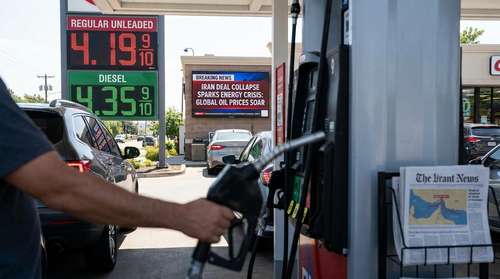
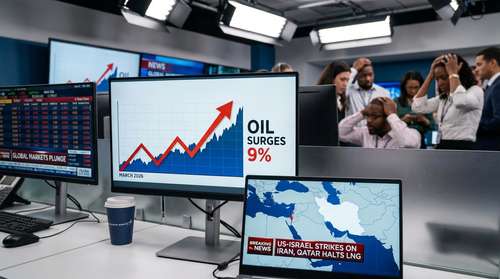
Global financial markets are in freefall today as the full economic impact of the weekend's massive US-Israel military campaign against Iran begins to materialize. Following the launch of "Operation Epic Fury" on Saturday, which resulted in the confirmed death of Iranian Supreme Leader Ayatollah Ali Khamenei, panic has gripped trading floors from Tokyo to New York. The Iran war business impact is proving immediate and severe, with Brent crude surging over 9% to breach $82 per barrel and European natural gas futures skyrocketing 40% in early trading on Monday, March 2, 2026.
Energy Crisis 2026: Oil and Gas Prices Explode
The most immediate shockwave has been the oil price surge March 2026 will be remembered for. With the Strait of Hormuz effectively closed to tanker traffic due to insurer withdrawals and active threats, the global energy supply chain faces its most significant disruption in decades. West Texas Intermediate (WTI) crude jumped nearly 8% to hover around $72, while Brent crude touched highs not seen since early 2025.
Adding fuel to the fire is the confirmed Qatar LNG facility shutdown. State-owned giant QatarEnergy announced late Sunday that it was suspending production at its massive Ras Laffan industrial complex following a targeted Iranian drone attack. "The threat to security of supply is here and now," warned Simone Tagliapietra, an energy analyst at Bruegel. With Qatar accounting for roughly 20% of the world's LNG supply, this outage has sent European gas benchmarks vertical, raising fears of a renewed energy crisis 2026 just as the continent was emerging from winter.
Saudi Infrastructure Targeted
The disruption isn't limited to gas. Saudi officials confirmed that the Ras Tanura refinery, one of the world's largest, has initiated a precautionary shutdown after intercepting two drones nearby. While damage is reported to be minimal, the psychological blow to the market has been immense, cementing the fear that no energy infrastructure in the Gulf is currently safe.
Defense Stocks Rally: Lockheed Martin Leads the Charge
While the broader S&P 500 and Dow Jones Industrial Average opened deep in the red, signaling a potential global market crash today, the defense sector is experiencing an unprecedented boom. Investors are flocking to safety and capitalizing on expectations of prolonged military engagement. The defense stocks rally Lockheed Martin is leading has seen shares of the aerospace giant (NYSE: LMT) jump over 7% in pre-market trading, reaching new all-time highs.
Other major contractors are following suit. Northrop Grumman and RTX Corp (formerly Raytheon) both posted gains exceeding 5% as the Pentagon signaled that the conflict could last for weeks. "This is a fundamental shift in the security architecture of the Middle East," noted market strategist Linda Yeung. "The market is pricing in a sustained period of high kinetic activity and the inevitable replenishment of US and Israeli munition stockpiles."
Middle East Travel Chaos Grounds Thousands
Beyond the financial tickers, the human cost of the escalation is visible at airports worldwide. The unfolding Middle East travel chaos is being described by aviation experts as the worst disruption since the COVID-19 pandemic. Major regional hubs, including Dubai International (DXB), Doha (DOH), and Abu Dhabi (AUH), have suspended almost all commercial operations indefinitely.
Emirates, Qatar Airways, and Etihad have grounded their fleets, leaving hundreds of thousands of passengers stranded across Europe, Asia, and the Americas. The closure of Iranian, Iraqi, and Jordanian airspace has forced long-haul carriers to reroute flights, adding hours to travel times and straining fuel reserves. "We are looking at a total paralysis of the east-west air corridor," said aviation analyst Henry Harteveldt. "The ripple effects will be felt for months."
What Investors Should Watch Next
As the situation remains fluid, market watchers are advising extreme caution. The key variable remains the duration of the Strait of Hormuz closure. If the waterway remains impassable for more than a week, analysts predict oil could easily surpass $100 per barrel, triggering recessionary alarms globally. For now, volatility is the only certainty, with safe-haven assets like gold and the US dollar seeing heavy inflows alongside the defense sector.