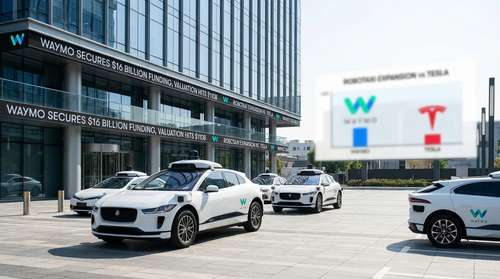
Alphabet’s autonomous driving unit, Waymo, is reportedly finalizing a monumental $16 billion funding round that would skyrocket its valuation to $110 billion. This strategic capital injection, primarily fueled by Alphabet itself, marks a definitive move to cement Waymo’s dominance in the robotaxi market expansion race just as competition with Tesla reaches a fever pitch. If completed, this deal would more than double Waymo's valuation from just 15 months ago, signaling Wall Street’s roaring confidence in the future of driverless car technology news.
A Record-Breaking $16 Billion War Chest
According to reports surfacing late this weekend, the new financing round is set to be one of the largest private tech investments in history. Alphabet is expected to shoulder the lion's share of the burden, contributing approximately $13 billion to maintain its controlling stake. This massive commitment underscores Alphabet’s belief that Waymo is transitioning from a "moonshot" experiment to a central revenue pillar for the tech giant.
The remaining capital is poised to come from a syndicate of blue-chip external investors. New backers reportedly include Sequoia Capital, DST Global, and Dragoneer Investment Group, joining existing heavyweights like Andreessen Horowitz and the Abu Dhabi sovereign wealth fund, Mubadala. This diverse backing validates the Alphabet Waymo valuation 2026 surge, positioning the company as the undisputed leader in a sector once plagued by skepticism.
Waymo vs Tesla Robotaxi: The Battle for Autonomy
The timing of this funding is no coincidence. The Waymo vs Tesla robotaxi rivalry has intensified significantly in early 2026. Just last month, Tesla began unsupervised robotaxi operations in Austin, Texas, and is pushing for European regulatory approval for its Full Self-Driving (FSD) software this February. While Tesla relies on a camera-only "vision" approach to keep costs low, Waymo has doubled down on its sensor-rich strategy, utilizing LiDAR and detailed mapping to ensure safety and reliability.
Industry analysts view Waymo’s $16 billion war chest as a direct counter-offensive to Tesla's aggressive rollout. With Tesla CEO Elon Musk promising mass production of the "Cybercab," Waymo is using its financial muscle to scale its physical fleet faster than Tesla can deploy its software updates. The funding will likely accelerate Waymo’s expansion into new markets, with confirmed plans for Washington, D.C., and potential international launches in the UK and Japan later this year.
Scaling Operations and Revenue
Waymo’s operational metrics justify the premium valuation. The company has now completed over 20 million fully autonomous trips and is currently facilitating more than 450,000 paid rides per week across its active markets, including San Francisco, Phoenix, Los Angeles, and Miami. Recent data suggests Waymo’s annual recurring revenue has crossed the $350 million threshold, a figure that is expected to grow exponentially as it aims for 1 million weekly rides by the end of 2026.
Navigating Safety Scrutiny and Regulations
Despite the bullish financial outlook, the path forward isn't without hurdles. Autonomous vehicle safety investigation protocols remain strict. Just last week, federal regulators opened a probe following an incident involving a Waymo vehicle in Santa Monica. While the company maintains a safety record superior to human drivers, every incident attracts heightened scrutiny in the current regulatory climate.
Waymo’s response has been to emphasize "safety-led operational excellence." Unlike competitors who have faced operational shutdowns, Waymo has managed to scale while maintaining regulatory trust. The fresh capital will likely be heavily invested in next-generation hardware and safety redundancies to satisfy regulators as the fleet size balloons.
The Future of Self-Driving Car Industry Trends
As self-driving car industry trends shift from R&D to commercialization, this funding round represents a maturing of the market. Investors are no longer just betting on the technology working; they are betting on it scaling profitably. With a $110 billion price tag, Waymo is now valued more highly than many legacy automakers, reflecting a belief that the future of transport belongs to the robots.
For Alphabet, this is a decisive moment. By locking in a massive valuation and securing a runway for aggressive expansion, they are effectively daring competitors to keep up. As 2026 unfolds, the question isn't just who has the best technology, but who has the deepest pockets to deploy it globally.