
The escalation of military operations in West Asia has officially sent shockwaves through the global economy. As the US-Israel-Iran war enters its third week, global oil prices March 2026 are exhibiting unprecedented volatility, with international benchmarks smashing through the psychological $100-per-barrel threshold. The primary catalyst for this dramatic surge was a massive, coordinated U.S. airstrike on military targets situated on Iran's highly sensitive Kharg Island late Friday. With geopolitical tensions at a boiling point and shipping lanes paralyzed, financial experts are aggressively revising their economic outlooks, warning that this rapidly escalating conflict could spell disaster for international trade.
Kharg Island Oil Terminal Strikes: The Strategic Target
In what the Pentagon has dubbed Operation Epic Fury, U.S. Central Command confirmed that American forces utilized precision munitions to hit over 90 Iranian military targets on Kharg Island. These included naval mine storage facilities, sophisticated air defenses, and a helicopter hangar. Located roughly 15 miles off Iran's southwestern coast, this small coral island represents a tiny geographic footprint but carries massive global weight, handling approximately 90% of Iran's crude oil exports and processing up to 950 million barrels annually.
While President Donald Trump announced that the bombing raid successfully neutralized defensive assets, he explicitly stated that the island's energy infrastructure was intentionally spared for reasons of decency. However, the threat to reconsider this restraint hangs heavily over the market. These Kharg Island oil terminal strikes represent a pivotal escalation in the 15-day conflict. Energy analysts from institutions like JPMorgan caution that a direct hit or seizure of the island's petroleum facilities could immediately halt the bulk of Iran's crude exports, triggering severe retaliation and catapulting prices exponentially higher.
Strait of Hormuz Shipping Disruptions Escalate
Compounding the relentless pricing pressure are severe Strait of Hormuz shipping disruptions. Iran's new Supreme Leader, Mojtaba Khamenei, issued a public statement insisting the vital waterway will remain closed to pressure adversaries. Tehran has already targeted over a dozen commercial vessels in the corridor, which typically accommodates 20% of global oil shipments and crucial liquefied natural gas (LNG) cargo. Traffic through the maritime chokepoint has ground to a near standstill.
Iranian military officials have bluntly warned that any direct destruction of their energy infrastructure will result in symmetric retaliation against U.S.-linked energy facilities across the Gulf. This threat materialized rapidly over the weekend, with reports confirming a drone strike hitting a major oil complex in the United Arab Emirates. For global trade, an effective, prolonged closure of the Strait of Hormuz is the ultimate worst-case scenario.
Brent Crude $100 Forecast Shattered by Energy Market Crisis 2026
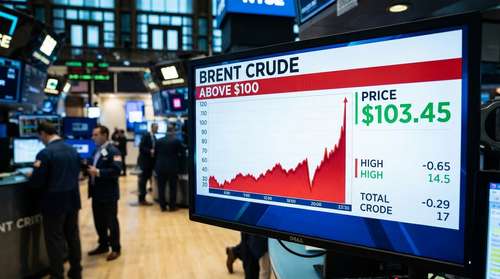
Oil markets react instantly to geopolitical shocks, and the latest offensive is no exception. At the close of Friday trading, Brent crude futures settled above $103 per barrel—having surged over 40% since the war began in late February. West Texas Intermediate (WTI) closely tracked this momentum, hovering near the $100 mark. This stark reality easily shatters the earlier conservative Brent crude $100 forecast, cementing a severe energy market crisis 2026.
The broader US-Iran war business impact is sending tremors through corporate boardrooms worldwide. Transportation, logistics, and manufacturing sectors are already bracing for massive spikes in operational costs. Even a coordinated release of 400 million barrels from strategic reserves by International Energy Agency (IEA) member states provided only a temporary buffer against the panic. Analysts at major financial institutions are now warning that prolonged disruption in the strait could push Brent crude toward $110 to $120 a barrel in the coming weeks.
Financial Contagion and the Stock Market Crash Today
The fallout extends far beyond commodity exchanges. A frantic flight to safety is well underway across global equities, dragging down major international indices. Friday saw a brutal sell-off, sparking frantic headlines of a stock market crash today as institutional investors rapidly liquidated riskier assets. The Dubai International Financial Centre (DIFC) and major Asian exchanges reported sharp, immediate declines as traders scrambled to assess long-term regional stability.
Airlines, shipping conglomerates, and energy-intensive manufacturing stocks bore the brunt of the market anxiety. Conversely, defense contractors and domestic U.S. energy producers saw a sharp uptick in trading volume. Market strategists note that the true danger lies in the unpredictability of the days ahead. If international supply chains remain choked, the ripple effect will exacerbate persistent inflation and potentially force global central banks into emergency monetary interventions.
Navigating the Global Economic Fallout
For the average consumer, the immediate downstream effects will be felt at the gas pump and in elevated utility bills. Diesel and gasoline futures are already reacting aggressively to the supply chokeholds, jumping around 4.5% to 5% in just a few days. For global enterprises, the current landscape requires rapid, decisive pivoting. Risk mitigation, securing alternative supply routes, and hedging energy costs will dominate corporate strategy through the spring.
The coming 48 hours are incredibly critical. Whether Washington and its allies can carve out a safe passage for international tankers or the conflict shifts directly into widespread energy infrastructure destruction will determine just how deep this crisis cuts. Until then, the global economy remains held hostage by the volatile waters of the Persian Gulf.