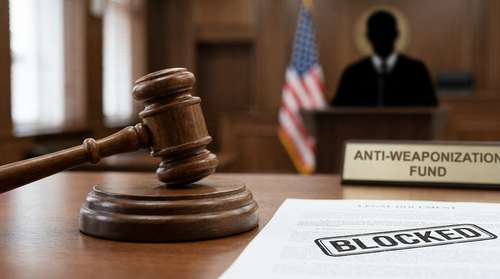
A federal judge on Friday temporarily halted the Trump administration from moving forward with a highly controversial $1.776 billion initiative, issuing a sweeping order that stops all financial transfers, administrative planning, and potential claims. U.S. District Judge Leonie Brinkema barred the government from operating the so-called Trump anti-weaponization fund, a massive program born out of an unprecedented legal settlement that has quickly drawn bipartisan fury across Washington. The sudden freeze guarantees that not a single dollar of taxpayer money can be distributed while the court reviews the constitutionality of the program.
The temporary restraining order arrives just over a week after the Justice Department formally announced the anti-weaponization settlement fund. Designed ostensibly to compensate individuals who claim they were targeted by politically motivated federal prosecutions during previous administrations, the program has been widely condemned by legal scholars and lawmakers as an unconstitutional executive overreach.
Origins of the Unprecedented Trump Lawsuit Settlement
The multi-billion-dollar initiative stems from a highly unusual Trump lawsuit settlement finalized earlier this month. The legal saga began when Donald Trump and his family sued the Internal Revenue Service and the Treasury Department for $10 billion. The lawsuit cited the unauthorized leak of the president's confidential tax returns by Charles Littlejohn, a former IRS contractor who was recently sentenced to five years in prison for distributing the financial records to the media.
Rather than seeking direct financial damages for the president himself—which legal experts noted would be difficult to secure—the settlement required Acting Attorney General Todd Blanche to establish a $1.776 billion compensation pool. The symbolic figure, mirroring the year of America's founding, was explicitly designated to aid citizens who experienced alleged "lawfare" or domestic political persecution. However, government watchdog groups immediately raised red flags about the non-adversarial nature of the agreement, pointing out that the administration effectively settled a massive lawsuit with its own executive branch, completely bypassing congressional approval.
Bipartisan Outrage Over a Taxpayer Funded Slush Fund
The primary catalyst for the mounting legal challenges is the staggering lack of transparency and legislative oversight built into the fund's framework. Because the money would be drawn from the Treasury's Judgment Fund—an account normally reserved for legitimate, court-ordered damage claims—lawmakers from both sides of the aisle have labeled the program a taxpayer funded slush fund.
Bipartisan backlash reached a boiling point on Capitol Hill when it was revealed that the program featured virtually no restrictions on who could apply for compensation. Prominent Republicans and Democrats alike expressed outrage over the possibility that violent January 6 rioters, including those convicted of seditious conspiracy or assaulting police officers at the U.S. Capitol, might be eligible for massive federal payouts.
Furthermore, the settlement terms allow the administration to keep the identities of payout recipients and the justification for their compensation completely secret, shielding the process from public scrutiny.
The Legal Challenge Against Executive Overreach
The specific lawsuit that prompted Friday's temporary block was filed by the legal advocacy group Democracy Forward. The plaintiffs represent a diverse coalition of citizens, including a former federal prosecutor who investigated the January 6 attack, a professor acquitted of protest-related charges, and several municipal leaders. They argue that the executive branch has no constitutional authority to spend public money on a political rewards program without explicit appropriation from Congress.
"Today, a federal court recognized the urgent need to prevent taxpayer dollars from being distributed through a secretive and unprecedented political compensation scheme," stated Skye Perryman, CEO of Democracy Forward. "No administration has the authority to spend public money through a political rewards program that Congress never authorized."
Why Judge Leonie Brinkema Halted the Program
In her concise two-page order issued in Alexandria, Virginia, Judge Leonie Brinkema made it clear that the federal court needed adequate time to properly evaluate the heavy constitutional questions at play. The Bill Clinton-appointed judge ruled that preserving the status quo is essential to ensure that no taxpayer funds are "irreversibly disbursed" before the litigation is fully resolved on its merits.
Under the initial terms of the rapid settlement, Acting AG Blanche had until mid-June to appoint a five-member DOJ weaponization commission. This panel would be granted unilateral authority to determine payout criteria, review applications, and disburse the cash, with all members serving at the pleasure of the president. Brinkema's ruling explicitly forbids the Justice Department from taking any further administrative steps toward building this commission, processing incoming claims, or instructing the Treasury to transfer the billions required to open the fund.
Looking Ahead to the June 12 Hearing
With the program entirely frozen, all eyes are now firmly fixed on the federal courthouse in Eastern Virginia. Judge Brinkema has scheduled a formal hearing for June 12, 2026, to hear comprehensive arguments on whether to extend the temporary restraining order into a longer-term preliminary injunction.
The White House has declined to comment publicly on the judge's ruling, referring all questions to the Justice Department, which has also remained silent. As multiple separate lawsuits—including aggressive challenges from watchdog groups like Citizens for Responsibility and Ethics in Washington (CREW) and the Society for the Rule of Law—continue to mount, the legal battle over executive power and the congressional power of the purse is likely just beginning.
For now, the administration's controversial attempt to financially compensate its political allies remains firmly blocked by the federal judiciary, leaving the future of the nearly two-billion-dollar fund in severe doubt.