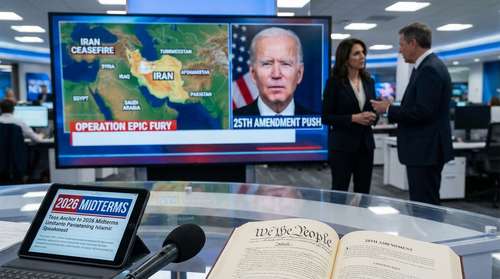
The political landscape in Washington is boiling over as the dust settles in the Middle East. While the White House celebrates the conclusion of its 38-day military campaign, a profound 25th Amendment removal push 2026 is gaining unprecedented momentum. Following the harrowing climax of a newly brokered two-week truce, the intensifying battle lines drawn between a defiant administration and an outraged opposition are reshaping the nation's focus heading into a pivotal election year.
Operation Epic Fury Concludes as Fragile Ceasefire Holds
In the latest Trump Iran ceasefire news, the United States and Iran have agreed to a conditional two-week truce mediated by Pakistani Prime Minister Shehbaz Sharif. The ceasefire, which officially began on April 7, 2026, paused a devastating 38-day conflict just hours before a White House-imposed deadline that threatened widespread destruction of Iranian infrastructure. Under the terms of the temporary pause, Tehran has ostensibly agreed to reopen the strategically vital Strait of Hormuz, averting what international legal scholars warned could be an unprecedented humanitarian disaster.
At the Pentagon, officials are projecting absolute confidence. Recent Operation Epic Fury victory analysis highlights bold assertions from Secretary of War Pete Hegseth and Chairman of the Joint Chiefs of Staff Gen. Dan Caine, who declared that the United States military achieved its primary objectives on schedule. According to the Defense Department, the campaign involved hundreds of precision strikes that systematically dismantled Iran's defense industrial base and decimated over 90 percent of its naval fleet. However, independent analysts warn that the underlying nuclear and geopolitical issues remain profoundly unresolved. With Iran's nuclear enrichment status still a point of fierce contention, the region remains on a knife-edge as the two-week clock ticks down.
Democrats Mobilize: The 25th Amendment Removal Push
The administration's military assertions have been entirely overshadowed by the President's volatile rhetoric leading up to the ceasefire. Just hours before the agreement, a Truth Social post predicting that a whole civilization would die triggered international alarm and domestic outrage. This apocalyptic threat has accelerated a historic constitutional showdown, transforming whispers of presidential unfitness into a roaring legislative firestorm.
Major advocacy groups have taken extraordinary steps. In an unprecedented move, the NAACP and Common Cause publicly urged the Cabinet to invoke Section 4 of the 25th Amendment to remove the President from power, citing deteriorating stability and reckless behavior. Concurrently, Rep. John B. Larson officially filed articles of impeachment, warning that the administration's actions risk global security and constitute illegal warfare. Larson explicitly noted that the escalating crisis is costing American lives and punishing working families.
A Historic Constitutional Showdown
This aggressive maneuvering highlights the defining theme of Congressional Democrats vs Trump 2026. While legal experts point out that invoking the 25th Amendment requires the highly unlikely cooperation of a fiercely loyal Cabinet, the momentum for a Trump impeachment second term is undeniable. Opposition leaders argue they have a moral obligation to build a formal congressional record of the administration's erratic wartime conduct. This strategy signals an intent to dominate committee hearings through the summer, keeping the President's fitness for office front and center in the public consciousness.
Economic Fallout at the Pump
Beyond the constitutional crises in Washington, everyday Americans are grappling with the direct, painful economic consequences of the conflict. The temporary closure of the Strait of Hormuz, a crucial artery handling a massive percentage of global oil shipments, sent global energy markets into a tailspin. The resulting US gas price inflation April 2026 has hit families exceptionally hard, driving transportation and freight costs to record highs right as the summer driving season approaches.
Even as the White House attempts to frame the military campaign as a triumphant demonstration of peace through strength, voters are staring at exorbitant numbers at the pump. The stark disconnect between the administration's declarations of total victory and the financial pain felt by consumers is creating a highly combustible political atmosphere. Economists warn that even with the Strait of Hormuz slated to reopen under the ceasefire terms, the supply chain shockwaves will take months to fully stabilize, virtually ensuring that fuel prices remain elevated for the foreseeable future.
Looking Ahead: 2026 Midterm Election Political Trends
As the nation looks toward November, the chaotic intersection of foreign policy brinkmanship and domestic economic strain is heavily dictating 2026 midterm election political trends. Polling experts suggest that the electorate is increasingly polarized, split evenly between those who applaud the administration's heavy-handed military approach and those terrified by the President's apocalyptic rhetoric and the resulting inflationary pressures.
For Democrats, the dual strategy of emphasizing executive instability and linking erratic foreign policy decisions to soaring gas prices forms the absolute core of their midterm messaging. Republicans, meanwhile, are aggressively banking on the narrative of a decimated Iranian military threat to rally their conservative base. Ultimately, the durability of this fragile Middle Eastern ceasefire, and whether the ongoing push for constitutional removal gains mainstream traction, will determine control of Congress in what is rapidly shaping up to be one of the most consequential midterm elections in modern American history.