
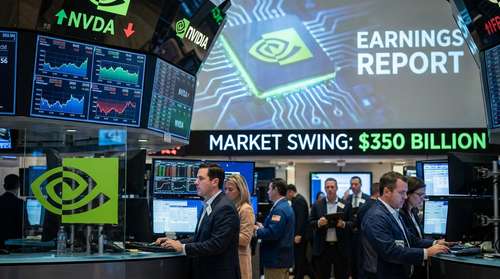
Wall Street is collectively holding its breath as the ultimate litmus test for the ongoing technology boom approaches. After the closing bell today, May 20, 2026, semiconductor juggernaut Nvidia will release its highly anticipated fiscal first-quarter earnings report. Far from a routine financial update, this release is being treated as a macroeconomic earthquake, with options markets currently pricing in a staggering market capitalization swing of up to $355 billion.
To put that impending volatility into perspective, a $350 billion move—representing roughly a 6.5% fluctuation in the NVDA stock price forecast—is larger than the standalone, total market value of roughly 90% of the constituent companies in the S&P 500. The stakes have simply never been higher for the market's undisputed leader.
The Main Event: Nvidia Earnings 2026 Under the Microscope
For the fiscal first quarter of 2027, the consensus among analysts models Nvidia's revenue at a record-shattering $79.2 billion, alongside earnings per share (EPS) of $1.78. This implies an almost 80% year-over-year revenue growth. However, while a beat on the top and bottom lines is widely expected—with markets pricing in a 97% beat probability—headline figures alone won't be enough to satisfy an incredibly demanding investor base.
Beyond the core numbers, gross margin trajectory will be a focal point for analysts. Maintaining margins near the 75% level is critical for justifying Nvidia's premium valuation. Any compression in profitability, even amid record-breaking revenues, could prompt a swift reevaluation of the stock's near-term upside. With options traders pricing in roughly 6.5% two-way volatility, the margin for error is razor-thin.
Institutional traders are hyper-focused on forward-looking guidance, particularly the highly anticipated rollout of the company's 'Vera Rubin' architecture. Following the massive success of the Grace Blackwell platform, Rubin is reportedly set to slash inference token costs by an order of magnitude. Investors will be listening closely for updates on production timelines and early delivery metrics to leading AI developers like OpenAI and Anthropic.
The China Wildcard and Global Expansion
Another crucial element of today's Nvidia earnings 2026 report is the company's international trade strategy. Current forward guidance assumes essentially zero data-center revenue from China amid ongoing regulatory hurdles. However, CEO Jensen Huang's recent diplomatic efforts in Beijing have raised hopes for progress. Analysts note that securing renewed access to the Chinese market could add roughly $50 billion to Nvidia's addressable revenue, making it a massive catalyst for future growth.
Navigating Artificial Intelligence Market Trends and CapEx Realities
The foundation of Nvidia's ongoing surge rests securely on the massive capital expenditure (CapEx) of the major 'hyperscalers'—tech behemoths including Microsoft, Amazon, Meta, and Alphabet. Combined, these four companies have guided their 2026 CapEx spending to eclipse a staggering $700 billion, laying the physical groundwork for the next generation of agentic AI systems.
Furthermore, the competitive landscape is shifting. While rumors circulate about hyperscalers developing their own custom silicon to reduce reliance on Nvidia, the current global compute constraint means nearly all viable computing power will be absorbed by the market. Nvidia's first-mover advantage and entrenched CUDA software ecosystem provide a formidable moat that competitors are struggling to breach.
This colossal investment cycle dictates the broader semiconductor industry outlook. Skeptics have intermittently questioned whether such aggressive infrastructure spending is sustainable over the long term. Yet, the sheer volume of secured orders for Nvidia's AI infrastructure—reportedly extending through the end of 2026—suggests the world's largest tech companies are far more terrified of falling behind in the AI arms race than they are of overspending.
Nasdaq 100 Performance and Tech Sector Volatility
Nvidia's gravitational pull on the broader indices remains completely unprecedented. As the preeminent force among S&P 500 market movers, the chipmaker heavily dictates Nasdaq 100 performance on a daily basis. Year-to-date, NVDA shares have surged roughly 19%, significantly outpacing the broader market averages.
However, the sheer size of the anticipated post-earnings valuation swing highlights brewing tech sector volatility. Options data indicates that while the skew has markedly shifted toward bullish call options since March, there is also a noticeable uptick in defensive hedging across the sector. Institutional traders are aggressively paying premium prices for upside exposure, betting on another massive wave of growth. Simultaneously, they are purchasing insurance policies to lock in gains from the semiconductor sector's blistering rally.
What This Means for Global Markets Tonight
When Jensen Huang takes the virtual stage this evening to deliver the earnings call, every syllable of his commentary will be scrutinized by algorithms and human traders alike. If Nvidia can demonstrate that enterprise spending on generative data centers remains robust and the transition to the Rubin architecture is executing flawlessly, it could unleash another massive wave of institutional buying across the technology sector.
Conversely, any hint of supply chain bottlenecks, margin compression, or softening hyperscaler demand could trigger a sharp, localized sell-off, bringing the broader tech rally down with it. For the financial world, the impending $350 billion swing isn't just about one company's quarterly balance sheet. It is a definitive referendum on the sustainability of the global technology landscape. Whether you are an individual retail trader or a Wall Street fund manager, the true main event happens right after today's closing bell.