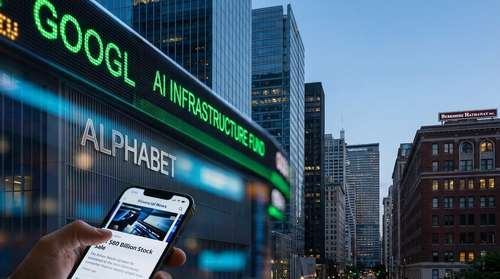
In a move that has fundamentally rewritten the rules of the artificial intelligence arms race, Google's parent company has stunned Wall Street with a historic financial maneuver. Announced on June 1, 2026, the unprecedented Alphabet stock sale aims to raise a staggering $80 billion. The market's reaction was swift, sending shares down 4.4% as investors digested the sheer scale of the largest equity fundraise in corporate history—a figure that dwarfs the world's three largest Initial Public Offerings combined.
For years, Silicon Valley titans have relied heavily on their massive internal cash flows to fund research and development. However, the sheer capital density required to train and run next-generation large language models is forcing a paradigm shift. Alphabet's decision to tap public markets signals that the financial demands of the generative AI boom have exceeded even the deepest corporate pockets.
The Anatomy of the Google 80 Billion Equity Raise
To fully grasp the magnitude of this secondary stock offering, you must look at how the deal is structured. Alphabet is not flooding the market with a single block of shares. Instead, the tech giant has carefully orchestrated the raise across three distinct avenues to balance immediate capital requirements with long-term corporate flexibility.
The first pillar consists of $30 billion in concurrent underwritten public offerings, managed by Wall Street heavyweights including Goldman Sachs, JPMorgan Chase, and Morgan Stanley. This tranche is split evenly: $15 billion in depositary shares representing mandatory convertible preferred stock, and $15 billion in Class A Common and Class C Capital stock.
The second pillar involves a sprawling $40 billion at-the-market (ATM) program expected to launch in the third quarter of 2026. Interestingly, while the headline focuses on AI, Alphabet earmarked the proceeds from this specific ATM program to facilitate administrative changes to tax obligations associated with the vesting of employee equity awards.
Yet, it is the third pillar that has the financial media buzzing: a massive private placement that brings a legendary value-investing conglomerate deeper into the Silicon Valley fold.
The Berkshire Hathaway Google Investment
When Goldman Sachs bankers made urgent weekend calls to secure backing for the offering, one response stood out for its speed and scale. Under the leadership of CEO Greg Abel, Berkshire Hathaway committed to a $10 billion private placement within 24 hours. This swift Berkshire Hathaway Google investment represents a stark departure from the conglomerate's historically cautious approach to tech valuations under Warren Buffett.
Berkshire agreed to purchase $5 billion of Alphabet's Class A shares at $351.81 each, alongside $5 billion of Class C stock at $348.20 per share. These figures represent a roughly 6% discount to the closing market prices prior to the announcement. This lightning-fast transaction significantly increases Berkshire's exposure to the tech giant. Coming on the heels of Berkshire's recent acquisition of Taylor Morrison Home Corporation, the move firmly anchors the traditional holding company right in the center of the modern technological revolution.
Fueling the Big Tech AI Spending Spree
Why does a company valued at over $4.5 trillion need an external capital injection of this size? The answer lies entirely in the soaring costs of AI infrastructure spending. Alphabet recently reported that customer demand for its Gemini enterprise solutions and cloud services is vastly outpacing available supply.
Google CEO Sundar Pichai previously warned investors that the company was "compute-constrained," meaning it simply could not build server farms and acquire necessary silicon accelerators fast enough. The broader Big Tech AI spending spree reflects this harsh reality. Industry giants like Amazon, Microsoft, Alphabet, and Meta are collectively estimated to spend over $700 billion this year alone on data centers, chips, and advanced computing infrastructure.
During its first-quarter earnings call, Alphabet revised its 2026 capital expenditure forecast upward to between $180 billion and $190 billion, explicitly warning that 2027 spending would climb even higher. Half of the newly raised $80 billion is directly earmarked to close this physical infrastructure gap, ensuring Google Cloud and the Gemini ecosystem remain highly competitive.
Decoding the Latest GOOGL Stock News
For retail and institutional shareholders closely tracking GOOGL stock news, the initial 4.4% dip reflects typical market anxieties over share dilution combined with sheer sticker shock. Analysts at Deutsche Bank noted that the raise serves as a loud warning to markets regarding the "unprecedented scale of the AI spending boom," prompting questions about when these massive infrastructure investments will yield proportional returns.
However, by opting for a Google 80 billion equity raise rather than issuing debt, Alphabet protects its fortress balance sheet against fluctuating interest rates. Securing this capital now provides the long-term runway needed to outbuild competitors without risking over-leverage.
The scale of this financial move sends an undeniable message to the entire technology sector: Alphabet is willing to spend whatever it takes to dominate the next decade of spatial computing and artificial intelligence. The stakes have never been clearer, and for Big Tech, the price tag for victory has officially reached historic new heights.