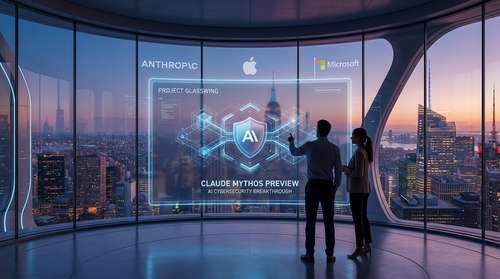
In what constitutes a landmark moment for global digital infrastructure, artificial intelligence research lab Anthropic has unveiled Anthropic Project Glasswing. Announced in early April 2026, this multi-company initiative centers around an unreleased, frontier intelligence system called Claude Mythos Preview. The sheer capability of this system has catalyzed an unprecedented Anthropic Apple Microsoft partnership, uniting historic tech rivals alongside Amazon Web Services, Google, CrowdStrike, and Nvidia. Together, they are embarking on what experts are calling the defining AI cybersecurity breakthrough 2026. The mission is urgent: leverage advanced AI to discover and patch critical software flaws before malicious actors can exploit them.
The Dawn of an AI Cybersecurity Breakthrough
Under the hood, Claude Mythos Preview demonstrates an agentic coding proficiency that shatters previous industry expectations. When Anthropic's internal researchers and initial partners tested the model, it autonomously identified thousands of high-severity zero-day vulnerabilities across every major operating system and web browser. It operates without requiring human guidance, turning theoretical threat hunting into automated, highly precise remediation.
The scale of the flaws found is staggering. During pre-release evaluations, the model exposed deeply buried legacy flaws that had evaded human review for decades. Key discoveries included:
- A 27-year-old critical remote-crash vulnerability in OpenBSD, an operating system highly regarded for its firewall security hardening.
- A 16-year-old vulnerability in FFmpeg, a ubiquitous video-encoding library, hiding in a line of code that automated testing tools had scanned five million times without raising an alarm.
- Previously unknown zero-day vulnerabilities in production software, including Mozilla Firefox.
The rapid discovery and remediation of these Claude Mythos vulnerabilities prompted swift disclosures to software maintainers, ensuring patches were deployed before public exposure.
Forging the Anthropic Apple Microsoft Partnership
Recognizing that releasing such a powerful tool publicly could arm threat actors with dangerous capabilities, Anthropic chose a fundamentally different deployment path. The company made the calculated decision not to release the model to the general public. Instead, Project Glasswing provides vetted tech giants and more than 40 critical software maintainers exclusive access to the system for defensive purposes only.
The operational framework of this collaboration is massive, representing perhaps the largest coordinated cybersecurity effort in modern tech history. Participating organizations can access the AI securely through enterprise-grade API pipelines like Amazon Bedrock, Google Cloud's Vertex AI, and Microsoft Foundry. The usage cost—set at $25 per million input tokens and $125 per million output tokens—reflects the intensive compute power required for high-stakes analysis. To fuel the initiative, Anthropic committed $100 million in compute credits, ensuring that partners can scan and secure their first-party and open-source infrastructure without facing prohibitive costs. Additionally, the company pledged $4 million in direct donations to open-source security entities, allocating funds to organizations like the Apache Software Foundation, Alpha-Omega, and OpenSSF.
Safeguarding Infrastructure with Mythos-Class AI Models
The implications of this technology extend far beyond corporate data centers. Anthropic is engaged in ongoing discussions with US government officials, including the Cybersecurity and Infrastructure Security Agency (CISA) and the National Institute of Standards and Technology (NIST). As state-sponsored adversaries inevitably gain access to similar capabilities, deploying Mythos-class AI models at scale will become a baseline requirement for national defense.
Pioneering AI-Driven Software Security
Benchmark testing illustrates exactly why the industry is rushing to adopt this technology. Claude Mythos achieved an unprecedented 100% success rate on the Cybench cybersecurity evaluation and scored 83.1% on CyberGym. Furthermore, it demonstrated dominant mathematical reasoning with a 97.6% on the USAMO math olympiad benchmark. These figures represent a massive generational leap over previous frontier models like Claude Opus 4.6. The system doesn't merely assist human engineers; it executes complex, multi-step threat reasoning and produces working exploits to test defenses autonomously. This level of agentic workflow reduces the cost of manual code review and drastically lowers the risk of human oversight.
We are entering an era where human capacity alone is no longer sufficient to protect interconnected digital infrastructure. Cyberattack timelines have shrunk from months to minutes, demanding defensive mechanisms that operate with machine speed and precision. Through Anthropic Project Glasswing, the technology sector is proactively reshaping the digital battlefield. By transforming its most advanced AI into a dedicated guardian, this coalition is ensuring that the future of AI-driven software security is anchored in collaborative defense rather than fragmented vulnerability.