Families heading on a European getaway this summer are facing an unprecedented travel crisis, with widespread Europe airport delays in 2026 reaching critical levels. Europe's newly introduced digital Entry/Exit System (EES) has triggered severe operational breakdowns at major Schengen borders, leaving passengers stranded in passport queues for up to five hours. In response to the escalating EU EES travel chaos, major airlines including Ryanair have issued urgent warnings, while the European Union has officially postponed its highly anticipated ETIAS travel authorization program until 2027.
Ryanair Warns of Severe Europe Airport Delays in 2026
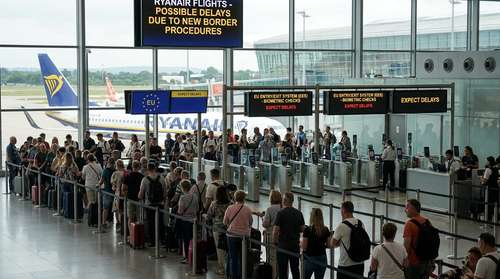
The situation has deteriorated so rapidly that Ryanair has issued direct alerts to travelers heading to 16 major European airports. Popular vacation gateways, including Tenerife South, Alicante, Malaga, Majorca, and Milan Bergamo, have become significant bottlenecks. Budget airlines are reporting that the biometric processing required by the new border rules is severely disrupting flight schedules, creating compounding delays across the continent.
"Families heading away for a well-earned summer holiday should be thinking about suitcases, suncream and sangria, not standing in passport queues for hours," said Ryanair's Chief Operations Officer Neal McMahon in a statement released on July 17. McMahon emphasized that passengers should not serve as the "testing ground for unfinished border infrastructure," pointing out that the system remains heavily flawed months after its initial spring rollout.
The Ryanair Europe flight delays aren't just an inconvenience; they are actively threatening summer vacations. In extreme cases, airport trade bodies report that some flights have been forced to depart half-empty because hundreds of passengers were physically trapped in immigration halls at gate closing time.
What is Causing the EU Entry Exit System Queues?
The root of the current summer travel crisis is the full implementation of the EU's Entry/Exit System, which requires all non-EU nationals to submit biometric data—specifically facial images and fingerprints—when crossing into the Schengen free-movement area. While designed to modernize border security, the rollout has been plagued by broken self-service kiosks, software glitches, and a severe lack of trained border staff.
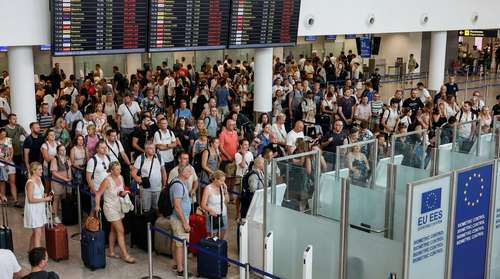
Travel industry representatives note that processing times per passenger have skyrocketed. The resulting EU Entry Exit System queues have forced travelers to wait in lines that sometimes stretch outside terminal buildings onto exposed airport aprons. The World Travel and Tourism Council (WTTC) recently warned that the ongoing border friction puts a staggering 41 million arrivals and $45.4 billion in visitor spending at risk this year, as frustrated travelers reconsider their trips to the continent.
Nine Nations Demand Urgent Border Relief
The sheer scale of the disruption has prompted a massive industry pushback. Top representative bodies, including Airports Council International Europe (ACI), Airlines for Europe (A4E), and the International Air Transport Association (IATA), recently sent a joint letter to European Commission President Ursula von der Leyen. They demanded immediate intervention, asking for the ability to completely suspend EES processing when passenger volumes exceed an airport's operational capacity.
Political pressure is also mounting. Nine European countries—including major tourism hubs like France, Germany, Greece, Italy, and Portugal—have joined the aviation industry in challenging Brussels. These nations are urging the European Commission to extend emergency EES flexibilities into early 2027, which would allow border police to manually process travelers or skip biometric enrollment entirely during peak congestion. So far, the Commission has maintained that a blanket suspension is "not possible," though they acknowledge acute issues at 20 critical border chokepoints.
Relief for Now: ETIAS Travel Authorization Delay
In a direct concession to the ongoing operational disaster, the European Union has officially pulled the plug on its next major border initiative for the immediate future. The highly publicized launch of the European Travel Information and Authorisation System—a €20 pre-travel clearance required for visa-exempt visitors—has been shelved.
This ETIAS travel authorization delay pushes the program's start date to at least 2027. EU-Lisa, the agency responsible for the underlying IT architecture, cited "technical glitches" and the necessity of stabilizing the current EES framework before layering on additional digital requirements. For travelers, this means avoiding the extra fee and paperwork for another year, though it does little to solve the immediate physical queues at immigration counters.
Navigating Summer Travel to Europe in 2026
If you are planning summer travel to Europe in 2026, preparation is vital. Aviation experts and airlines are universally advising non-EU passport holders to arrive at the airport significantly earlier than the standard two-hour window, especially if flying out of known congestion hotspots like Paris Beauvais, Lisbon, or Berlin. Ensure your connections within the Schengen zone have generous layover buffers, and pack extra patience as Europe's border technology struggles to meet peak summer demand.