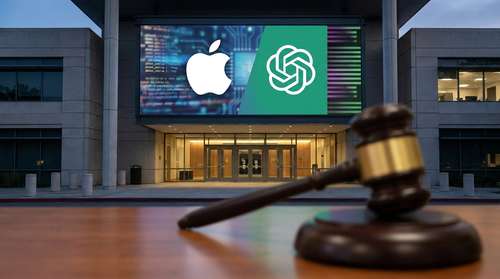
As Apple sues OpenAI in an explosive federal lawsuit, it sets the stage for what could be the most fiercely contested legal showdown in recent technology history. Filed in the U.S. District Court for the Northern District of California on Friday, July 10, the blockbuster OpenAI trade secret lawsuit accuses the AI titan of systematically poaching employees to steal highly confidential hardware designs and supply chain data. At the heart of the matter is the development of a highly anticipated consumer product—sparking a fierce Apple vs OpenAI hardware rivalry that threatens to upend the entire industry.
A Historic Silicon Valley Legal Battle
The relationship between these two tech behemoths has experienced a breathtakingly rapid deterioration. Only months ago, the companies announced a landmark partnership to integrate ChatGPT into iOS, iPadOS, and macOS, a move designed to bring advanced generative AI to hundreds of millions of Apple users. Today, Apple is taking the offensive in a court of law.
According to court filings, Apple alleges that OpenAI engaged in a "coordinated pattern of misconduct at an institutional level" to misappropriate proprietary technology and fast-track its own consumer hardware initiatives. The ChatGPT maker sued by Apple maintains that these allegations are entirely unfounded. A spokesperson for OpenAI, Drew Pusateri, stated the company is reviewing the filing but insisted it has "no interest in other companies' trade secrets" and remains focused on building innovative technology independently.
Yet, Apple's scathing 41-page complaint paints a drastically different picture. The iPhone manufacturer argues that OpenAI's upcoming hardware venture rests on "the shakiest of foundations, rotten to its core by its illegal reliance on misappropriated trade secrets".
Tang Tan Apple Lawsuit: The Core Allegations
Central to the complaint are the brazen actions of former Apple executives and engineers who departed for OpenAI. The Tang Tan Apple lawsuit specifically names OpenAI's Chief Hardware Officer, Tang Yew Tan, as a primary defendant. Tan spent nearly 24 years at Apple as Vice President of Product Design, where he oversaw the creation of generation-defining devices like the iPhone and Apple Watch.
The lawsuit outlines several shocking claims against Tan and his technical staff:
- "Show and Tell" Interviews: Apple alleges that Tan explicitly coached job candidates to evade Apple's rigid security protocols. He allegedly directed recruits to bring confidential, unreleased Apple parts—including specialized batteries and logic boards—to their OpenAI interviews.
- Unauthorized Data Access: Another named defendant, former Apple senior electrical engineer Chang Liu, is accused of exploiting a shared network vulnerability to hack internal servers. The suit claims he downloaded thousands of pages of proprietary hardware files while actively developing technology for OpenAI, and even left a mocking "LOL" message on a colleague's laptop celebrating the security breach.
- Coordinated Recruitment: Apple asserts that over 400 former employees have now transitioned to OpenAI. The lawsuit claims OpenAI leadership actively targeted engineers possessing critical, specialized knowledge of unreleased products, manufacturing processes, and supplier negotiations.
The Jony Ive AI Hardware Device at the Center of the Dispute
To fully understand the motive behind this alleged corporate espionage, one must examine OpenAI's aggressive pivot into consumer hardware. Tensions initially flared when OpenAI invested heavily to acquire io Products, a hardware startup co-founded by legendary former Apple design chief Jony Ive, along with Tang Tan and other Apple veterans. The $6.5 billion acquisition in 2025 signaled CEO Sam Altman's concrete intent to release a revolutionary Jony Ive AI hardware device.
While specific details remain tightly guarded behind closed doors, industry analysts believe this new category of AI-powered hardware is designed to eventually challenge the dominance of the smartphone. By integrating advanced natural language models, like the newly rolled out GPT-5.6, directly into a novel form factor—potentially a screen-free conversational agent or an always-on wearable—OpenAI aims to reshape how humans interact with the digital world. However, Apple contends this ambitious vision was illegally accelerated using stolen blueprints, internal codenames, and supplier relationships that took Apple decades and billions of dollars to cultivate.
"Rotten to Its Core": Apple vs OpenAI Hardware Showdown
This lawsuit fundamentally shifts the dynamic of the ongoing artificial intelligence boom. Previously, the industry focus was strictly centered on software models, cloud computing infrastructure, and enterprise partnerships. Now, the battleground has expanded into the physical world. The Apple vs OpenAI hardware race represents a high-stakes clash over who will control the next paradigm of consumer computing.
If Apple successfully proves that OpenAI's upcoming hardware relies on stolen intellectual property, the fallout could be catastrophic for the AI startup. Apple is seeking substantial damages and an injunction that could indefinitely stall the release of OpenAI's first consumer device. Furthermore, the shadow of this litigation could severely complicate OpenAI's theoretical initial public offering and alienate crucial investors who are wary of IP disputes.
What This Means for the Future of AI and Tech
As both companies prepare their legal arsenals, the global tech community is watching closely. This Silicon Valley legal battle will likely feature prolonged and messy discovery processes, potentially exposing internal communications from some of the industry's most prominent figures. Regardless of the final legal outcome, the talent war between legacy tech giants and nimble AI pioneers has officially escalated from aggressive recruitment to outright corporate warfare.
For consumers, this confrontation underscores just how pivotal the next generation of AI-integrated hardware will be. The race to replace the iPhone has begun, and the world's most powerful tech companies are playing for keeps.