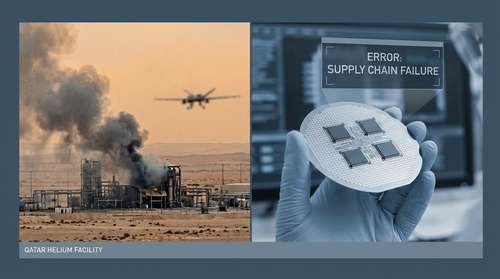
The global tech industry is facing an unprecedented emergency this week as escalating geopolitical conflict in the Middle East cripples a highly specialized, yet critical component of the digital economy. The sudden helium supply crisis 2026 was triggered by coordinated drone strikes on Qatar's Ras Laffan complex earlier this month, knocking offline a massive energy hub responsible for nearly one-third of the world's helium output. As the immediate shockwaves settle, industry experts are issuing dire warnings this week that the prolonged outage is rapidly turning into a full-blown semiconductor production shortage. Without a swift resolution, this bottleneck threatens the availability of everything from cutting-edge smartphones and autonomous vehicles to life-saving medical imaging equipment. With no viable substitutes available for manufacturing, tech giants and foundries are scrambling to secure remaining stockpiles before fabrication lines are forced to halt entirely.
Drone Strikes on Helium Infrastructure Paralyze Global Output
The acute fragility of the global tech supply chain was laid bare when targeted drone strikes on helium infrastructure completely paralyzed QatarEnergy's operations. Because industrial helium is almost exclusively captured as a byproduct of liquefied natural gas (LNG) processing, the shutdown of the massive Ras Laffan plant immediately froze all local helium extraction.
This particular helium extraction facility is an absolute titan in the industry, historically supplying roughly 30% of global demand, which equates to approximately 63 million cubic meters annually. In the immediate aftermath of the attacks, QatarEnergy was forced to declare force majeure, freeing the state-owned company from its delivery obligations and instantly removing around 5.2 million cubic meters of the vital gas from the market each month. As of late March, the financial fallout is undeniable. Spot prices for helium have exploded across international markets, with some desperate buyers reportedly facing premiums exceeding $2,000 per thousand cubic feet.
The Irreplaceable Gas: Why the Chip Manufacturing Crisis is Imminent
You might wonder why a gas best known for filling party balloons and operating MRI machines is suddenly a matter of national security for tech conglomerates. In the realm of advanced electronics, helium is entirely irreplaceable. The gas is a non-negotiable requirement across multiple stages of semiconductor fabrication, specifically in creating the highly stable vacuum environments necessary for precision lithography, etching, and deposition equipment.
Furthermore, helium's exceptionally low thermal conductivity and lightweight atomic structure make it the perfect cooling medium. During the manufacturing of cutting-edge 3-nanometer and 2-nanometer nodes, silicon wafers undergo intense thermal stress. Helium rapidly dissipates this heat, preventing physical warping and massive performance degradation. Without a continuous supply of this inert gas, the escalating chip manufacturing crisis will force foundries to drastically slow production—by some estimates up to 15% per week—or risk catastrophic hardware rejection rates due to temperature spikes.
South Korea and Taiwan at Ground Zero
The most vulnerable players in this rapidly unfolding scenario are the major Asian foundries. Recent data from the Korea International Trade Association indicates that South Korea sourced a staggering 65% of its helium from Qatar last year. Major memory and logic chip producers like SK hynix and Samsung are heavily exposed, putting the advanced nodes required for global compute directly in the crosshairs. While companies like SK hynix have stated this week that they have diversified short-term procurement to maintain yields, the clock is ticking.
The Looming AI Hardware Shortage and Cloud Delays
Just as artificial intelligence investments were expected to hit record highs this year, this severe supply shock threatens to derail the industry's momentum. Taiwan Semiconductor Manufacturing Company (TSMC), which currently produces roughly 90% of the world's most advanced logic chips, remains the sole supplier for major AI accelerators. Any prolonged disruption to their thermal control processes directly threatens an estimated $650 billion in planned global AI infrastructure investments.
The ripple effects are already extending well beyond fabrication plants. Leading cloud providers and tech behemoths are reportedly dealing with the direct fallout of the regional instability. Amazon has noted disruptions involving its data center operations in the United Arab Emirates and Bahrain, underscoring the vulnerability of physical infrastructure in the Gulf. If the current supply bottleneck extends into the summer, a severe AI hardware shortage is virtually guaranteed by the third quarter of this year. This will inevitably starve data center operators of the high-bandwidth memory and advanced compute accelerators they desperately need to scale their platforms.
Navigating the 2026 Semiconductor Production Shortage
Leading industry analysts are painting a sobering picture of the recovery timeline over the next few months. Phil Kornbluth, a prominent analyst at Kornbluth Helium Consulting, highlighted this week that even if hostilities cease immediately, the market is facing a minimum of two to three months of pure production disruption. Compounding this delay is the logistical nightmare of revalidating regional suppliers and redistributing complex cryogenic equipment. True normalization of the supply chain could take anywhere from four to six months.
As we look ahead to the remainder of the year, the helium supply crisis 2026 serves as a glaring wake-up call for the technology sector regarding raw material dependencies. While major foundries maintain short-term emergency stockpiles, that buffer is dangerously thin. If diplomatic resolutions fail to materialize soon and crucial shipping routes like the Strait of Hormuz remain obstructed, both enterprises and everyday consumers should brace for massive delays and steep price hikes across the entire consumer electronics and AI landscape.