U.S. business leaders and trade groups are launching an aggressive campaign to reclaim an estimated $133 billion in tariff refunds today, following a historic Supreme Court ruling that struck down the Trump administration's reciprocal trade measures as unconstitutional. The scramble for restitution comes just hours before a new, sweeping 15% global import tax is set to take effect at midnight on February 24, 2026, threatening to plunge the retail industry news today into further chaos.
Supreme Court Tariff Ruling 2026 Sparks Refund Frenzy
In a stunning 6-3 decision delivered on Friday, the Supreme Court ruled that the President exceeded his authority under the International Emergency Economic Powers Act (IEEPA) by imposing broad "reciprocal" tariffs without direct Congressional approval. The ruling, authored by Chief Justice John Roberts, has opened the floodgates for business tariff refund claims, with major importers like Costco, Revlon, and the National Retail Federation (NRF) demanding the immediate return of duties collected since April 2025.
"This ruling is a victory for the Constitution and American consumers," said Neil Bradley, Executive Vice President of the U.S. Chamber of Commerce. "However, the government is currently holding over $133 billion in illegally collected taxes. American businesses need that capital back now to offset the rising costs of doing business." Legal experts predict the refund process could be messy, likely requiring intervention from the U.S. Court of International Trade to determine the mechanics of repayment.
Trump Counters with 15% Import Duty Impact
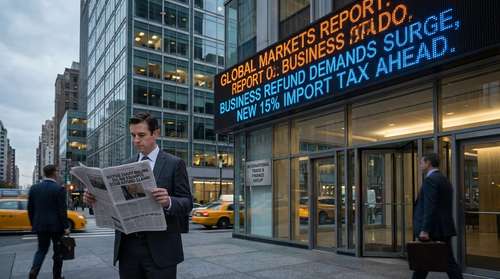
The White House has moved with lightning speed to counter the judicial setback. Citing US trade policy updates and shifting legal strategies, President Trump announced late Sunday that he would invoke Section 122 of the Trade Act of 1974—a rarely used provision addressing balance-of-payments deficits—to impose a blanket 15% global import tax on all foreign goods.
This new levy, the maximum allowed under Section 122, is scheduled to hit at midnight tonight. Unlike the previous IEEPA-based tariffs, this measure is time-limited to 150 days unless extended by Congress. "We will not allow foreign nations to strip-mine our wealth while our hands are tied by activist judges," the President stated in a press release, framing the Trump global import tax as a necessary stopgap to protect domestic manufacturing.
Inflation and Tariffs 2026: Economic Fallout
Economists are already warning that the new 15% rate, which allows for fewer exemptions than previous regimes, could reignite inflation and tariffs 2026 concerns. The swift implementation leaves importers with virtually no time to adjust supply chains. "The volatility is unprecedented," notes Sarah Johnson, a trade analyst at Goldman Sachs. "Businesses are being whipped back and forth between legal victories and new executive penalties. The 15% flat tax will almost certainly be passed directly to consumers at the checkout line."
Retailers Brace for Midnight Deadline
For the retail sector, the situation is dire. Companies that were celebrating the Supreme Court victory on Friday are now scrambling to clear customs before the new 15% import duty impact kicks in. Logistics hubs at the Ports of Los Angeles and Savannah report record congestion as importers rush to beat the midnight deadline.
Major industry players warn that price hikes are inevitable if the new tax holds. "We are looking at a scenario where apparel, electronics, and home goods see immediate price increases of 10-15%," stated the NRF in a morning briefing. As the clock ticks down to February 24, the dual battle for billions in refunds and against new levies marks a critical turning point in the administration's second-term economic agenda.