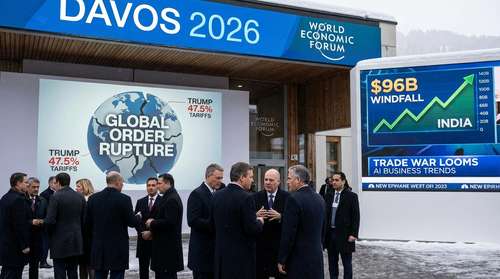
The 56th World Economic Forum in Davos has drawn to a close, leaving global leaders grappling with a stark new reality: the era of polite globalization is officially over. As helicopters depart the Swiss Alps this weekend, the prevailing mood is one of defensive calibration. The summit, dominated by President Donald Trump's aggressive protectionist policies and a crushing 47.5% tariff on Chinese imports, culminated in a sobering warning from Canadian Prime Minister Mark Carney. In a defining speech, Carney declared a "rupture" in the global order, asserting that the "old order is not coming back." Yet, amidst the geopolitical fracture, pockets of immense opportunity emerged, most notably India securing a staggering $96 billion in investment commitments for the Mumbai region.
The 'Rupture': A World Economy Fragmenting
For decades, the World Economic Forum 2026 takeaways have focused on connectivity and cooperation. This year, the narrative shifted violently toward fragmentation. The buzzword in the congress center wasn't "poly-crisis" but "rupture." Mark Carney's address captured the sentiment perfectly, warning delegates that nostalgia for the pre-2025 rules-based system is "not a strategy."
European Central Bank President Christine Lagarde, while attempting to downplay the panic, admitted that Europe needs a "Plan B." Her comments followed a tense week where US Commerce Secretary Howard Lutnick reportedly berated European economic performance at a private dinner, prompting a walkout by some officials. The message from Washington is clear: the U.S. is prioritizing economic nationalism over alliance maintenance. IMF Managing Director Kristalina Georgieva added to the gravity, describing trade flows as a "river" that will find new paths around obstacles, but warned that the adjustment period will be volatile and costly.
Trump Tariffs 2026 Impact: The 47.5% Wall
The specter of the U.S. trade war loomed larger than any snowstorm. Data released during the summit confirmed that Trump tariffs 2026 impact has been profound. With duties on Chinese goods now averaging 47.5%, imports from China to the U.S. have plummeted by nearly 25% in the last year. This aggressive decoupling is forcing a rewiring of global supply chains that business leaders described as "frantic" and "expensive."
The volatility isn't contained to China. European allies spent the week scrambling after Trump threatened new tariffs on EU nations in relation to the dispute over Greenland. While a last-minute "framework" deal with NATO de-escalated the immediate threat, the incident underscored the unpredictability of the current administration. For global CEOs, the takeaway is clear: Global trade war news is no longer a risk to be managed but a daily operational reality.
India's $96 Billion Win: A Counter-Narrative of Growth
Amidst the Western anxiety, India provided the summit's most significant bullish signal. In a historic move, the Mumbai Metropolitan Region Development Authority (MMRDA) announced it had secured $96 billion (₹8.73 lakh crore) in investment commitments. This massive influx of capital highlights the shifting center of economic gravity.
Maharashtra Chief Minister Devendra Fadnavis termed these agreements the blueprint for "Mumbai 3.0." The deals include:
- $45 billion from Italy's SBG Group for logistics and data infrastructure.
- $25 billion from Panchshil Realty for mixed-use development.
- $8 billion from Japan's Sumitomo Realty for transit-oriented projects.
This success positions the India $96 billion investment Davos story as a beacon for the Global South, proving that capital is still flowing aggressively to markets that offer stability and scale, even as the West turns inward.
AI Business Trends 2026: From Hype to 'Physical AI'
Beyond geopolitics, the technology conversation matured significantly. The "generative AI" hype of previous years has evolved into a focus on Physical AI—the integration of artificial intelligence into robotics and real-world infrastructure. NVIDIA CEO Jensen Huang and Qualcomm’s Cristiano Amon dominated discussions, outlining a future where AI steps out of the screen and into the factory floor and city grid.
However, the AI business trends 2026 discussion came with its own warnings. The IMF's Georgieva cautioned of an impending "tsunami" hitting labor markets, predicting that 60% of jobs in advanced economies will be impacted. The consensus among tech leaders is that 2026 is the year of "Agentic AI"—autonomous systems that don't just generate text but execute complex workflows, further pressuring the white-collar workforce to adapt or face obsolescence.
Future of Global Economy: The New Normal
As the Davos 2026 highlights are digested in boardrooms worldwide, the future of global economy looks markedly different than it did just two years ago. We are entering an era of "variable geometry" alliances, where middle powers like Canada, India, and Japan must navigate between a protectionist America and a resilient China.
The "rupture" is real. The global trading system has not just bent; it has broken into regional blocs. For investors and businesses, success in 2026 will depend not on waiting for the storm to pass, but on building reinforced shelters and finding new paths for growth in the emerging markets that are refusing to participate in the West's pessimism.