
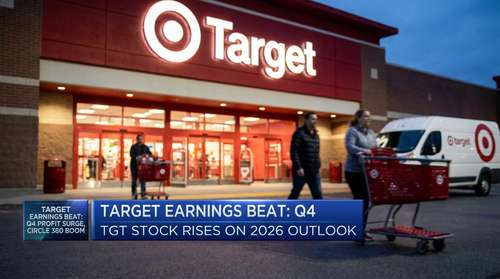
Target Corp. (NYSE: TGT) has officially signaled a turning point for the US retail industry, smashing Wall Street’s profit expectations in its Q4 2025 earnings report and projecting a decisive return to growth in 2026. The big-box retailer saw its stock climb significantly in early trading after revealing a 30% surge in same-day delivery services and a remarkable doubling of revenue from its Target Circle 360 loyalty program. As consumer discretionary spending stabilizes, Target’s latest financial results offer a bullish case for a wider retail recovery heading into the new fiscal year.
Q4 2025 Earnings Analysis: Profitability Over Revenue
While top-line revenue presented a mixed picture, Target’s bottom-line performance demonstrated impressive operational discipline. The company reported adjusted earnings per share (EPS) of $2.44, handily beating the analyst consensus of roughly $2.16. This profit surge comes despite a 1.5% dip in total revenue to $30.5 billion, a figure that reflects the lingering caution in the broader retail landscape.
The narrative here isn't just about raw sales numbers; it's about efficiency. Gross margins expanded to 26.6%, driven by reduced supply chain costs and lower inventory shrink—a critical metric that plagued retailers throughout 2024 and 2025. CEO Michael Fiddelke emphasized that while the sales environment remains competitive, the company’s ability to protect profits while investing in growth engines is paying off.
Breaking Down the Numbers
- Adjusted EPS: $2.44 (vs. $2.16 expected)
- Revenue: $30.5 billion (down 1.5% YoY)
- Comparable Sales: Declined 2.5%
- Digital Sales: Comparable digital sales rose 1.9%
Target Circle 360 and the Digital-First Pivot
The standout star of the earnings report was undoubtedly the company's membership and delivery ecosystem. Target Circle 360, the retailer's answer to Amazon Prime and Walmart+, is rapidly becoming a cornerstone of its business model. Membership revenue more than doubled year-over-year, validating the company's aggressive push into the subscription economy.
This isn't just about collecting membership fees; it's about changing how customers shop. Same-day delivery volume, powered by the Shipt infrastructure integrated into Circle 360, grew by over 30%. This metric is vital because it proves Target can compete on speed and convenience, not just price. As shoppers increasingly value time over minor price differences, Target’s logistical investments are creating a "sticky" ecosystem that locks in high-value repeat customers.
2026 Guidance: A Return to Growth
Looking ahead, Target’s 2026 revenue guidance paints a picture of optimism. After a challenging fiscal 2025 where full-year sales dipped 1.7%, management is forecasting a 2% net sales increase for fiscal 2026. This projection is significant—it marks the end of the post-pandemic correction and the beginning of a new growth cycle.
The company expects earnings per share for the full year to land between $7.50 and $8.50. This guidance suggests that the operational efficiencies realized in Q4 are sustainable. The strategy is clear: leverage the improved margin profile to fund competitive pricing in essentials like food and beverage, while counting on the high-margin digital advertising business (Roundel) and membership fees to drive profitability.
Stock Price Reaction and Analyst Sentiment
Markets reacted swiftly to the news. TGT stock price analysis shows a jump of approximately 2-5% in pre-market and early trading sessions immediately following the release. Investors appear relieved that the "bleeding" in discretionary categories like home decor and apparel has slowed, and are encouraged by the green shoots in digital engagement.
Analysts are particularly focused on the "category mix." While discretionary spending is still soft, the growth in high-frequency categories like Beauty and Food & Beverage provides a safety net. The consensus view is shifting from "cautious" to "accumulate," as Target proves it can navigate a high-interest-rate environment better than many of its mall-based peers.
Broader Implications for US Retail Trends 2026
Target’s performance serves as a bellwether for the entire US retail industry. The stabilization of inventory levels and the success of paid membership tiers suggest that the "retail apocalypse" narratives are overblown. Instead, we are seeing a bifurcation: retailers with robust digital logistics and loyalty moats are thriving, while those relying solely on foot traffic continue to struggle.
For investors and industry watchers, the message from Minneapolis is clear. The consumer is still spending, but the *way* they spend has fundamentally shifted toward delivery-first convenience and membership-driven value. Target has successfully aligned its ship with these winds, setting the stage for a rebound year in 2026.