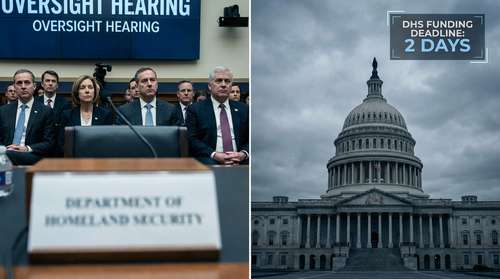
Washington — The threat of a partial government shutdown intensified Tuesday as top immigration officials faced a blistering interrogation on Capitol Hill regarding the deaths of two U.S. citizens during a controversial federal enforcement operation in Minneapolis. With a Friday funding deadline approaching, Senate Democrats have drawn a line in the sand, vowing to block Department of Homeland Security (DHS) appropriations unless the White House accepts strict new prohibitions on the tactics used in the ongoing Trump immigration crackdown news dominates.
Immigration Oversight Hearing 2026: Tensions Boil Over
For the first time since the launch of "Operation Metro Surge" in late 2025, the heads of the nation's three primary immigration agencies appeared before the House Homeland Security Committee. The immigration oversight hearing 2026 was characterized by fierce exchanges between Democratic lawmakers and the witnesses: Acting ICE Director Todd Lyons, CBP Commissioner Rodney Scott, and USCIS Director Joseph Edlow.
The hearing, intended to review the agencies' fiscal requests, quickly pivoted to the deaths of Renée Nicole Good and Alex Pretti, two Minneapolis residents killed by federal agents in January. Democrats, led by Ranking Member Bennie Thompson (D-MS), accused the agencies of operating as a "secret police force," citing the widespread use of unmarked vehicles and masked agents who refuse to identify themselves to local law enforcement.
"Two Americans are dead, their families are grieving, and this administration offers nothing but defiance," Thompson said in his opening statement. "We cannot and will not sign a blank check for a paramilitary force that operates above the law."
Operation Metro Surge Deaths: Conflicting Accounts
The core of the controversy centers on the Operation Metro Surge deaths that have sparked weeks of protests across the Twin Cities. Renée Good, 37, was shot in her vehicle on January 7 by an ICE agent who claimed she attempted to run him over—a narrative that has been challenged by bystander video showing her vehicle moving away from officers. Two weeks later, Alex Pretti, an ICU nurse, was killed by CBP agents who alleged he was brandishing a firearm, a claim later debunked by security footage.
During ICE testimony today, Acting Director Lyons refused to apologize to the families of the victims, citing ongoing internal investigations. "Our officers are facing unprecedented threats from anarchists and political agitators," Lyons told the committee. "We will not be intimidated by those who wish to see our borders erased. The President has given us a mandate to restore order, and we are fulfilling it."
Lyons confirmed that despite a recent tactical withdrawal of 700 agents announced by Border Czar Tom Homan, approximately 2,000 federal agents remain stationed in Minnesota. He touted the arrest of 4,000 "criminal illegal aliens" since the operation began, though he declined to specify how many of those detained had violent criminal records versus civil immigration violations.
Federal Agent Masking Controversy and Funding Battle
The hearing highlighted the growing federal agent masking controversy, a key sticking point in the current budget negotiations. Senate Democrats have introduced a rider to the DHS funding bill that would mandate all federal agents displayed visible identification badges and ban the use of "tactical anonymity" in non-covert domestic operations. The White House has threatened to veto any bill containing such restrictions, setting the stage for a potential DHS shutdown threat by midnight Friday.
The Economic and Social Toll
Beyond the human tragedy, lawmakers from Minnesota highlighted the economic devastation caused by the surge. Minneapolis officials estimate the city is losing $20 million weekly as fear grips the community, shuttering businesses on Lake Street and keeping children from school. "You are not just hunting individuals; you are suffocating an entire American city," said Rep. Ilhan Omar (D-MN), who questioned the witnesses on the constitutionality of their deployment.
Border Security Funding Battle Intensifies
As the clock ticks toward the funding deadline, the border security funding battle has become a proxy war for the broader direction of the country's immigration policy. Republicans on the committee praised the agency heads for their "unyielding resolve" and argued that the Metro Surge operation serves as a necessary model for future enforcement actions in sanctuary jurisdictions.
However, with the Senate gridlocked and the White House digging in, the possibility of a DHS shutdown is becoming increasingly real. If a continuing resolution is not passed by Friday, thousands of border agents and administrative staff could be furloughed, ironically stalling the very enforcement machinery the administration seeks to expand.
"We are at an impasse," said Senate Majority Leader Chuck Schumer. "We will not fund a domestic army that kills American citizens with impunity. The ball is in the President's court."