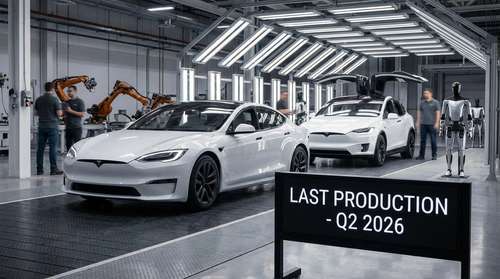
In a watershed moment for the automotive industry, Tesla has officially announced it will cease production of its flagship Model S and Model X vehicles by the second quarter of 2026. The stunning revelation came during the company's Q4 2025 earnings call on Wednesday, where CEO Elon Musk declared it was time to give the pioneering electric vehicles an "honorable discharge." This strategic pivot marks the definitive end of Tesla's "S3XY" vehicle lineup era and signals an aggressive reallocation of resources toward the Optimus humanoid robot and autonomous robotaxi platforms. As the Fremont factory gears up for a radical transformation, the move underscores Tesla's transition from a traditional EV manufacturer to what Musk describes as a "physical AI company."
The End of the S3XY Era: Model S and X Discontinued
After more than a decade of defining the modern electric vehicle landscape, the Tesla Model S and Model X are reaching the end of the line. Musk confirmed that production for both models will wind down completely by the end of Q2 2026. "It’s time to basically bring the Model S and X programs to an end with an honorable discharge, because we’re really moving into a future that is based on autonomy," Musk told investors. The decision, while emotionally significant for early adopters, is driven by cold financial logic. Combined sales for the luxury flagship models dwindled to approximately 30,000 units globally in 2025, a fraction of the volume generated by the mass-market Model 3 and Model Y.
The discontinuation of the Model S, which launched in 2012 and proved that electric cars could be desirable and high-performing, closes a defining chapter in automotive history. However, Tesla has assured existing owners that it will continue to support the vehicles with parts and service indefinitely. For those looking to own a piece of history, Musk issued a final call to action: "If you’re interested in buying a Model S and X, now would be the time to order it."
The Optimus Pivot: From Cars to Humanoid Robots
The vacuum left by the Model S and X at Tesla's Fremont, California facility will be filled immediately by the company's most ambitious project yet: the Elon Musk Optimus robot. The production lines that once assembled luxury sedans and SUVs are being retrofitted to manufacture Tesla's Gen 3 humanoid robots. Musk outlined a staggering long-term goal of producing one million Optimus units annually at the site, aiming for a price point between $20,000 and $30,000 per unit.
This shift represents a massive gamble on AI robotics trends. Musk has frequently stated that Optimus has the potential to be "more significant than the vehicle business," envisioning a future where robots handle dangerous, repetitive, or boring tasks. By cannibalizing its own flagship vehicle lines to make room for robotics, Tesla is putting its entire manufacturing prowess behind the belief that the labor market—not the car market—is the next frontier for growth. "The future is autonomous," Musk emphasized, reiterating his vision of Tesla as a robotics and AI superpower rather than just a car company.
Tesla Robotaxi News 2026: The Autonomous Horizon
Alongside the robotics pivot, the Tesla robotaxi news 2026 landscape is heating up. While the Model S and X are being retired, Tesla is doubling down on its dedicated Cybercab platform. Updates from the earnings call indicate that Cybercab volume production is on track to begin later this year, with unsupervised rides already being tested in select markets like Austin, Texas.
Unsupervised FSD Progress
The company reported that its "unsupervised" Full Self-Driving (FSD) tests in Austin are expanding, though not without scrutiny. Reports surfaced earlier this week about the temporary pausing of unsupervised rides, but Musk assured investors that the data gathered is paving the way for a broader rollout in 2027. The removal of the Model S and X simplifies Tesla's manufacturing complexity, allowing the engineering teams to focus entirely on the next-generation vehicle platform designed specifically for a driverless future.
Market Reaction and Future of Tesla EV
Despite reporting its first-ever annual revenue drop in 2025, Tesla's stock surged over 3% following the announcement. Investors appear to be buying into the Tesla strategic pivot, valuing the potential of the robotics market over the declining returns of aging luxury vehicle models. However, not everyone is convinced. Analysts like Gary Black have voiced concerns, calling the discontinuation of the high-margin Model S and X a "mistake" given their strong brand loyalty compared to the newer, polarizing Cybertruck.
The future of Tesla EV production now rests squarely on the shoulders of the Model 3, Model Y, and the ramping Cybertruck, until the lower-cost next-gen vehicles arrive. By cutting the low-volume heritage models, Tesla is streamlining its operations to survive a competitive EV market while simultaneously betting the farm on an AI-driven future. As 2026 unfolds, the world will watch to see if Musk's gamble to trade proven luxury cars for humanoid robots will pay off or leave the company vulnerable in the transition.