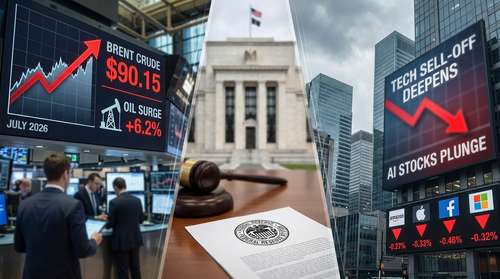

On Friday, March 13, 2026, investors awoke to a brutal reality as a historic global stock market crash wiped out trillions in market value worldwide. The catalyst is an unprecedented oil price shock 2026, fueled by the complete blockade of the world's most vital energy artery. Following intense US-Israel-Iran military escalations that began in late February, the shutdown of maritime traffic in the Middle East has sent Brent crude rocketing toward $140 a barrel. With supply chains paralyzed and energy costs spiraling out of control, Wall Street and international exchanges are now aggressively pricing in a severe economic contraction.
The Strait of Hormuz Closure Impact on Global Trade
The Strait of Hormuz closure impact cannot be overstated. Roughly 20% of the world's daily oil consumption and a fifth of global liquefied natural gas (LNG) normally traverse this 21-mile-wide chokepoint. Following joint military strikes on February 28, the passage is effectively closed to commercial shipping, guarded by immediate military threats to any vessel attempting transit.
Shipping giants including Maersk, CMA CGM, and MSC immediately suspended operations in the area, leaving over 150 tankers idling outside the Gulf rather than risking their crews and cargo. To compound the logistical nightmare, QatarEnergy declared force majeure on LNG shipments after its facilities were compromised, instantaneously removing a massive chunk of global supply.
For the first time in modern history, both of the Middle East's major maritime corridors are simultaneously blocked. With the Red Sea route already operating at less than half of its pre-crisis capacity due to regional hostilities, commercial fleets are being forced to take the costly, weeks-long detour around the Cape of Good Hope. This dual blockade has generated the most severe Middle East conflict economic news in decades, completely choking off critical supply lines to Asia and Europe.
Brent Crude Price Surge and the Oil Price Shock 2026
Energy markets reacted with ferocious speed. The Brent crude price surge pushed oil well past the $100 mark earlier this month, and intraday trading is now seeing futures test the devastating $140 threshold. Asian economies, which are structurally reliant on Middle Eastern energy imports, are bearing the immediate brunt of the crisis.
Japan, which imports 95% of its crude from the region, and South Korea, heavily dependent on Gulf LNG, have watched their equity markets plunge. South Korea's KOSPI index recently triggered a rare circuit breaker following a massive double-digit decline, marking its worst trading day of the episode. In the United States, consumers are already feeling the physical pinch at the pump, with gasoline prices in California breaching $5 a gallon in the second week of March.
Analysts warn that if this oil price shock 2026 sustains, the damage to global manufacturing, commercial transportation, and agricultural production will mirror the worst days of the 1970s energy crisis. A potential looming energy shortage could shutter factories across the industrial world.
Worsening Inflation Forecast 2026 Limits Central Bank Action
Before this geopolitical crisis exploded, economists widely expected the U.S. Federal Reserve and the European Central Bank to initiate interest rate cuts by the spring. That optimistic inflation forecast 2026 is now completely dead. Central bankers find themselves trapped between rapidly slowing economic growth and a reignited inflationary fire.
Every sustained $10 increase in the price of a barrel of oil cascades directly through the global economy, hiking the cost of freight, industrial manufacturing, and raw materials. Shippers are already being hit with emergency freight surcharges and skyrocketing war risk insurance premiums. Consequently, baseline inflation metrics are expected to aggressively reverse their downward trend. The Federal Reserve simply cannot lower interest rates while energy costs are hyper-inflating. Doing so would risk a currency crisis and runaway consumer prices. Businesses and households will therefore continue to suffer under punitively high borrowing costs.
Emerging Markets Face Disproportionate Risks
Beyond the Western indices, emerging markets are particularly exposed to the unfolding disaster. Financial institutions have highlighted that developing currencies are incredibly vulnerable to the ongoing blockade. Because nations like India import the vast majority of their liquefied petroleum gas and natural gas from the Middle East, sustained oil prices near $120 to $140 per barrel could drastically widen their current account deficits.
This dynamic applies broadly across developing nations in Asia and Africa. A lengthy closure scenario threatens to morph into an economic environment resembling the darkest days of the pandemic lockdowns, but driven entirely by resource scarcity. Without access to affordable energy, the manufacturing backbone of the global supply chain faces an existential threat.
Recession Fears March 2026 Grip Wall Street
The lethal combination of supply chain paralysis and surging fuel costs has unleashed widespread recession fears March 2026. The resulting equities sell-off has been completely indiscriminate. Over the past week, emerging market exchanges eroded over $120 billion in total wealth. Meanwhile, U.S. and European indices have suffered their steepest weekly falls in over a year.
The VIX fear gauge spiked past 25 as portfolio managers rushed to hedge their exposure. Investors are rapidly dumping technology and consumer discretionary stocks, seeking refuge instead in traditional safe-haven assets like gold and sovereign bonds. European shares dropped sharply on Friday, with Germany's DAX and France's CAC 40 taking heavy losses as their industrial sectors face the dual threat of energy shortages and collapsing export demand.
With no diplomatic resolution in sight for the Middle East crisis, the global financial sector is officially bracing for a protracted period of stagflation. The global economy is on highly unstable footing, and the next few weeks of trading will likely determine the ultimate severity of the impending 2026 recession.