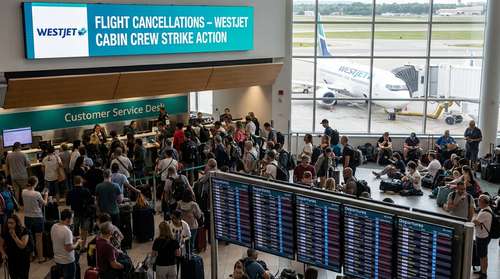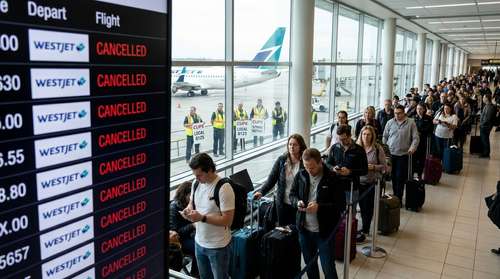
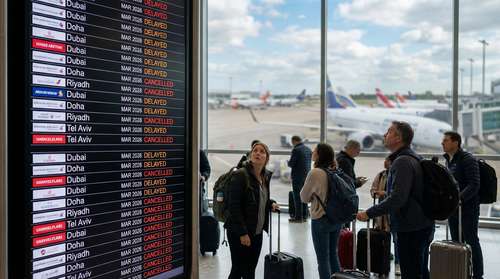
The global travel sector has been thrust into unprecedented chaos. Triggered by sudden military escalations and sweeping airspace closures, the Middle East flight disruptions 2026 are leaving holidaymakers stranded and the aviation industry reeling. What began as regional security measures has rapidly morphed into a global travel economic crisis, right at the onset of one of the busiest travel periods of the year. With tens of thousands of flights canceled and key transit hubs paralyzed, the financial and logistical fallout is fundamentally reshaping the global tourism landscape.
The $600 Million Daily Blow to Global Tourism
The financial magnitude of this aviation crisis is staggering. According to the newly released WTTC tourism impact report, the ongoing geopolitical conflict is draining the global travel sector of an estimated $600 million every single day in lost international visitor spending. The Middle East serves as a critical bridge between East and West, historically accounting for roughly 14 percent of the world's international transit traffic and 5 percent of global international arrivals.
Major aviation hubs, including Dubai, Doha, Abu Dhabi, and Bahrain, typically process over 526,000 passengers daily. Now, these once-efficient transit corridors are facing catastrophic bottlenecks. The World Travel & Tourism Council had originally forecasted $207 billion in regional visitor spending for 2026. That projection is now under severe threat as traveler confidence plummets. Gloria Guevara, President and CEO of the WTTC, recently noted that while the industry is remarkably resilient, the geographic scale of this disruption directly threatens the world's most vital air corridors.
Iran Conflict Aviation News: Airspace Closures and Security
The catalyst for this unprecedented disruption stems from recent military engagements. Following the launch of Operation Epic Fury in early March 2026, multiple nations abruptly closed their airspace to commercial traffic. The most recent Iran conflict aviation news highlights that over 18,000 flights have been delayed or canceled worldwide. A recent drone incident near Dubai International Airport—which wounded four people but did not halt operations—underscores the tense, rapidly evolving security environment.
The Reality of International Flight Rerouting
To prioritize passenger safety, carriers from Europe, Asia, and North America have implemented massive international flight rerouting protocols. Airlines such as Lufthansa, Air India, and British Airways have temporarily suspended direct services to several high-risk destinations across the Gulf. Flights that previously relied on Middle Eastern air corridors are now taking significant detours. These diverted paths add hours to long-haul journeys, stretching crew schedules to their breaking points and forcing travel operators into logistical nightmares.
Spring Break Travel Delays and the U.S. Ripple Effect
The timing of the crisis could not be worse for North American tourists. As U.S. airlines prepare for a projected 171 million passengers to fly before the end of April, Spring Break travel delays are reaching historic levels. The situation at domestic airports is further aggravated by a partial government shutdown impacting Transportation Security Administration (TSA) funding. Travelers at major hubs like Atlanta and Charlotte are facing security lines stretching up to three hours, causing thousands of missed connections.
In a desperate bid to ease the congestion, the U.S. Department of Homeland Security (DHS) recently reactivated the Global Entry program after a brief suspension. However, with global supply chains for aviation services severely strained by the sudden reallocation of fleet capacity, the domestic infrastructure is still buckling under the pressure. Travelers attempting to escape the chaos are engaging in a "flight to safety," shifting their bookings toward Western Europe and the Caribbean, which only compounds the congestion at alternative transit points.
Soaring Airfares March 2026
Beyond the sheer inconvenience of massive delays, tourists are taking a substantial hit to their wallets. The necessity of rerouting flights around restricted airspace has caused aviation fuel consumption to skyrocket. Combined with broader oil price spikes directly linked to the conflict, carriers have implemented emergency fuel surcharges. Consequently, travelers are experiencing soaring airfares March 2026, with last-minute rerouting costs being passed directly to the consumer. Finding an affordable alternative flight has become nearly impossible for families attempting to salvage their spring holidays.
Navigating the Global Travel Economic Crisis
While the immediate outlook appears grim, industry leaders emphasize that the tourism sector has a strong track record of bouncing back. Historical data indicates that demand following security-related incidents can recover in as little as two months, provided governments and aviation authorities act decisively to restore traveler trust. For now, navigating the global travel economic crisis requires immense patience and flexibility.
Travelers heading out for Spring Break are strongly advised to verify their flight status constantly through official airline channels. Experts recommend packing lightly to avoid checked baggage delays, arriving at airports far earlier than usual, and preparing financially for premium costs if itineraries require sudden adjustments. As the aviation world holds its breath, the focus remains entirely on operational safety and bringing stranded holidaymakers home safely.