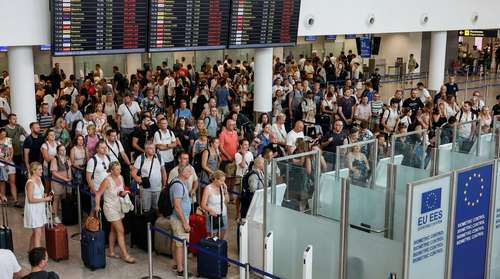
The highly anticipated peak tourist season has rapidly deteriorated into the Europe summer travel chaos 2026, leaving tens of thousands of passengers stranded across the continent. A perfect storm of crippling air traffic control constraints, severe airline staffing shortages, and the rocky rollout of a new digital border checkpoint network has pushed major international hubs to their breaking points. Central to this unprecedented gridlock are the severe EU Entry Exit System EES delays, which have transformed routine passport control into a biometric border "nightmare," forcing planes to depart half-empty while passengers languish in holding areas.
EU Entry Exit System EES Delays Paralyze Terminals
Launched in April 2026 after multiple postponements, the European Union's Entry/Exit System (EES) was designed to modernize border security. The new infrastructure replaces manual passport stamping with automated digital tracking, requiring non-EU citizens—including travelers from the United Kingdom, North America, and Australia—to register their biometric data. This involves rigorous fingerprint scanning and facial imaging upon first crossing into the Schengen area.
However, the technological implementation has severely buckled under the weight of peak summer traffic. The result? Airport biometric border control lines stretching for up to five hours at major terminals. Despite urgent pleas from the aviation industry to temporarily suspend the scheme until September, the European Commission has firmly refused to halt the checks. EU migration chief Magnus Brunner recently acknowledged that while the system is "not perfect," a full suspension is simply "not possible," noting that around 20 major border crossing points remain significant "difficult spots". Consequently, border control facilities cannot process arrivals quickly enough, leaving airlines with no choice but to close boarding gates while ticketed passengers remain stuck in line.
Ryanair Passport Queue Chaos Spain and Beyond
The operational friction at European borders has triggered fierce backlash from industry leaders. Budget airline powerhouse Ryanair has actively warned holidaymakers about imminent Ryanair passport queue chaos Spain, specifically highlighting catastrophic bottlenecks at vital holiday gateways like Tenerife South, Palma de Mallorca, Alicante, and Malaga. The carrier's Chief Operations Officer, Neal McMahon, bluntly stated that travelers should not be used as "guinea pigs" for a "half-baked passport control system" that was clearly ill-prepared for July passenger volumes.
Beyond the Spanish coast, these major disruptions have heavily impacted other regional hubs, including Milan Bergamo in Italy, Paris Beauvais in France, and Krakow in Poland. The ongoing lack of operational kiosks and trained border personnel has forced airport management at these facilities into crisis mode, desperately trying to manage overflowing terminal halls while keeping aircraft turnarounds on schedule.
European Flight Delays and Cancellations Compound the Crisis
While biometric border lines dominate terminal discussions, the broader aviation network is suffering from a massive capacity meltdown. European flight delays and cancellations have surged to alarming levels due to heavily congested airspace, unpredictable weather systems over Central Europe, and localized labor actions. Recent aviation data revealed that more than 1,900 flight delays and cancellations hit major European airports in a single early-July window.
In Italy, the airspace network was practically paralyzed on July 5 by a coordinated labor strike that resulted in over 900 affected flights in just 24 hours. Rome Fiumicino and Milan Malpensa bore the brunt of the disruption, suffering 223 cancellations and 704 massive delays. Similar disruptions have recently swept through Germany—where Frankfurt and Munich saw over 1,200 delays in late June—effectively eliminating any operational slack in airline recovery schedules. Once an aircraft loses its departure slot in this fragile environment, the knock-on effects quickly spread across the entire continent.
ETIAS Visa Delayed 2027: A Quiet Concession
In a direct ripple effect of the ongoing EES border failures, Brussels has quietly made a major concession regarding its upcoming travel policies. The European Travel Information and Authorisation System (ETIAS)—the EU's electronic travel authorization program meant to function similarly to the American ESTA—has been officially pushed back.
Originally targeted for a late 2026 rollout, the ETIAS visa delayed 2027 announcement has brought a collective sigh of relief to those following European travel industry news. The agency in charge of the launch, EU-Lisa, reportedly acknowledged that integrating another complex electronic travel authorization scheme by the end of this year was no longer operationally feasible. European aviation authorities simply cannot risk layering a secondary pre-travel clearance system on top of the already collapsing EES infrastructure without risking a total cessation of international tourism.
How to Survive the Summer Network Gridlock
If you are planning to cross Schengen borders in the coming weeks, meticulous preparation is no longer optional—it is an absolute necessity. Here are vital strategies to help mitigate the risk of severe disruption:
- Arrive Exceptionally Early: Standard two-hour windows are completely insufficient for non-EU passport holders. Plan to arrive at the airport at least four hours prior to your international departure.
- Monitor Localized Alerts: Keep a close eye on regional union updates to track impromptu transit strikes or sudden airspace constraints, especially if traveling through Italy or Germany.
- Understand Passenger Rights: Familiarize yourself with EU261 compensation regulations, though you must be aware that delays caused directly by border control queues or Air Traffic Control limitations often fall outside airline liability parameters.
While the continent's historic and cultural draw remains as vibrant as ever, navigating the extreme volatility of summer 2026 requires immense patience and strategic foresight. Until the biometric scanning infrastructure fully stabilizes and airspace congestion eases, travelers must brace themselves for the very real possibility of long waits, unexpected itinerary shifts, and intense terminal gridlock.