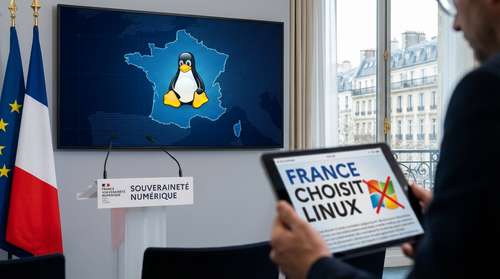
In an unprecedented pivot away from American technology dominance, the French government has officially initiated a nationwide France Linux migration, mandating the replacement of Microsoft Windows across 2.5 million public sector desktops. Announced by the Interministerial Digital Directorate (DINUM) in mid-April 2026, the sweeping transition marks a watershed moment for data sovereignty. For years, European policymakers have debated the strategic risks of relying on foreign platforms. Now, France is turning those policy discussions into an operational reality.
The Catalyst: Microsoft Windows 11 Privacy and the AI Backlash
The push for a sovereign digital infrastructure has accelerated significantly due to mounting Microsoft Windows 11 privacy concerns. As proprietary operating systems shift toward cloud-dependent architectures and aggressive data harvesting, foreign governments are increasingly wary of deploying them in sensitive administrative environments.
The relentless integration of controversial automated features into modern desktop environments has fueled a broader Windows AI backlash. With tools like 'Recall' designed to capture continuous, searchable snapshots of user activity, the cybersecurity risks for government networks handling classified intelligence and citizen health records became untenable. The French state recognized that these continuous telemetry streams and deeply embedded AI surveillance mechanisms inherently conflict with stringent European privacy laws.
"The State can no longer simply acknowledge its dependence; it must break free," stated David Amiel, the French Minister of Public Action and Accounts, during the April 8 policy seminar. "We can no longer accept that our data, our infrastructure, and our strategic decisions depend on solutions whose rules, pricing, evolution, and risks we do not control". Minister Delegate for Artificial Intelligence and Digital Technology Anne Le Hénanff reinforced this stance, declaring digital sovereignty a "strategic necessity" rather than an optional choice.
Executing the "Sortie de Windows"
Referred to internally as the "sortie de Windows" (exit from Windows), the France Linux migration is not merely a symbolic gesture. DINUM, the agency spearheading the initiative, has ordered every government ministry and affiliated public operator to submit comprehensive technology replacement plans by autumn 2026.
These plans must audit and eliminate extra-European dependencies across eight major categories, spanning far beyond the desktop operating system. The mandate covers antivirus software, cloud virtualization, telecommunications equipment, and database management. By treating the operating system as just one layer of a compromised stack, France is executing one of the most aggressive deployments of open source government software in modern history.
La Suite Numérique: Replacing the American Ecosystem
The groundwork for this transition has been quietly laid over the past year. France recently migrated 80,000 employees within the National Health Insurance Fund to open-source alternatives, entirely phasing out commercial platforms like Microsoft Teams, Zoom, and Dropbox.
Instead, civil servants are utilizing "La Suite Numérique," a domestic ecosystem of productivity tools. This includes Tchap for encrypted end-to-end messaging, FranceTransfert for secure file sharing, and Visio for video conferencing. Hosted on local servers managed by Outscale—a subsidiary of French software giant Dassault Systèmes—these tools ensure that both sensitive data and taxpayer dollars remain strictly within French borders. Furthermore, the government has committed to migrating its entire national health data platform to a fully trusted, domestic infrastructure by the end of 2026.
Linux vs Windows 2026: A Blueprint for European Digital Independence
The debate of Linux vs Windows 2026 is no longer confined to enthusiast forums and enterprise server rooms; it has become a central theater of geopolitical strategy. Linux provides an auditable, highly customizable foundation that inherently resists vendor lock-in. Unlike proprietary systems managed by overseas corporations, an open-source architecture allows French cybersecurity agencies like ANSSI to inspect every line of code, dictate exactly when and how updates are staged, and guarantee that no underlying telemetry is siphoning data back to foreign servers.
France is not acting in isolation. This mandate is the vanguard of a broader push toward European digital independence. The German state of Schleswig-Holstein recently transitioned tens of thousands of state workplaces to open-source alternatives, while Austria's Armed Forces have already abandoned Microsoft Office in favor of LibreOffice.
By leveraging its purchasing power to standardize on Linux, the French government is actively reshaping the enterprise technology market. If this monumental migration proves successful, it will serve as the ultimate blueprint for other nations seeking to reclaim control over their digital destinies, proving that a modern, efficient government can operate entirely free of Silicon Valley's monopoly.